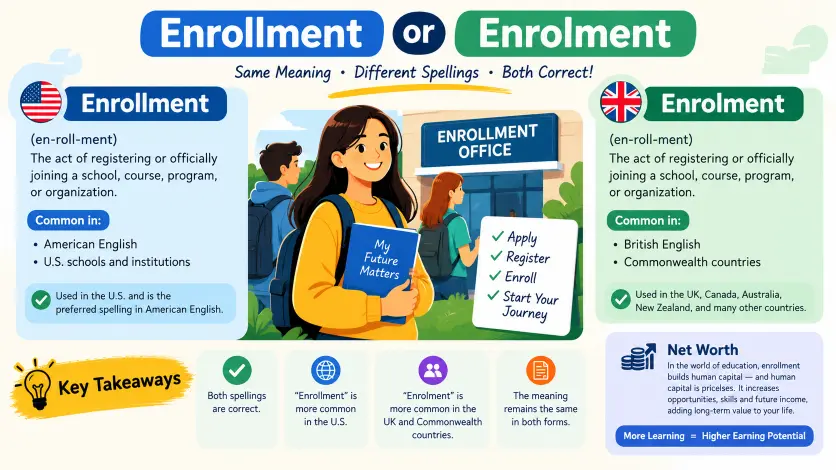
If you’ve ever hesitated over “enrollment” or “enrolment,” you’re not alone. Both spellings are correct, but the version you should use depends largely on the variety of English you’re writing in. “Enrollment” is the standard American English spelling, while “enrolment” is commonly preferred in British English and other varieties influenced by British usage.
This small spelling difference can matter when you’re writing academic applications, professional documents, websites, or formal communication for an international audience. Understanding the distinction helps you write with greater accuracy and consistency.
In this guide, we’ll explain the meanings, spelling patterns, regional differences, and practical examples of enrollment or enrolment so you can confidently choose the right form. Whether you’re a student, teacher, content writer, job applicant, or English learner, you’ll learn when each spelling is appropriate and how native usage differs across countries. The goal is simple: make the choice clear without unnecessary confusion.
Enrollment vs Enrolment: What’s the Difference?
The difference between enrollment and enrolment is mainly a matter of regional spelling. Both words have the same meaning and refer to the process of officially registering for a school, university, course, program, service, or organization. Therefore, neither spelling is grammatically wrong.
Enrollment is the preferred spelling in American English. For example, an American university may write, “Student enrollment increased this year.”
Enrolment is the preferred spelling in British English and is also common in countries that follow British spelling conventions. For example, a British university may write, “Student enrolment increased this year.”
| Feature | Enrollment | Enrolment |
|---|---|---|
| Part of speech | Noun | Noun |
| Meaning | Official registration | Official registration |
| Main spelling system | American English | British English |
| Common example | College enrollment | University enrolment |
| Meaning difference | None | None |
In short, the two words mean the same thing.
The main difference is the English variety being used.
Choose enrollment for American English.
Choose enrolment for British English.
The most important rule is to remain consistent throughout your writing.
Is Enrollment vs Enrolment a Grammar, Vocabulary, or Usage Issue?
Primarily, this is a spelling and usage issue, rather than a grammar problem.
Both forms function as nouns. For instance, you can write, “Enrollment begins in August,” or “Enrolment begins in August.” The grammatical structure is identical.
Moreover, neither spelling is inherently more correct than the other. Instead, each belongs to a different established variety of English.
Are they interchangeable?
In meaning, yes. In every writing environment, however, not necessarily.
If a document follows American English conventions, enrollment is generally the appropriate choice. Conversely, if the document follows British English conventions, enrolment is normally preferred.
Formal versus informal usage
Interestingly, the distinction has little to do with formality.
Both spellings can appear in highly formal documents, including university policies, government publications, corporate documents, research material, and official forms.
Likewise, both can appear in casual writing.
Therefore, replacing one spelling with the other does not automatically make a sentence more professional.
Academic versus casual usage
Academic institutions usually follow the spelling standards associated with their region.
Consequently, an American college may discuss undergraduate enrollment, while a British university may discuss undergraduate enrolment.
The important principle is consistency. A document should generally avoid switching between regional conventions without a clear reason.
Enrollment: Practical Usage in American English
The spelling enrollment is the conventional American form. It appears frequently in education, employment, healthcare, software, memberships, and administrative communication.
Workplace example
A company might write:
“Employee enrollment in the new benefits program closes on Friday.”
Here, enrollment describes the process of employees registering for a workplace benefit.
Academic example
An American university could state:
“Fall enrollment increased by eight percent compared with the previous academic year.”
In this sentence, the noun refers to the number of students registered at the institution.
Technology example
A software provider might use:
“Device enrollment allows administrators to register company computers with the management platform.”
Here, the concept has moved beyond education. The word still refers to registering something within an organized system.
Usage recap
Choose enrollment when your publication follows American English.
It works naturally in education, business, administration, and technology.
It can describe either the registration process or the resulting number of participants.
It is not a more formal alternative to enrolment.
Enrolment: Practical Usage in British English
The spelling enrolment is strongly associated with British English. It is also common in several countries and institutions that follow British spelling conventions.
Workplace example
A British organization might write:
“Staff enrolment for the professional development course begins next month.”
Here, the term describes employees registering for training.
Academic example
A university could announce:
“Student enrolment for the new academic year opens in September.”
The meaning is exactly the same as in the American version.
Technology example
A technology company may write:
“Automatic device enrolment simplifies registration for newly issued laptops.”
Therefore, British spelling does not restrict the word to schools or universities. The term can describe registration within many organized systems.
Usage recap
Choose enrolment when following British English conventions.
The spelling is appropriate for education, business, technology, and administrative contexts.
It carries the same basic meaning as enrollment.
When You Should NOT Use Enrollment or Enrolment
Although both nouns are correct, several situations can produce awkward or incorrect usage.
1. When you mean the person
Neither enrollment nor enrolment normally means the person who registers.
Instead, use terms such as student, participant, member, registrant, or enrollee, depending on context.
For example:
“Each enrollee received a confirmation email.”
2. When you mean the act of teaching
Registration and education are different concepts.
Therefore, enrolment does not mean instruction, teaching, training, or education itself.
3. When you mean admission
Admission can occur before enrollment.
For example, a university can admit a student in June and complete the student’s enrollment later.
Thus, these concepts should not automatically be treated as synonyms.
4. When you mean attendance
Enrollment means official registration. Attendance means actually being present.
A person can be enrolled in a course without attending every session.
5. When you mean application
An application is a request to enter or participate.
Enrollment generally describes the completed registration stage.
Consequently, “course application” and “course enrollment” can represent different stages.
6. When you are describing a person as registered
A noun referring to the person may be more suitable.
For example:
“The enrolled students received their schedules.”
Here, enrolled is an adjective or participial form rather than the noun enrollment.
7. When your document follows one regional standard
Avoid switching casually between American and British spelling.
A publication that uses “color,” “center,” and “organization” will usually look inconsistent if it suddenly uses “enrolment.”
Consistency improves clarity and editorial credibility.
Common Mistakes with Enrollment and Enrolment
Although enrollment and enrolment have the same meaning, writers often use them incorrectly because they focus on the spelling rather than the English variety being used. Fortunately, the most common mistakes are easy to avoid.
1. Mixing American and British spelling
One of the biggest mistakes is using enrollment in one part of a document and enrolment in another.
For example:
Inconsistent:
“Student enrollment begins in September. The enrolment deadline is October 1.”
Consistent:
“Student enrollment begins in September. The enrollment deadline is October 1.”
If you’re writing in British English, use enrolment consistently instead.
2. Assuming one spelling is always correct
Neither spelling is universally correct or incorrect. Enrollment is standard in American English, while enrolment is standard in British English.
Therefore, choose the form that matches your target audience and existing style.
3. Confusing enrolment with enrollee
These words are related, but they don’t mean the same thing.
Enrolment refers to the registration process.
Enrollee refers to the person who registers.
For example:
“Student enrolment opens next week.”
“The enrollee received a confirmation email.”
4. Confusing enrollment with admission
Enrollment and admission can describe different stages.
A university may first admit a student and then complete the student’s enrollment. Therefore, replacing one term with the other can change the intended meaning.
5. Using enrollment when you mean attendance
Being enrolled doesn’t necessarily mean being present.
For example, a student can remain enrolled in a course while missing a particular class. Therefore, attendance is the better word when you are talking about physical or online presence.
6. Using enrollment when you mean an application
An application is a request to join a course, institution, or program. Enrollment generally refers to the registration that follows acceptance or approval.
For example:
“Submit your application by June 10.”
“Complete your enrollment by June 20.”
These sentences describe two different steps.
7. Using the noun when a verb is needed
Enrollment and enrolment are nouns. Therefore, they shouldn’t replace the corresponding verbs.
American English uses enroll.
British English uses enrol.
For example:
“Students can enroll online.”
“Students can enrol online.”
Quick Rule to Remember
If you’re following American English, use enrollment.
If you’re following British English, use enrolment.
If you’re talking about the person, use enrollee.
If you’re talking about the action, use enroll or enrol.
If you’re talking about the registration process, use enrollment or enrolment.
Enrollment and Enrolment in Modern Technology
Modern digital systems have expanded the contexts in which these words appear.
For example, users can encounter enrollment terminology while registering devices, activating accounts, joining subscription services, configuring security systems, or entering online training programs.
In American documentation, enrollment is commonly used for processes such as device enrollment, user enrollment, account enrollment, and program enrollment.
Meanwhile, documentation following British conventions may use enrolment for the same functions.
Furthermore, technology has made the distinction especially visible because global software products often serve audiences across several English speaking regions. Consequently, localization teams must choose terminology according to the intended market rather than treating one spelling as universally correct.
The underlying meaning remains stable: something or someone is being formally registered within a system.
A Short Etymology of Enrollment and Enrolment
Both forms ultimately trace back to the verb enroll, which developed from the idea of entering a name or record into a formal list.
The spelling difference emerged through broader differences between American and British English.
American English commonly developed simplified spellings in several areas, while British English retained conventions associated with French influenced forms and established European usage.
This pattern can be seen in other spelling pairs involving regional conventions. However, each pair must be evaluated individually because English spelling does not follow one simple rule.
An expert style rule can therefore be stated simply:
“When two regional spellings share the same meaning, consistency with the intended variety matters more than declaring one universally correct.”
This principle is particularly useful for editors working with international audiences.
Two Practical Case Studies
Case Study 1: University Communication
Imagine an American university preparing an admissions webpage for domestic students.
The institution uses terms such as “program,” “center,” and “organization” throughout its editorial material. Consequently, enrollment fits the established American spelling pattern.
Now imagine a British university preparing a comparable page. Its editorial conventions may use “programme” and other British spellings. In that setting, enrolment naturally belongs to the same linguistic system.
The concrete result is consistency across the complete document. Readers are less likely to interpret regional spelling changes as accidental editorial errors.
Case Study 2: Global Software Documentation
Consider a technology company publishing registration instructions for users in several countries.
An American version may describe “device enrollment,” while a British version may describe “device enrolment.”
The registration mechanism itself does not change merely because the spelling changes. Instead, the wording is localized for the expected audience.
The practical result is clearer regional documentation without creating a false distinction between the underlying processes.
Error Prevention Checklist
Always use enrollment when
- Your publication follows American English.
- Your institution uses American spelling conventions.
- Your audience primarily expects American English.
- Your existing editorial style consistently uses American forms.
Always use enrolment when
- Your publication follows British English.
- Your institution uses British spelling conventions.
- Your audience primarily expects British English.
- Your surrounding terminology follows British spelling.
Never use either form when
- You actually mean a person.
- You mean teaching rather than registration.
- You mean attendance rather than registration.
- You mean an application rather than completed registration.
- You need a verb and are mistakenly using a noun.
Related Grammar Confusions You Should Master
Understanding this distinction becomes easier when you also recognize other regional and usage differences.
1. License and licence
British English commonly distinguishes the noun licence from the verb license, while American English generally uses license for both.
2. Practice and practise
British English traditionally uses practice as a noun and practise as a verb. American English commonly uses practice for both.
3. Center and centre
These forms demonstrate another familiar American and British spelling distinction.
4. Color and colour
The same regional pattern appears in this common spelling pair.
5. Organization and organisation
Both forms occur in established English varieties, although individual style systems can vary.
6. Program and programme
American English generally favors program, while British English commonly uses programme in many contexts.
7. Traveler and traveller
The spelling conventions differ between major English varieties.
8. Catalog and catalogue
Both forms are established, with catalog particularly common in American English and catalogue common in British English.
9. Toward and towards
Both forms are grammatical, although regional and stylistic preferences differ.
10. Among and amongst
Both are established English forms, but their frequency and stylistic distribution vary.
Frequently Asked Questions
What is the difference between enrollment and enrolment?
There is no meaningful difference in basic meaning. Enrollment is the standard American spelling, while enrolment is the standard British spelling and is common in other British English contexts.
Is enrollment American or British English?
Enrollment is primarily the American English spelling. Therefore, it is generally preferred in documents following United States spelling conventions.
Is enrolment British English?
Yes. Enrolment is the established British English spelling and is also widely used in other regions that follow British spelling conventions.
Which is correct, enrollment or enrolment?
Both are correct. The appropriate choice depends on the English variety used by your audience, institution, publication, or style guide.
Is enrollment a noun or a verb?
Enrollment is a noun. The corresponding verb is enroll in American English and enrol in British English.
Should I use enrollment in academic writing?
Yes, if your academic writing follows American English. If your institution follows British English, enrolment is generally more appropriate.
What does enrollment mean in education?
In education, enrollment can refer to the process of officially registering for a school, course, program, or institution. It can also refer to the number of registered students.
What is the plural of enrollment?
Enrollment is generally treated as an uncountable noun when referring to the overall process or number of registered students. Context determines whether a different construction is more natural.
Is enrollee the same as enrolment?
No. Enrollee refers to a person who has registered. Enrolment refers to the registration process or the resulting registered population.
Should a website use enrollment or enrolment?
A website should normally follow the spelling convention of its intended audience. American audiences generally expect enrollment, while British audiences generally expect enrolment.
Conclusion
The choice between enrollment and enrolment is straightforward once regional English conventions are understood. Both words are nouns, both describe registration or the registered population, and neither carries a fundamentally different meaning.
The practical distinction is geographical. American English generally uses enrollment, whereas British English generally uses enrolment. Therefore, the safest approach is to identify your intended audience first and then maintain that spelling throughout the document. Furthermore, remember that registration, admission, attendance, application, and the person who registers are related concepts rather than interchangeable terms.
Ultimately, consistency is the most useful editorial principle. Choose the form that matches your English variety, apply it throughout the document, and avoid changing spelling simply because another version looks familiar.









