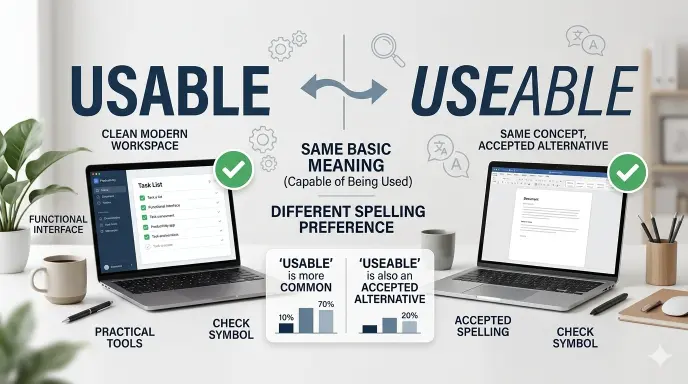
\Usable or useable which spelling is correct? If you have ever hesitated before writing this word, you are not alone. Both usable and useable appear in English, which can make this spelling choice confusing. In most modern writing, usable is the more common and widely preferred form. It generally means something that can be used effectively, practically, or conveniently. However, useable is also recognized as a legitimate spelling, so the choice is not simply a matter of one being completely wrong and the other being right.
Understanding the difference between usable or useable can help you write more confidently in emails, academic work, websites, product descriptions, and professional documents.
This guide explains the meaning, spelling, pronunciation, usage, and practical differences between the two forms. You will also see clear examples showing when usable or useable works best. By looking at modern English usage and standard dictionary conventions, you can quickly learn which spelling is usually the safest choice for everyday and professional writing.
Usable or Useable: What’s the Difference?
The words usable and useable are adjectives. Therefore, both describe something that can be used successfully, practically, or conveniently. In most situations, they communicate essentially the same idea.
However, the main distinction is spelling preference and frequency rather than meaning. Usable is generally the preferred form in contemporary English because it is shorter, cleaner, and more widely recognized.
Meanwhile, useable follows a more transparent spelling pattern. Since the base verb is use, some writers naturally preserve the complete spelling before adding the suffix. As a result, the longer form continues to appear in dictionaries, books, technical material, and everyday writing.
Quick Recap
Therefore, usable and useable normally have the same meaning.
However, usable is the more familiar spelling for most modern readers.
Meanwhile, useable is not automatically a spelling error.
Consequently, consistency matters more than treating the longer version as inherently incorrect.
Is Usable or Useable a Grammar, Vocabulary, or Usage Issue?
Primarily, this is a spelling and usage issue, rather than a difference in grammar.
Both forms function as adjectives. For example, you can describe a website as usable, a device as useable, or instructions as usable. In each situation, the adjective explains whether something can reasonably be put to use.
Furthermore, neither spelling changes the grammatical role of the word. You can place either form before a noun or after a linking verb.
For example:
The equipment is usable.
The equipment is useable.
Both sentences communicate the same basic message.
Nevertheless, frequency creates an important practical distinction. Because readers encounter usable more often, it usually feels more natural in contemporary professional communication.
In academic writing, therefore, usable may be the safer choice when you want conventional wording. Similarly, in workplace documents, manuals, reports, and product descriptions, the shorter spelling tends to look more familiar.
However, useable can still be appropriate when a publication, organization, style guide, or established terminology uses that form consistently.
Are They Interchangeable?
In ordinary contexts, yes. Both forms can describe something that is capable of being used.
For instance:
The remaining data is usable.
The remaining data is useable.
The underlying meaning remains unchanged.
However, interchangeable does not always mean equally common. Therefore, if you have no specific reason to select the longer spelling, usable is generally the straightforward choice.
When Should You Use Usable?
Generally, choose usable when describing something that works sufficiently well for its intended purpose.
Because this spelling is concise and familiar, it fits naturally into professional, educational, technical, and everyday contexts.
Workplace Example
The revised template is much more usable for new employees.
Here, usable means that employees can work with the template without unnecessary difficulty.
Likewise:
We need a usable system for organizing customer records.
The adjective focuses on practicality and ease of use.
Academic Example
The researchers collected enough usable information to support the analysis.
In this sentence, usable means suitable or valuable for the particular research purpose.
Similarly:
The textbook provides usable examples for students.
The examples are practical enough to help learners understand the subject.
Technology Example
The application has a simple interface and is highly usable.
Here, usable describes how effectively people can interact with the application.
Likewise:
The new dashboard is more usable on smaller screens.
The word emphasizes practical interaction rather than merely stating that the dashboard exists.
Usage Recap
Therefore, usable works naturally when you want a concise adjective meaning practical, functional, suitable, or capable of being used.
Moreover, it is especially convenient in formal and professional contexts because most readers recognize it immediately.
When Should You Use Useable?
Although less common, useable can also be used when you want the same basic adjective.
For example:
The damaged equipment is still useable.
Here, the writer means that the equipment remains capable of being used despite its condition.
Likewise:
Only a small amount of the original material was useable.
The meaning is clear even though the spelling contains the extra letter.
Workplace Example
Several older computers are still useable for basic office tasks.
The writer is explaining that the machines remain suitable for limited work.
Academic Example
The surviving documents contained some useable evidence.
Here, useable indicates that the evidence could still serve a research purpose.
Technology Example
The old interface is useable, although it is difficult to navigate.
This example also demonstrates an important point. Something can be useable without being especially convenient.
Usage Recap
Consequently, useable is not automatically wrong.
However, because it occurs less frequently, some readers may regard it as unusual.
Therefore, unless your preferred style requires it, usable will usually provide the more familiar presentation.
When You Should NOT Use Usable or Useable
Although both spellings can be correct, neither should be used when another adjective communicates the intended idea more precisely.
1. When You Mean Easy to Understand
If the real meaning is clarity, understandable may be better.
Instead of:
The explanation is usable.
Consider:
The explanation is understandable.
2. When You Mean Easy to Operate
If your focus is simplicity, user friendly or easy to operate may communicate the idea more clearly.
3. When You Mean Available
Something can be available without being practical to use.
Therefore, available and usable should not be treated as automatic substitutes.
4. When You Mean Functional
If your point is that a machine works correctly, functional may be more precise.
5. When You Mean Valuable
A resource can be valuable without being directly usable.
Consequently, choose vocabulary according to the intended meaning rather than replacing every similar adjective mechanically.
6. When You Mean Appropriate
If something fits a particular situation, appropriate may be the better choice.
7. When You Mean Accessible
Accessibility concerns whether people can reach or interact with something, while usability concerns practical use. Therefore, the two concepts overlap but are not identical.
8. When You Are Following a House Style
Finally, if your workplace, university, publisher, or organization has a preferred spelling, follow that established convention consistently.
Common Mistakes: Usable or Useable
The most frequent mistake is assuming that only one spelling can possibly be correct.
For example:
Decision Rule
If you mean something can be used effectively or practically, either spelling can express the idea.
However, choose usable by default when you want the shorter and more widely familiar modern form.
Importantly, the distinction is not about an action versus a person or tool. Both usable and useable are adjectives, so that particular rule does not apply here.
Usable and Useable in Modern Technology
Modern technology has made the concept of usability especially important.
For example, software developers frequently discuss whether an application is easy to navigate, efficient, understandable, and practical. Consequently, usable appears naturally in discussions about interfaces, applications, websites, dashboards, devices, and digital services.
The word can also describe digital features:
The search function is usable even for first time visitors.
Similarly:
The updated menu makes the platform more usable.
In technical documentation, consistency is particularly important. Therefore, a development team should normally select one spelling and apply it consistently across interface descriptions, documentation, training materials, and support content.
Moreover, automated writing systems and language tools may recognize both forms. Nevertheless, recognition does not mean that both forms are equally frequent in every variety of English.
As a result, writers who want the most familiar contemporary spelling will generally find usable to be the simpler option.
Etymology: Where Do Usable and Useable Come From?
Both forms are built from the verb use and the adjective forming suffix able.
The basic construction expresses the idea of something being capable of being used.
English spelling, however, does not always produce a single predictable form when suffixes are added. Consequently, both usable and useable developed as accepted spellings.
The shorter version removes the final letter from the base spelling before the suffix is added. Meanwhile, the longer version keeps the visible connection to use.
This difference explains why the two spellings can look distinct while still carrying essentially the same meaning.
Expert Style Explanation
“Both spellings can express the same adjective, although usable is the more familiar choice in much contemporary writing.”
The practical lesson is simple: spelling length does not automatically create a difference in meaning.
Two Practical Case Studies
Case Study One: Workplace Documentation
Consider a company revising its employee handbook.
The original document repeatedly describes procedures as useable, while a later editor changes the spelling to usable.
The meaning does not change. Instead, the revision creates a more familiar visual form for readers.
For consistency, the company then uses usable throughout the handbook.
Result: The terminology becomes consistent without changing the underlying message.
Case Study Two: Software Documentation
Imagine a development team describing a new dashboard.
One writer uses usable, while another repeatedly writes useable. Neither writer is necessarily communicating a different meaning.
However, inconsistent terminology can make technical documentation appear less carefully edited.
The team therefore chooses usable as its house spelling and applies it throughout the documentation.
Result: Readers encounter one consistent form, making the material easier to scan and maintain.
These examples demonstrate an important editorial principle: when two accepted forms share a meaning, consistency often matters more than arguing that one form has an entirely different definition.
Error Prevention Checklist
Always Use Usable When
You want the shorter, more familiar spelling.
You are writing general professional material.
You are preparing instructions, reports, product descriptions, or educational material.
Your organization already prefers the shorter form.
You want to avoid distracting readers with an uncommon spelling.
Never Treat Useable As
An automatic spelling mistake.
A word with a completely different definition.
A noun describing a person.
A verb describing an action.
A form that must always be corrected.
Instead, recognize that useable can function as an accepted adjective while usable remains the more common choice in many modern contexts.
Related Grammar Confusions You Should Master
Once you understand usable or useable, several other English spelling and usage questions become easier to handle.
Affect or Effect
These words often differ in grammatical function and meaning, although both can appear in related contexts.
Fewer or Less
The distinction generally concerns countable and uncountable nouns.
Further or Farther
These forms overlap, although traditional usage often separates abstract and physical distance.
Practice or Practise
The preferred form depends partly on the variety of English being used.
Everyday or Every Day
One is normally an adjective, while the other functions as a phrase expressing frequency.
Advice or Advise
These words differ in both pronunciation and grammatical category.
Complement or Compliment
Their meanings are different even though their pronunciations are similar.
Principal or Principle
One commonly refers to a person or something primary, while the other concerns a rule, belief, or guiding idea.
Stationary or Stationery
The spelling difference reflects completely different meanings.
Accept or Except
These words can sound similar in some speech patterns, yet their meanings and grammatical functions differ substantially.
Frequently Asked Questions
Is usable or useable correct?
Both usable and useable are accepted spellings. However, usable is generally more common in contemporary English, making it the natural default for many writers.
Is usable the preferred spelling?
Generally, yes. Usable is the shorter and more familiar form for many modern readers. Therefore, it is often the practical choice when no particular style guide requires another spelling.
Is useable a real word?
Yes. Useable is a legitimate adjective. It means capable of being used or suitable for use, much like usable.
Is there a difference between usable and useable?
Usually, there is no meaningful difference in definition. Both adjectives describe something that can be used. The principal distinction is spelling frequency and stylistic preference.
Which is more common, usable or useable?
Usable is generally more common. Consequently, readers are more likely to encounter this shorter form in contemporary professional, educational, and technical writing.
Should I write usable in academic writing?
Usually, usable is a straightforward choice for academic writing. Nevertheless, always follow the spelling conventions established by your institution, publication, or chosen style guide.
Can usable describe a person?
Normally, usable describes a thing, resource, system, method, or material that can be used. It is not ordinarily used to describe a person’s personal qualities.
Is usable a noun or adjective?
Usable is an adjective. It modifies nouns or appears after linking verbs to describe something that can be used effectively or practically.
Is useable more formal than usable?
Not necessarily. The extra letter does not make useable inherently more formal. In practice, usable is simply the more familiar spelling for many readers.
Which spelling should I choose?
If you have no specific house style, usable is usually the simplest choice because it is shorter, familiar, and widely recognized. However, useable remains acceptable when used consistently.
Final Answer
So, usable or useable? Both forms can be correct.
Usable is generally the preferred modern spelling because it is shorter and more widely familiar. Meanwhile, useable is an accepted alternative that carries essentially the same meaning.
Therefore, when you need a simple default for workplace, academic, technical, or everyday writing, choose usable. However, you do not need to assume that useable is automatically wrong.
Ultimately, the key distinction is not meaning but usage frequency, spelling preference, and consistency. Once that difference is understood, choosing between the two forms becomes straightforward.









