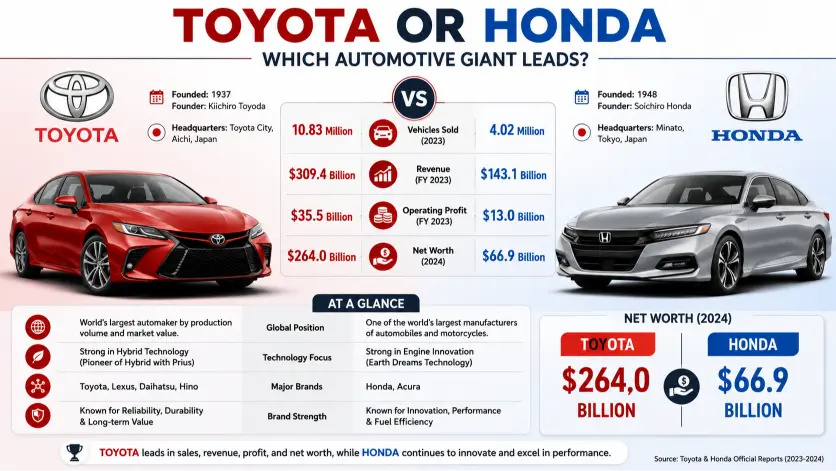
Choosing between Toyota or Honda can feel surprisingly difficult. Both brands have built strong reputations for producing dependable vehicles, practical family cars, efficient commuters, and models that hold their value well. But reliability alone does not tell the whole story. Your ideal choice may depend on your budget, driving habits, fuel economy expectations, comfort preferences, maintenance costs, safety features, and how long you plan to keep the vehicle.
So, is Toyota or Honda actually better? The answer depends on what you need from your car. In this guide, we’ll compare Toyota and Honda across the factors that matter most to everyday buyers, including reliability, performance, fuel efficiency, pricing, maintenance, safety, comfort, technology, and resale value.
Rather than declaring one brand the winner without context, we’ll explain where each manufacturer tends to stand out and where it may fall short. This practical comparison is designed to help you make a confident, informed decision based on real-world ownership priorities, not just brand reputation.
Toyota or Honda: What’s the Difference?
When comparing Toyota or Honda, the first thing to understand is that both are automobile manufacturers, not individual vehicle models. Toyota is a Japanese automaker with a particularly strong reputation for durability, hybrid technology, and broad vehicle selection. Honda is another major Japanese automaker known for efficient engines, practical vehicles, comfortable cabins, and a somewhat sportier driving character in several models.
The two brands overlap considerably. Both sell compact cars, sedans, SUVs, hybrids, and family focused vehicles. Both have built reputations around engineering that can withstand years of ordinary use when vehicles are properly maintained.
The important difference is usually not whether one company makes good cars. Both do. The more useful question is which brand better matches your driving habits, budget, preferred vehicle type, technology expectations, and ownership priorities.
| Comparison | Toyota | Honda |
| Country of origin | Japan | Japan |
| Brand reputation | Reliability and durability | Reliability and driving experience |
| Hybrid selection | Very extensive | Growing selection |
| Driving character | Comfortable and predictable | Often more responsive |
| Interior practicality | Strong | Excellent in many models |
| Resale value | Generally strong | Generally strong |
| Family appeal | Very high | Very high |
| Fuel efficiency | Excellent, especially hybrids | Excellent |
| Performance focus | Select performance models | Several sportier options |
| Long term ownership | Excellent | Excellent |
Quick Recap
Toyota is a particularly strong choice for buyers who value efficiency, hybrid technology, and proven long term ownership.
Honda is appealing to drivers who want practicality with a slightly more engaging driving experience.
Neither brand automatically wins every category.
The best choice depends heavily on the specific model and year you are considering.
Is Toyota or Honda a Brand, Vocabulary, or Usage Issue?
Unlike confusing words such as “affect” and “effect,” Toyota or Honda is not a grammar or vocabulary problem. It is primarily a comparison and purchasing question.
Toyota and Honda are proper nouns because they identify specific companies and automotive brands. They should normally be capitalized when written in standard English.
You might see the names used casually in conversations such as, “Should I buy a Toyota or Honda?” In more formal writing, the comparison may be expanded to explain the exact vehicle, such as a Toyota RAV4 compared with a Honda CR V.
The distinction becomes especially important when people use a brand name as though every vehicle produced by that company has identical characteristics. A brand reputation can provide useful context, but it shouldn’t replace model specific research.
For example, saying “Honda is better than Toyota” is an overly broad statement. A particular Honda may be more suitable than a particular Toyota for one buyer, while the opposite may be true for another.
Toyota: When Does It Make the Most Sense?
Toyota has developed one of the strongest reputations in the automotive industry for dependable transportation. Its lineup includes compact cars, family sedans, crossovers, pickup trucks, SUVs, and hybrid vehicles.
One of Toyota’s biggest advantages is its extensive hybrid experience. The company’s hybrid systems have been a major part of its product strategy for decades, making Toyota a natural consideration for drivers who want lower fuel consumption without moving entirely to an electric vehicle.
Workplace Example
Imagine an employee who drives to work every weekday and occasionally travels between cities for meetings. Reliability and predictable fuel expenses may matter more than aggressive acceleration.
For this type of driver, a Toyota hybrid or efficient compact vehicle could be particularly appealing. The priority isn’t necessarily luxury or performance. It’s dependable transportation that fits a repetitive daily routine.
Academic Example
A university student may need a vehicle that can handle commuting, errands, part time work, and occasional longer trips. Purchase price, fuel economy, maintenance costs, and resale value can all influence the decision.
A practical Toyota model may work well when minimizing long term ownership expenses is the primary objective.
Technology Example
Toyota is also closely associated with hybrid technology. Buyers interested in electrified transportation often consider Toyota because the brand has offered hybrid vehicles across multiple segments.
Toyota Usage Recap
Choose Toyota when reliability, fuel efficiency, hybrid availability, practical transportation, and long term ownership are major priorities.
That doesn’t mean every Toyota is automatically more reliable than every Honda. The individual model, production year, maintenance history, and driving conditions still matter.
Honda: When Does It Make the Most Sense?
Honda has earned a strong reputation for building practical vehicles with efficient engines and useful interior layouts. The brand is particularly popular among drivers who want everyday transportation without giving up a more responsive driving feel.
Honda’s lineup has historically included compact cars, midsize sedans, SUVs, minivans, and performance oriented vehicles.
A major attraction is practicality. Honda vehicles often make effective use of interior space, which can be important for families, commuters, and drivers who regularly carry passengers or equipment.
Workplace Example
Consider a professional who spends several hours each week commuting and frequently carries a laptop, work equipment, or passengers.
A Honda with a flexible interior may provide the combination of comfort and practicality this driver needs.
Academic Example
A college student or young professional might prefer a Honda because it can combine sensible fuel economy with a more engaging driving experience.
The ideal vehicle still depends on budget and condition, but Honda can be attractive to buyers who don’t want a vehicle that feels purely utilitarian.
Technology Example
Honda has continued expanding its electrified vehicle offerings and modern driver assistance technology. Depending on the model and model year, buyers can find features such as advanced infotainment systems, smartphone integration, hybrid powertrains, and driver assistance systems.
Honda Usage Recap
Choose Honda when practicality, efficient engines, interior versatility, and responsive driving characteristics are high priorities.
As with Toyota, however, the badge alone shouldn’t determine the purchase. Always evaluate the exact vehicle.
When You Should NOT Choose Toyota or Honda
There are situations where choosing either brand simply because of reputation can lead to a poor decision.
- Don’t choose a brand without checking the specific model. Reliability can vary between engines, transmissions, generations, and production years.
- Don’t assume the cheapest purchase price is the lowest ownership cost. Insurance, fuel, maintenance, financing, depreciation, and repairs all matter.
- Don’t choose Toyota solely because someone says it lasts forever. Maintenance history remains extremely important.
- Don’t choose Honda solely because it feels sportier. Your priorities may favor comfort, fuel economy, cargo capacity, or hybrid efficiency instead.
- Don’t ignore vehicle history when buying used. A neglected vehicle from a highly respected brand can be a worse purchase than a carefully maintained alternative.
- Don’t compare brands without comparing equivalent models. A compact Toyota and a large Honda SUV serve completely different purposes.
- Don’t overlook recalls and service information. Check the exact vehicle identification information and maintenance documentation before purchasing a used vehicle.
- Don’t assume brand reputation guarantees a perfect experience. Every manufacturer has models and production periods that deserve closer examination.
Common Mistakes When Comparing Toyota and Honda
A frequent mistake is treating brand reputation as a universal score. In reality, reliability is influenced by the engine, transmission, model generation, maintenance schedule, mileage, climate, driving style, and previous ownership.
| Correct comparison | Incorrect comparison | Explanation |
| Compare equivalent Toyota and Honda models | Compare any Toyota with any Honda | Vehicle size and purpose matter |
| Check the exact model year | Assume every generation is identical | Engineering changes over time |
| Review maintenance records | Buy based only on brand reputation | Condition matters greatly |
| Compare hybrid systems separately | Assume all hybrids work the same way | Powertrain designs differ |
| Calculate total ownership costs | Compare only sticker prices | Fuel, insurance, maintenance, and depreciation affect cost |
| Test drive both vehicles | Choose based only on reviews | Personal comfort and driving preferences matter |
Decision Rule Box
If you mean the Toyota brand or a Toyota vehicle, use “Toyota.”
If you mean the Honda brand or a Honda vehicle, use “Honda.”
If you are deciding between them, compare equivalent models, model years, powertrains, ownership costs, and maintenance records rather than relying on the brand name alone.
Toyota or Honda for Reliability?
Reliability is one of the biggest reasons people search for Toyota or Honda in the first place.
Both brands have established reputations for dependable vehicles. However, reliability should be evaluated at the model level rather than treated as a permanent characteristic of an entire manufacturer.
A well maintained Honda can provide many years of dependable service. The same is true for a well maintained Toyota.
For used vehicle buyers, maintenance history can be particularly important. Oil changes, fluid services, brake maintenance, tire condition, previous accident damage, and repair records can tell you more about an individual vehicle than the badge on its hood.
The strongest decision is therefore not simply “Toyota wins.” Instead, compare the exact vehicles and investigate their history.
Toyota or Honda for Fuel Economy?
Fuel economy depends on the engine, transmission, vehicle size, drivetrain, driving conditions, and model year.
Toyota has a major advantage in consumer awareness because of its long standing hybrid presence. If hybrid efficiency is your central concern, Toyota deserves serious consideration.
Honda also offers efficient gasoline and hybrid vehicles, so it shouldn’t be dismissed when fuel economy matters.
For either brand, pay attention to real world driving conditions. Heavy traffic, frequent short journeys, high speeds, aggressive acceleration, cold weather, and heavy loads can all reduce fuel economy.
Toyota or Honda for Families?
Both brands offer strong family oriented choices.
Toyota can appeal to families seeking SUVs, crossovers, hybrids, and vehicles with a reputation for long term durability.
Honda has traditionally been strong in practical family transportation, particularly where cabin flexibility and passenger usability are important.
For families, the better choice may come down to details such as rear seat dimensions, child seat compatibility, cargo capacity, door opening angles, visibility, ride comfort, safety equipment, and ease of daily use.
A vehicle that looks impressive on paper may not work well for your family once car seats, luggage, groceries, and passengers are involved.
Toyota or Honda for Resale Value?
Resale value is influenced by demand, vehicle condition, mileage, accident history, maintenance, market conditions, trim level, powertrain, and model popularity.
Toyota and Honda both have strong reputations in the used vehicle market. That can help desirable models retain value, although resale performance varies substantially between individual vehicles.
If you plan to sell the vehicle after several years, calculate depreciation as part of your original purchase decision.
A slightly more expensive vehicle may sometimes make financial sense if it holds its value better, but buyers should never assume that automatically happens.
Toyota or Honda for Technology and Tools
Modern Toyota and Honda vehicles increasingly rely on sophisticated software, digital displays, smartphone connectivity, sensors, cameras, navigation systems, and driver assistance technologies.
This changes the meaning of automotive reliability.
A vehicle can have a mechanically durable engine while still experiencing problems involving electronics, infotainment, sensors, software, or connectivity.
Modern tools are also becoming more relevant to modern automotive technology. Driver assistance systems can use sophisticated computing and sensor processing to help with functions such as lane awareness, adaptive cruise control, collision warnings, and other assistance features.
However, drivers should distinguish between driver assistance and autonomous driving. Technology designed to assist a driver does not eliminate the driver’s responsibility to monitor the road.
When comparing Toyota or Honda, don’t simply count technology features. Consider whether the systems are useful, intuitive, dependable, and easy to operate while driving.
Toyota and Honda Etymology and Brand Identity
Toyota’s name is associated with the Toyota Motor Corporation, which developed from the Toyoda family business in Japan. The company became one of the world’s most influential automobile manufacturers and became particularly well known for its production methods and later for hybrid technology.
Honda traces its origins to Soichiro Honda and the company established in Japan in the twentieth century. Honda initially became especially well known for motorcycles before becoming a major global automobile manufacturer.
The two companies therefore share Japanese origins but developed distinctive corporate identities.
Expert Style Perspective
The most useful Toyota versus Honda comparison isn’t about which logo is better. It’s about which specific vehicle gives the buyer the best combination of reliability, suitability, cost, safety, and ownership satisfaction.
Case Study 1: The High Mileage Commuter
Consider a commuter who drives roughly 50 miles each weekday and frequently encounters urban traffic.
Fuel consumption becomes an important part of the ownership equation. Over thousands of miles, even a modest difference in fuel efficiency can become financially meaningful.
For this buyer, a fuel efficient Toyota hybrid could be particularly attractive because reducing fuel consumption may have a measurable impact on recurring expenses.
The concrete result isn’t that every Toyota will save more money. The result depends on the actual vehicle, fuel prices, mileage, driving conditions, and purchase price.
Case Study 2: The Growing Family
Now consider a family that needs more interior flexibility for passengers, luggage, shopping, and weekend trips.
Instead of choosing based on brand reputation, the family compares an equivalent Toyota and Honda SUV. They test both vehicles with their actual child seats and luggage.
The concrete result of this process is a more informed purchase because the decision reflects real household needs rather than generalized online claims.
This is a useful lesson for every buyer: the best car is the one that works in your real life.
Author Expertise
This article is prepared from an automotive research and SEO content perspective, with emphasis on clear terminology, practical ownership considerations, model level comparisons, and evidence based decision making.
Error Prevention Checklist
Always Use Toyota When
You are referring specifically to the Toyota automotive brand.
You are discussing a Toyota manufactured vehicle.
You are comparing Toyota with another automotive manufacturer.
You are discussing Toyota’s hybrid or vehicle technology.
Never Use Honda When
You actually mean a Toyota vehicle.
You are describing Toyota’s corporate history.
You are referring to a Toyota model but have replaced its name with Honda.
You are making a brand comparison without identifying which manufacturer you mean.
The same principle works in reverse. Use Honda when you are specifically referring to Honda or one of its vehicles.
Related Automotive Comparisons You Should Master
If you’re researching Toyota or Honda, several related comparisons can help you make a more informed vehicle decision:
- Toyota vs Honda reliability
- Toyota vs Honda maintenance costs
- Toyota vs Honda hybrid systems
- Toyota vs Honda resale value
- Toyota vs Honda fuel economy
- Toyota vs Honda safety technology
- Toyota SUV vs Honda SUV
- Toyota sedan vs Honda sedan
- Toyota hybrid vs Honda hybrid
- Toyota vs Honda long term ownership
These comparisons are more useful when they identify equivalent models and specific model years.
Frequently Asked Questions
Is Toyota or Honda better?
Neither brand is universally better. Toyota may be preferable for buyers prioritizing hybrid technology, fuel efficiency, and long term dependability, while Honda may appeal to buyers who prioritize practical interiors and responsive driving. The exact model and year can change the answer.
Is Toyota more reliable than Honda?
Toyota and Honda both have strong reliability reputations. It isn’t accurate to assume every Toyota is more reliable than every Honda. Individual model design, maintenance, mileage, ownership history, and production year all influence reliability.
Is Honda cheaper to maintain than Toyota?
Maintenance costs vary by model, engine, mileage, location, labor rates, and service requirements. Comparing the exact Toyota and Honda models you’re considering gives a more useful answer than comparing the brands generally.
Which lasts longer, Toyota or Honda?
Both Toyota and Honda vehicles can last for many years when properly maintained. Longevity depends heavily on maintenance, driving conditions, vehicle design, and how the vehicle has been treated.
Is Toyota or Honda better for families?
Both brands offer excellent family vehicles. Toyota can be attractive for hybrid availability and broad SUV choices, while Honda is particularly appealing when interior practicality and flexible passenger space are important.
Is Toyota or Honda better for fuel economy?
Both brands offer efficient vehicles. Toyota has a particularly strong position in hybrid vehicles, but the most efficient choice depends on the exact model, powertrain, driving conditions, and model year.
Should I buy a used Toyota or Honda used?
Either can be a good used vehicle choice. Focus on the exact model, service history, mileage, accident history, mechanical condition, recall information, and purchase price instead of relying solely on brand reputation.
Which has better resale value, Toyota or Honda?
Toyota and Honda both have strong resale reputations, but resale value varies by model, condition, mileage, trim, powertrain, market demand, and vehicle history.
Is Toyota or Honda better for technology?
Both manufacturers offer modern infotainment, connectivity, driver assistance, and electrified powertrain technology. Toyota has particularly extensive hybrid experience, while Honda also provides competitive technology across its newer vehicles.
What should I compare before choosing Toyota or Honda?
Compare the specific vehicles by purchase price, reliability history, fuel economy, insurance, maintenance, safety equipment, interior space, technology, resale value, warranty coverage, and your own driving requirements.
Conclusion:
Choosing Toyota or Honda isn’t really about finding one brand that wins every category. Both manufacturers have earned strong reputations for practical, efficient, and dependable vehicles, but their individual models can differ considerably.
Toyota is especially compelling when hybrid technology, fuel efficiency, broad vehicle choice, and long term ownership are priorities. Honda can be an excellent choice when interior practicality, efficient performance, and engaging everyday driving matter more.
The smartest approach is to move beyond the badge. Compare the exact model and model year, inspect the vehicle’s condition, review maintenance history, consider total ownership costs, and take a proper test drive.
In short, don’t ask only which brand is better. Ask which specific Toyota or Honda is better for your budget, driving habits, family needs, and ownership plans.









