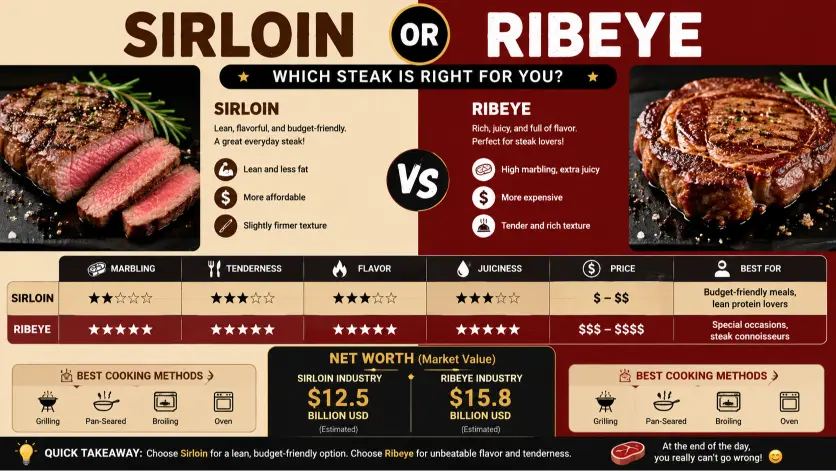
Choosing between sirloin or ribeye can feel surprisingly difficult when both steaks look tempting at the butcher counter. Do you want the rich, juicy bite of a well-marbled ribeye, or the leaner, beef-forward character of sirloin? The answer depends on more than personal taste; it can come down to marbling, tenderness, cooking method, budget, and the kind of meal you’re planning.
Ribeye is cut from the rib section and is known for abundant intramuscular fat, which contributes to its rich flavor and tenderness. Sirloin comes from farther back and is generally leaner, firmer, and more affordable. In this guide, we’ll break down sirloin vs. ribeye in practical terms so you can make a confident choice without relying on steakhouse hype.
We’ll compare their flavor, texture, fat content, tenderness, price, nutrition considerations, and best cooking methods. We’ll also explain when sirloin may be the smarter buy and when paying extra for ribeye makes sense. Since marbling plays an important role in perceived juiciness, flavor, and tenderness, understanding the difference can help you choose a steak that actually matches your preferences.
Sirloin or Ribeye: What’s the Difference?
The simplest way to understand sirloin and ribeye is to look at where each cut comes from and how that location affects the meat.
Sirloin is a beef cut taken from the rear section of the animal, near the hip. It is usually relatively lean, with a firm texture and a pronounced beef flavor. Depending on the exact sirloin cut, tenderness can vary considerably.
Ribeye comes from the rib section. It is known for substantial intramuscular fat, commonly called marbling. That fat melts during cooking, helping produce a juicy texture and rich flavor.
Both are technically nouns because they name types of beef cuts. They are not competing grammar forms, spelling variants, or interchangeable vocabulary choices. The difference is culinary rather than grammatical.
| Feature | Sirloin | Ribeye |
| Location | Rear section near the hip | Rib section |
| Typical texture | Firm and moderately tender | Very tender and juicy |
| Fat content | Usually lower | Usually higher |
| Marbling | Moderate or limited | Often abundant |
| Flavor | Beefy and relatively clean | Rich, buttery, and beefy |
| Price | Usually more affordable | Usually more expensive |
| Best for | Grilling, roasting, meal preparation | Grilling, pan searing, special meals |
| Ideal for | Leaner steak lovers | Marbling and richness lovers |
Quick recap
Sirloin is usually the leaner and more economical choice.
Ribeye is usually richer, fattier, and more tender.
Neither cut is universally better.
Your choice should depend on flavor, texture, cooking style, and budget.
Is Sirloin or Ribeye a Grammar, Vocabulary, or Usage Issue?
Unlike spelling questions such as two words that sound similar but have different meanings, sirloin and ribeye are culinary vocabulary terms.
They aren’t interchangeable because they identify different cuts of beef. Saying that you want a ribeye at a restaurant means something very different from ordering sirloin.
The confusion often comes from the fact that both terms describe steak. A menu may place them close together, and both can be grilled, pan seared, broiled, or cooked over an open flame. However, their characteristics are different.
In formal writing, such as a culinary textbook, food science paper, restaurant menu, or professional recipe, the distinction matters. In casual conversation, someone might simply say “steak” without specifying the cut.
Academic writing should use the exact term when discussing meat anatomy, fat distribution, cooking properties, or nutritional characteristics.
In casual conversation, broader wording can work when the specific cut isn’t important.
Is one more correct than the other?
No. Sirloin is not a variation of ribeye, and ribeye is not a more formal version of sirloin. They are separate beef cuts.
The correct choice depends on what you are describing or ordering.
Sirloin: What Is It and What Does It Taste Like?
Sirloin comes from an area toward the rear of the cow. It is valued because it can provide a strong beef flavor without the high fat content associated with many richer steak cuts.
One important detail is that “sirloin” can refer to more than one specific cut. Top sirloin and other sirloin related cuts can differ in tenderness and cooking performance.
A well prepared sirloin can have a firm, satisfying bite. Because it generally contains less fat than ribeye, it may taste less buttery but can deliver a more direct beef flavor.
Sirloin is particularly appealing to people who don’t want a heavily marbled steak.
Workplace example
Imagine a restaurant manager creating a lunch menu for employees. A sirloin steak may be selected because it offers a balance between recognizable steak quality and a more controlled food cost.
Academic example
A food science student might compare sirloin with other beef cuts when studying muscle structure, fat distribution, cooking loss, and tenderness.
Technology example
A recipe application might recommend sirloin when a user selects preferences such as leaner meat, moderate cost, and high protein content.
Sirloin usage recap
Use sirloin when you mean the specific beef cut from the sirloin region.
It is often a practical choice for everyday steak meals.
Its lower fat level can appeal to people who prefer a leaner texture.
Cooking it carefully is important because overcooking can make a lean steak noticeably firmer.
Ribeye: What Is It and What Does It Taste Like?
Ribeye is cut from the rib section and is famous for its marbling. That intramuscular fat is one of the biggest reasons ribeye is so popular.
As the steak cooks, some of the fat renders and contributes to the meat’s flavor and juiciness. The result can be exceptionally rich, especially when the steak is cooked properly.
A ribeye may be sold with the bone attached or without it. A bone in version is often called a rib steak, while a boneless version is commonly marketed as ribeye.
Ribeye is especially popular for high heat cooking methods such as grilling and pan searing.
Workplace example
A steakhouse may feature ribeye as a premium menu item because customers often associate generous marbling with richness and indulgence.
Academic example
A culinary student studying steak preparation may use ribeye to demonstrate how intramuscular fat influences flavor, moisture perception, and texture.
Technology example
A smart cooking thermometer or recipe application may recommend a specific cooking approach for ribeye based on thickness, target internal temperature, and preferred doneness.
Ribeye usage recap
Use ribeye when referring to the richly marbled steak from the rib section.
It is generally prized for tenderness and flavor.
Its higher fat content creates a richer eating experience.
It is often chosen for celebrations, steakhouse meals, and premium home cooking.
When You Should NOT Use Sirloin or Ribeye
Knowing when not to use each term can prevent confusion when ordering food, writing recipes, or discussing beef.
1. Don’t call every steak sirloin
A steak can come from many different sections of the animal. If the cut is ribeye, calling it sirloin is inaccurate.
2. Don’t call every premium steak ribeye
High price does not automatically make a steak a ribeye. Filet, strip steak, and other cuts can also be expensive.
3. Don’t use the terms as synonyms
Sirloin and ribeye describe different cuts with different characteristics.
4. Don’t assume every sirloin has identical tenderness
Different sirloin cuts can vary in texture and quality.
5. Don’t assume more marbling always means better
Some diners prefer leaner meat and a stronger, cleaner beef flavor.
6. Don’t use ribeye when discussing a lean steak
If your subject is specifically a leaner cut, ribeye may misrepresent what you’re describing.
7. Don’t choose based only on price
A cheaper steak isn’t necessarily worse. It may simply suit a different cooking style or preference.
8. Don’t confuse cooking method with steak type
Both sirloin and ribeye can be grilled or pan seared. The cooking technique does not determine the name of the cut.
Common Mistakes and Decision Rules
| Correct sentence | Incorrect sentence | Explanation |
| I ordered a ribeye because I wanted a rich, juicy steak. | I ordered a sirloin because I wanted ribeye’s marbling. | Ribeye generally has more marbling. |
| Sirloin is a good choice for a leaner steak. | Sirloin is always the fattiest steak. | Sirloin is generally leaner than ribeye. |
| Ribeye is known for its marbling. | Ribeye is another name for sirloin. | They are separate cuts. |
| We grilled the sirloin over high heat. | We changed the sirloin into ribeye by grilling it. | Cooking does not change the original cut. |
| The ribeye had abundant intramuscular fat. | The ribeye was leaner because it came from the rib section. | Ribeye is commonly recognized for substantial marbling. |
| I chose sirloin because it fit my budget. | I chose ribeye because it is always cheaper. | Ribeye is generally positioned as a more premium cut. |
Decision Rule Box
If you mean the leaner beef cut from the sirloin region, use “sirloin.”
If you mean the richly marbled steak from the rib section, use “ribeye.”
This rule works whether you’re writing a recipe, ordering at a restaurant, comparing steak cuts, or explaining beef to someone else.
Sirloin or Ribeye for Grilling?
Both cuts work exceptionally well on a grill, but they produce different results.
Sirloin benefits from careful temperature control because it generally has less fat to protect it from drying. A hot grill can create a flavorful crust while leaving the center tender when the steak isn’t overcooked.
Ribeye is particularly well suited to grilling because its marbling can render as the steak cooks. The combination of a hot surface, browned exterior, and melting fat creates a rich result.
For either cut, thickness matters. A thick steak gives you more control because the outside can brown while the interior remains less exposed to prolonged heat.
Allowing the steak to rest after cooking can also help create a better eating experience.
If you enjoy a leaner, firmer steak, sirloin may be the better grilling choice.
If you prefer a rich, juicy steak with substantial marbling, ribeye is often the stronger option.
Sirloin or Ribeye for Pan Searing?
Pan searing is another excellent method for both cuts.
Sirloin can develop a deep browned crust when cooked in a properly heated pan. Because it tends to be leaner, careful timing is especially important.
Ribeye can be particularly rewarding in a heavy skillet. Its fat can render during cooking, creating intense flavor and helping the surface develop a deeply browned crust.
A common mistake is moving the steak constantly. Good browning generally requires meaningful contact between the meat and the hot cooking surface.
Seasoning can also be simple. Salt and pepper are often enough to let the natural flavor of the beef stand out.
For a special dinner where richness is the priority, ribeye has a natural advantage.
For an everyday meal where you want strong beef flavor without as much fat, sirloin can be more practical.
Sirloin or Ribeye for Health and Nutrition?
Nutrition depends on the exact cut, trimming, serving size, cooking method, and preparation.
Generally, sirloin tends to contain less visible and intramuscular fat than ribeye. That can make it attractive to people who are specifically looking for a leaner beef option.
Ribeye typically contains more fat because its defining characteristic is abundant marbling. That fat contributes significantly to its flavor and texture.
However, calling one steak universally “healthy” and the other “unhealthy” oversimplifies nutrition. A person’s overall eating pattern matters far more than the name of one steak cut.
When comparing the two, look at the specific nutrition information for the cut and serving size rather than relying only on general assumptions.
Sirloin or Ribeye for Beginners?
For someone learning to cook steak, either cut can work well.
Sirloin can be a good starting point because it is often more affordable. If the first attempt isn’t perfect, the financial loss may be smaller.
Ribeye can also be forgiving in some cooking situations because its marbling contributes fat and flavor. However, beginners should still learn basic temperature control rather than relying on fat alone.
The most useful skill isn’t memorizing a single cooking time. It is learning how steak thickness, starting temperature, pan or grill heat, and desired doneness affect the final result.
A reliable instant read thermometer can make the learning process easier because appearance alone isn’t always a precise indicator of internal temperature.
Etymology and Culinary History
The word sirloin has a long history connected to the French term surlonge, referring to the part of beef situated above or along the loin. Over time, the word developed into the English culinary term used today.
The word ribeye is much more descriptive. It identifies a steak cut from the rib section, with the name reflecting its location and characteristic appearance.
The exact history of culinary terminology can be complicated because meat cutting traditions differ between countries. American, British, Australian, and other butchery systems don’t always use identical terminology or boundaries.
That means the same general area of beef may receive different names depending on the country, butcher, or grading system.
An Expert Perspective on Sirloin and Ribeye
“The better steak is the one whose fat level, texture, and flavor match the diner’s preference and cooking method.”
This principle is more useful than claiming that one cut is always superior. Steak quality is influenced by several variables, including animal quality, aging, marbling, preparation, cooking temperature, and handling.
A beautifully cooked sirloin can be more satisfying than an improperly cooked ribeye.
Likewise, someone who loves rich marbling may find a lean sirloin less enjoyable even when it is perfectly prepared.
Two Practical Case Studies
Case Study 1: The Everyday Dinner
A home cook wants steak for a regular weeknight meal and prefers a strong beef flavor without excessive richness.
Sirloin is the logical choice. It can provide a satisfying steak experience while generally costing less than ribeye. The cook uses a hot pan, seasons the steak simply, monitors the internal temperature, and allows it to rest.
Result: The meal delivers a flavorful steak with a leaner eating experience and better everyday value.
Case Study 2: The Special Occasion
Another diner is preparing steak for an anniversary dinner. Price is less important than tenderness, richness, and a restaurant style experience.
Ribeye is a natural candidate because its marbling contributes richness and juiciness. The steak is seared at high heat and cooked carefully to the desired level of doneness.
Result: The diner gets a more indulgent steak with pronounced richness and a texture that suits the occasion.
These examples demonstrate why “best steak” is not a universal category. The best choice changes with the situation.
Sirloin and Ribeye in Modern Technology and Tools
Modern cooking technology has made it easier to prepare both cuts consistently.
Digital thermometers can monitor internal temperature more reliably than visual inspection. Recipe applications can adjust instructions based on steak thickness and desired doneness. Smart ovens and connected cooking devices can also provide temperature guidance.
Modern tools cooking assistants can compare sirloin and ribeye according to preferences such as budget, fat content, cooking method, serving size, and desired texture.
However, technology doesn’t eliminate the importance of understanding the cut itself. A digital thermometer can tell you the temperature, but it cannot turn sirloin into ribeye.
Understanding the ingredient remains the foundation of good cooking.
Error Prevention Checklist
Always use sirloin when
- You mean the beef cut from the sirloin region.
- You are discussing a generally leaner steak option.
- You are comparing a more economical steak with a premium cut.
- Your recipe specifically calls for sirloin.
- You are describing top sirloin or another identified sirloin cut.
Never use ribeye when
- You actually mean sirloin.
- You are discussing a leaner cut specifically identified as sirloin.
- A recipe explicitly requires sirloin.
- You are describing the location of the sirloin section.
- You are using ribeye simply as a synonym for steak.
Always use ribeye when
- You mean the marbled steak from the rib section.
- You are discussing its characteristic intramuscular fat.
- A recipe specifically calls for ribeye.
- You are comparing rich, premium steak cuts.
Related Grammar Confusions You Should Master
Although sirloin and ribeye aren’t a grammar confusion, learning related vocabulary distinctions can improve precise writing and communication.
- Steak vs stake: A food item versus a share, interest, or wager.
- Beef vs veal: Meat from mature cattle versus younger cattle.
- Tender vs tenderloin: An adjective describing texture versus a specific cut.
- Loin vs tenderloin: Related anatomical terms that identify different cuts.
- Ribeye vs rib steak: Closely related names that can differ according to bone attachment and butchery terminology.
- Rare vs raw: A cooking level versus uncooked food.
- Grill vs broil: Different cooking methods involving high heat.
- Roast vs steak: A larger preparation or cut versus a steak portion.
- Flavor vs flavour: American and British spelling variants.
- Doneness vs tenderness: Cooking level versus the textural quality of meat.
Knowing these distinctions helps writers, cooks, restaurant professionals, and consumers communicate more accurately.
FAQs
Is sirloin or ribeye more tender?
Ribeye is generally more tender because of its marbling and the characteristics of the rib section. However, tenderness can vary based on the exact cut, quality, aging, cooking technique, and doneness.
Is sirloin healthier than ribeye?
Sirloin is generally leaner than ribeye, which can make it a useful choice for people seeking a lower fat steak. However, overall nutritional value depends on the exact cut, portion size, preparation, and the rest of the diet.
Is ribeye better than sirloin?
Neither is objectively better. Ribeye is usually preferable for people who want rich flavor, substantial marbling, and a juicy texture. Sirloin can be better for people who prefer a leaner steak, stronger beef character, or lower cost.
Which is better for grilling, sirloin or ribeye?
Both are excellent for grilling. Ribeye is especially popular because its marbling can produce a rich, juicy result. Sirloin can also grill beautifully when cooked carefully and not taken too far beyond the desired doneness.
Why is ribeye more expensive than sirloin?
Ribeye is commonly sold as a premium steak because of its tenderness, marbling, demand, and eating qualities. Sirloin is generally positioned as a more affordable steak category.
Does sirloin have more protein than ribeye?
The exact protein content depends on the specific cut, trimming, serving size, and preparation. Because sirloin is often leaner, it can provide a favorable protein profile relative to its fat content, but specific nutrition labels should be compared for accuracy.
Can I substitute sirloin for ribeye?
You can substitute sirloin for ribeye in many recipes, but the final result won’t be identical. Sirloin is generally leaner, while ribeye contributes more fat and richness. Adjust cooking carefully to avoid drying the sirloin.
Can I substitute ribeye for sirloin?
Yes, in many general steak recipes. However, ribeye may produce a richer and fattier result than the original recipe intended. You may also need to account for rendered fat during pan cooking.
Which steak should a beginner buy?
Sirloin can be an economical starting point, while ribeye can be attractive for beginners because its marbling contributes flavor and moisture. The best choice depends on budget and taste preference.
What is the main difference between sirloin and ribeye?
The main difference is their location and fat distribution. Sirloin comes from the rear section and is generally leaner, while ribeye comes from the rib section and is typically more heavily marbled.
Conclusion
Choosing sirloin or ribeye ultimately comes down to what you want from your steak. Sirloin is generally the better fit when you want a leaner, more affordable cut with a pronounced beef flavor. Ribeye is usually the stronger choice when richness, marbling, tenderness, and juiciness are your priorities.
Neither steak deserves to be labeled the universal winner. A well prepared sirloin can be excellent, while a carefully cooked ribeye can provide an exceptionally indulgent meal. Understanding the difference allows you to choose intentionally rather than simply selecting the more expensive option.
For everyday meals, sirloin can offer excellent value. For a special occasion or when maximum richness is the goal, ribeye is often worth considering.









