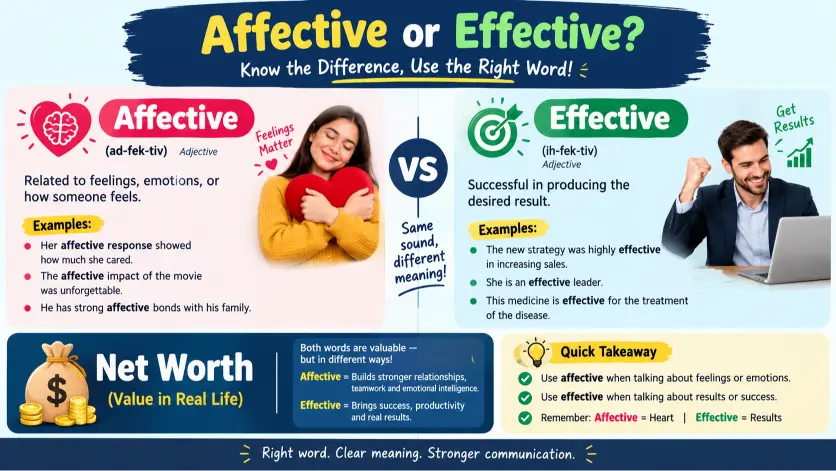
Have you ever paused while writing because you could not decide whether “affective” or “effective” was the right word? You are not alone. These two words look and sound remarkably similar, but they have different meanings and are used in different contexts. Affective generally relates to emotions, feelings, or the way something influences emotional responses, while effective describes something that successfully produces a desired result. A single letter can therefore change the meaning of an entire sentence.
Understanding this distinction is especially important in academic writing, professional communication, psychology, education, and everyday English. Once you understand what each word means and how it functions in context, choosing between them becomes much easier.
In this guide, we will clearly explain affective vs. effective, including their definitions, grammatical roles, common uses, and practical examples. You will also learn simple memory tricks that can help you avoid this common word-choice mistake. Whether you are an English learner, student, writer, or professional, this straightforward explanation will help you use both terms accurately and confidently. By the end, you should know exactly when to choose affective and when effective is the better fit.
Affective or Effective: What’s the Difference?
The simplest way to understand the distinction is to connect each word with a different concept.
Affective is an adjective related to feelings, emotions, moods, and emotional responses. It commonly appears in psychology, education, medicine, communication, and discussions about human behavior.
Effective is also an adjective, but it describes something that works successfully or produces the intended result. It is widely used in everyday English as well as professional, academic, scientific, and technical writing.
| Word | Part of Speech | Core Meaning | Common Context | Example |
|---|---|---|---|---|
| Affective | Adjective | Related to emotions or feelings | Psychology, education, behavior | The activity supported affective development. |
| Effective | Adjective | Successful in producing a result | Business, medicine, technology, everyday English | The new strategy was effective. |
A useful memory trick is to associate affective with affection and emotion.
Associate effective with effect and results.
If you’re talking about someone’s emotional response, affective is usually appropriate.
If you’re talking about whether something works, effective is usually the right choice.
Quick Recap
Affective describes the emotional side of an experience.
Effective describes successful performance or results.
Affective is common in psychology and education.
Effective is common when discussing solutions, methods, strategies, and tools.
Is Affective or Effective a Grammar, Vocabulary, or Usage Issue?
The confusion is primarily a vocabulary and usage issue, rather than a basic grammar problem.
Both words are grammatically correct adjectives. The challenge is choosing the word that communicates the intended meaning.
They aren’t normally interchangeable.
Consider these two sentences:
The program was effective.
This means the program worked or achieved its intended purpose.
The program had an affective impact on students.
This refers to the students’ emotions, attitudes, or feelings.
The difference becomes especially important in formal writing. A casual conversation may tolerate an incorrect word if the intended meaning is obvious, but academic and professional writing requires greater precision.
In academic research, for example, affective may describe emotional learning outcomes, while effective may describe whether an intervention achieved measurable results.
In casual English, effective is extremely common. Affective is more specialized and may sound technical unless the subject genuinely concerns emotion.
A good writer therefore doesn’t choose based on pronunciation alone. The writer first identifies the meaning and then selects the appropriate word.
How to Use Affective Correctly
Affective is generally used when something concerns emotion, mood, feeling, attitude, or emotional response.
It frequently appears in specialized contexts.
In psychology, an affective response can describe an observable emotional reaction. In education, affective learning may involve attitudes, motivation, values, and emotional development. In communication, affective language can influence how people feel about a subject.
Workplace Example
A manager might write:
The training program improved employees’ affective engagement with the company’s values.
The sentence focuses on employees’ feelings, attitudes, and emotional connection.
It would be incorrect to say:
The training program was affective at increasing productivity.
If the intended meaning is that the training successfully increased productivity, effective is needed instead.
Academic Example
A researcher might write:
The study examined affective responses to classroom feedback.
Here, the researcher is investigating how participants emotionally responded to feedback.
Another example is:
Affective learning outcomes included confidence, motivation, and attitudes toward the subject.
The word fits because these outcomes involve emotional or attitudinal dimensions.
Technology Example
Consider an educational application designed to improve students’ attitudes toward mathematics.
You could write:
The application produced positive affective responses among students.
The focus is on feelings and attitudes, not simply whether the application achieved a measurable technical objective.
Usage Recap
Use affective when the sentence concerns feelings or emotional responses.
It is especially useful in psychology, education, behavioral science, and research.
Do not use affective merely because you mean something had an effect.
How to Use Effective Correctly
Effective describes something that works successfully or achieves its intended purpose.
It can describe a person, strategy, treatment, method, tool, policy, argument, system, or solution.
For example:
The new marketing strategy was effective.
This means the strategy successfully achieved its intended objective.
Workplace Example
The manager developed an effective communication strategy.
The strategy works successfully, perhaps because it reduces misunderstandings and improves collaboration.
You could also say:
The new training method was effective in improving employee performance.
The emphasis is on the result.
Academic Example
The researchers found that the intervention was effective in reducing test anxiety.
Here, effective means the intervention successfully produced the desired outcome.
Notice that the subject is not necessarily emotional simply because the result involves an emotional condition. The word effective describes whether the intervention worked.
Technology Example
The security update was effective in preventing unauthorized access.
The focus is on performance and results.
Similarly:
The software uses an effective method for detecting unusual activity.
The method is successful at performing its intended function.
Usage Recap
Use effective when something works.
It is appropriate for strategies, methods, treatments, systems, arguments, policies, and solutions.
If your sentence asks whether something achieved its intended result, effective is usually the better choice.
When You Should NOT Use Affective or Effective
Many mistakes disappear once you recognize what each word is not supposed to describe.
1. Don’t use affective when you mean successful
Incorrect:
The new procedure was affective.
Correct:
The new procedure was effective.
The procedure is being evaluated according to whether it works.
2. Don’t use effective when discussing emotional qualities
Incorrect:
The researcher measured effective responses to the therapy.
Correct:
The researcher measured affective responses to the therapy.
The study concerns emotional responses.
3. Don’t assume affective means caused by an effect
Affective has a connection with emotion, not simply the idea of something producing a result.
4. Don’t replace effective with affective because they sound similar
Pronunciation can encourage confusion, but meaning should determine the choice.
5. Don’t use effective when describing emotional development
If a lesson develops students’ attitudes, values, motivation, or emotional awareness, affective may be appropriate.
6. Don’t use affective for a successful technology solution
If software solves a technical problem successfully, describe it as effective.
7. Don’t use effective simply because a sentence contains the word effect
The grammatical relationship between effect and effective doesn’t mean every sentence involving an effect requires effective.
8. Don’t use affective in ordinary contexts without an emotional meaning
Affective is more specialized. If you simply mean successful, effective is clearer and more natural.
Common Mistakes and Decision Rules
The following examples show how a single word can alter the meaning of a sentence.
| Correct sentence | Incorrect sentence | Explanation |
|---|---|---|
| The treatment was effective. | The treatment was affective. | The treatment successfully produced a result. |
| The patient showed an affective response. | The patient showed an effective response. | The sentence concerns emotion or feeling. |
| The teacher used an effective method. | The teacher used an affective method. | The method worked successfully. |
| The lesson had an affective component. | The lesson had an effective component. | The component concerns emotions or attitudes. |
| The policy was effective. | The policy was affective. | The policy achieved its intended purpose. |
| Researchers studied affective reactions. | Researchers studied effective reactions. | The focus is on emotional reactions. |
Decision Rule Box
If you mean emotions, feelings, attitudes, or emotional responses, use affective.
If you mean successful, useful, productive, or capable of producing a desired result, use effective.
This simple distinction handles most everyday cases.
Affective or Effective in Modern Technology and Tools
Modern technology creates new situations where the distinction matters.
Modern technology system can be effective if it successfully completes its intended task. For example, a writing assistant may be effective at identifying spelling errors.
A technology can also produce an affective response if users develop particular emotions or attitudes toward it.
Consider an educational tutor. Researchers might ask two separate questions:
Is the modern technology tutor effective?
This asks whether students actually improve their learning outcomes.
What are the students’ affective responses to the tutor?
This asks whether students feel confident, motivated, frustrated, comfortable, or anxious when using it.
The same technology can therefore be effective and associated with affective responses at the same time.
This distinction is increasingly valuable in user experience research, educational technology, psychology, human computer interaction, and AI evaluation.
Etymology and Word Origins
Understanding word history can make the distinction easier to remember.
Affective comes from the Latin root connected with the idea of influencing or affecting the emotions and states of feeling. Modern English uses it especially when discussing emotional experience.
Effective ultimately comes from Latin roots associated with producing, accomplishing, or bringing something about. Its modern meaning developed around the idea of successfully producing a desired result.
The two words therefore share historical connections with the broader concept of influence and results, but their modern uses have developed in different directions.
A useful expert style principle is:
Choose the word according to the meaning you intend, not according to how similar the words sound.
That principle applies far beyond these two adjectives.
Two Practical Case Studies
Case Study 1: Employee Training
Imagine a company introduces a new communication training program.
After three months, managers report that employees make fewer communication errors and complete collaborative tasks more efficiently.
The program can reasonably be described as effective because it achieved measurable workplace goals.
Now suppose researchers also measure employee confidence, motivation, and attitudes toward communication. Those emotional and attitudinal outcomes are affective measures.
The concrete distinction is therefore:
Effective result: fewer errors and better task performance.
Affective result: greater confidence and more positive attitudes.
The same training program can have both kinds of outcomes.
Case Study 2: Classroom Technology
Suppose a school introduces a digital mathematics platform.
After one semester, test scores increase from an average of 68 percent to 78 percent among participating students. In this hypothetical example, the platform could be described as effective because the measured academic outcome improved.
Researchers might also survey students and discover that reported confidence rises from 55 percent to 74 percent. That confidence measure represents an affective outcome.
The important lesson is that effectiveness describes successful performance, while affective measures describe emotional or attitudinal experience.
These examples demonstrate why the words shouldn’t be treated as interchangeable.
Error Prevention Checklist
Always Use Affective When
- You are discussing emotions.
- You mean feelings or moods.
- You are describing attitudes or values.
- You are discussing emotional reactions.
- You are writing about affective development in education.
- You are discussing emotional dimensions in psychology or behavioral research.
Never Use Effective When
- The sentence specifically means emotional or attitudinal.
- You are describing an emotional response.
- You mean a person’s feelings rather than the success of an action.
Always Use Effective When
- You mean successful.
- You mean something works.
- You are describing a successful strategy.
- You are evaluating a treatment or intervention.
- You are discussing a useful technology or system.
- You are describing a method that achieves its intended purpose.
Related Grammar Confusions You Should Master
Once you understand this distinction, several other commonly confused English words become easier to manage.
- Affect vs effect
- Advice vs advise
- Practice vs practise
- Compliment vs complement
- Principal vs principle
- Stationary vs stationery
- Its vs it’s
- Then vs than
- Further vs farther
- Lay vs lie
These pairs demonstrate an important principle of English usage: words that look or sound similar can perform different grammatical or semantic functions.
Learning the meaning and context of each word is more reliable than memorizing spelling alone.
Advanced FAQs
What is the difference between affective and effective?
Affective relates to emotions, feelings, moods, and attitudes. Effective means successful in producing a desired result. They are not normally interchangeable because they communicate different meanings.
Is affective a positive or negative word?
Affective is neither inherently positive nor negative. It simply relates to emotional or feeling based responses. An affective response can be positive, negative, neutral, complex, or mixed depending on the context.
Is effective the same as successful?
In many contexts, yes. Effective commonly means successful in achieving an intended goal. However, effective can sometimes describe something that works sufficiently without implying perfect or complete success.
How do you remember affective vs effective?
A useful memory association is affective equals emotion, while effective equals results. If you are discussing feelings, think affective. If you are discussing whether something works, think effective.
Is affective used in academic writing?
Yes. Affective is especially common in psychology, education, behavioral science, nursing, medicine, and research involving emotions, attitudes, motivation, or emotional responses.
Can something be both affective and effective?
Yes. A program can be effective because it achieves its objective while also producing affective outcomes such as increased confidence or motivation.
Is it correct to say an affective strategy?
It can be correct when the strategy specifically concerns emotional responses, attitudes, or feelings. If you mean a strategy that successfully achieves a goal, effective strategy is the natural expression.
Is affective a synonym for emotional?
In many contexts, affective is closely related to emotional. However, affective is often more technical and is particularly useful when discussing emotional states, responses, attitudes, and related psychological processes.
Should I use effective or affective in a business email?
Use effective when you mean successful or productive. Use affective only when the email specifically discusses emotions, attitudes, or emotional responses. For most ordinary business communication, effective will be the correct choice.
Which is correct: effective treatment or affective treatment?
Effective treatment is correct when you mean a treatment that works successfully. Affective treatment would only make sense in a specialized context where the treatment is being described in relation to emotions or emotional processes.
Conclusion:
The distinction between affective and effective becomes straightforward when you focus on meaning rather than appearance. Affective relates to emotions, feelings, attitudes, and emotional responses, while effective describes something that works successfully or produces an intended result.
When writing an academic paper, workplace report, technology review, or everyday message, pause before choosing the word. Ask yourself one question: Am I describing an emotion or a result?
If the answer is emotion, affective is generally the right choice. If the answer is successful performance or an achieved goal, effective is usually correct. That simple decision rule can prevent one of the most common vocabulary mistakes in formal English and make your writing clearer, more precise, and more authoritative.









