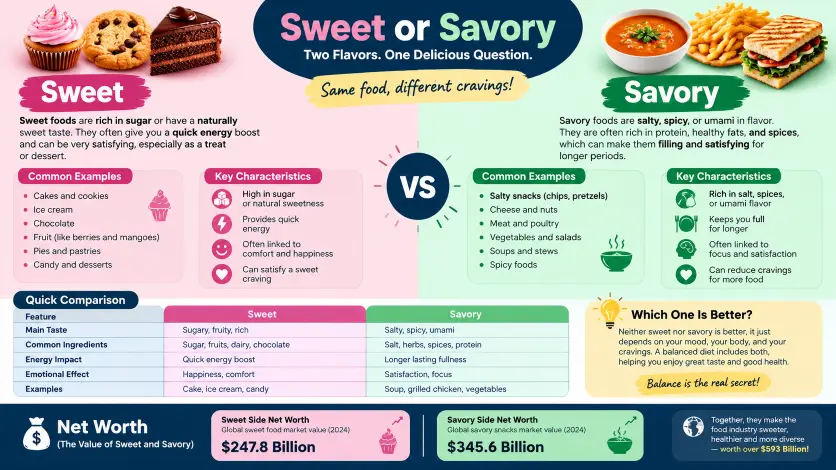
Have you ever struggled to choose between a slice of chocolate cake and a plate of crispy, cheesy fries? The debate over sweet or savory flavors is part of everyday life, influencing what people eat for breakfast, enjoy as snacks, and serve at special occasions. Although both categories offer delicious experiences, they differ in their characteristic tastes, common ingredients, and culinary uses. Understanding these differences can make food choices easier and introduce you to exciting combinations you may not have considered before.
Sweet foods are commonly associated with sugar, honey, fruit, and desserts, while savory foods often feature ingredients such as cheese, herbs, spices, vegetables, and meat. However, some dishes combine both profiles, creating balanced and memorable flavors. For example, honey-glazed chicken and salted caramel desserts demonstrate how contrasting tastes can complement each other.
This guide explains what sweet and savory mean, compares their defining characteristics, and explores familiar food examples. Drawing on established culinary terminology and practical everyday examples, it will help you identify each category confidently and discover which flavors suit your preferences.
Sweet or Savory: What’s the Difference?
When comparing sweet or savory, the main difference lies in the dominant taste profile of a food. Both terms describe flavors, yet they help distinguish different culinary experiences. For example, a chocolate cake is generally sweet, while a vegetable soup is usually savory.
Moreover, neither category depends entirely on sugar or salt. Naturally sweet fruits can taste delicious without added sugar, while savory dishes may contain a small amount of sweetness to balance their flavor.
What Does Sweet Mean?
Sweet is an adjective that describes a flavor commonly associated with sugar, honey, ripe fruit, and similar ingredients. It can also describe something pleasant, affectionate, or appealing in other contexts.
For instance, honey, caramel, strawberries, and vanilla pudding are commonly associated with sweetness. Furthermore, sweet flavors can appear in drinks, breakfast foods, sauces, and desserts.
What Does Savory Mean?
Savory is an adjective that describes food with a flavor profile that is generally not dominated by sweetness. It often involves herbs, spices, vegetables, meat, cheese, mushrooms, or umami rich ingredients.
For example, roasted chicken, mushroom soup, cheese omelets, and seasoned potatoes are typically savory. However, savory food doesn’t necessarily have to be salty or spicy. A mild vegetable broth can be savory because of its aromatic and satisfying flavor.
Sweet vs Savory Comparison Table
| Feature | Sweet | Savory |
|---|---|---|
| Main flavor impression | Sugary or fruity | Rich, earthy, salty, or umami |
| Common ingredients | Honey, fruit, sugar, chocolate | Herbs, vegetables, cheese, meat |
| Popular examples | Cake, cookies, pudding | Soup, curry, roasted vegetables |
| Common meal association | Desserts and sweet snacks | Main courses and hearty snacks |
| Taste experience | Often sugary or fruity | Often complex and deeply flavored |
| Typical seasonings | Cinnamon, vanilla | Garlic, pepper, thyme |
Quick Recap
Sweet describes flavors commonly associated with sugar, honey, and ripe fruit.
Savory describes flavors often associated with herbs, spices, vegetables, and umami.
However, some dishes combine both profiles to create a balanced taste.
Therefore, the best description depends on the food’s dominant flavor rather than a single ingredient.
Is Sweet or Savory a Grammar, Vocabulary, or Usage Issue?
The difference between sweet and savory is primarily a vocabulary and usage issue, not a grammatical problem. Both words function as adjectives, so they can describe nouns in similar sentence structures. Nevertheless, their meanings are different, which makes choosing the appropriate term important.
Are Sweet and Savory Interchangeable?
Generally, no. Although both describe food, they communicate different flavor expectations.
For example, saying that a dessert is sweet suggests a sugary or fruity taste. In contrast, describing the same dessert as savory suggests ingredients such as cheese, herbs, vegetables, or spices that create a less sugary flavor.
Nevertheless, certain dishes combine these profiles. Sweet and sour chicken, honey glazed carrots, and cranberry sauce served with roasted meat demonstrate how sweetness can complement savory ingredients.
Formal vs Casual Usage
Both adjectives are suitable for formal and informal communication. For instance, a restaurant menu might describe a sweet pastry or a savory tart. Similarly, someone chatting with friends might ask whether they prefer sweet snacks or savory treats.
In professional writing, however, the surrounding context determines how much detail is appropriate. A food scientist may describe sweetness intensity or umami characteristics, while a home cook may simply call a dish sweet or savory.
Academic vs Casual Usage
In academic writing, these words can describe sensory characteristics, culinary traditions, and food preferences. For example, a student studying nutrition might investigate how people respond to sweet beverages compared with savory snacks.
In everyday conversation, the distinction is usually simpler. Someone might say, “I prefer savory breakfasts,” or “I always crave something sweet after dinner.”
Consequently, both terms work across different settings, provided their meanings match the intended description.
Practical Usage of Sweet
Sweet is the appropriate choice when the dominant flavor resembles sugar, honey, ripe fruit, or another familiar source of sweetness. However, the term can also describe affectionate behavior, pleasant sounds, or appealing experiences.
Workplace Example
Imagine a bakery employee describing a new product to a customer. The employee might say, “Our sweet cinnamon rolls contain brown sugar and a vanilla glaze.”
This description communicates the product’s flavor and helps the customer understand what to expect. Likewise, a restaurant manager could explain that a new sweet sauce pairs well with grilled fruit.
Academic Example
A culinary student could write, “The ripe mango developed a sweeter flavor as it matured.”
This sentence communicates a change in taste associated with ripening. Similarly, a researcher studying food perception might compare the sweetness of different fruit varieties.
Technology Example
A recipe application may categorize honey cake, fruit smoothies, and chocolate pudding as sweet recipes. As a result, users can find dishes that match their preferences without examining every ingredient individually.
Likewise, a digital grocery list might organize sweet ingredients such as maple syrup, dates, and brown sugar into a convenient category.
Usage Recap
Use sweet when a flavor has a noticeable sugary or fruity character. Nevertheless, remember that the word also describes nonfood qualities, including kindness, pleasantness, and affection. Context determines the intended meaning.
Practical Usage of Savory
Savory is useful when describing foods with rich, aromatic, herbal, spicy, earthy, or umami characteristics. Although these dishes may contain some sugar, sweetness isn’t usually their dominant feature.
Workplace Example
A chef might tell a restaurant supervisor, “The savory mushroom filling needs more thyme and black pepper.”
This description identifies the intended flavor profile and suggests suitable seasonings. Similarly, a catering manager could offer savory pastries alongside sweet desserts at a corporate event.
Academic Example
A food studies student might write, “The experiment examined how roasted garlic affected the savory character of vegetable broth.”
Here, savory describes the broth’s overall taste experience rather than a particular ingredient. In addition, the sentence communicates the purpose of the experiment clearly.
Technology Example
A meal planning application might group lentil soup, spinach quiche, and vegetable curry under savory dishes. Consequently, someone planning a hearty lunch can browse suitable recipes more efficiently.
Furthermore, a cooking assistant can recommend savory alternatives when a person wants a filling snack without choosing a sugary dessert.
Usage Recap
Choose savory when the overall flavor is rich, aromatic, or predominantly non sweet. However, don’t assume that every savory dish must contain meat, dairy, or large amounts of salt. Plant based meals can also have satisfying savory qualities.
When You Should NOT Use Sweet or Savory
Although the distinction is straightforward, several situations can cause confusion. Consider these common mistakes before describing a meal, writing a menu, or discussing personal taste.
1. Don’t call every dessert sweet without considering its ingredients. A cheese tart or a vegetable filled pastry may be savory, even when served in a pastry shell.
2. Don’t assume savory means salty. Unsalted roasted mushrooms can have a pronounced savory character because of their natural umami compounds.
3. Don’t assume sweet always means unhealthy. Fresh fruit can taste sweet without added sugar, while nutritional value depends on the food as a whole.
4. Don’t use savory as a synonym for spicy. A dish seasoned with herbs may be savory without producing any heat.
5. Don’t describe a dish by one ingredient alone. A honey glazed chicken dish may combine sweetness with savory flavors.
6. Don’t treat breakfast as exclusively savory or sweet. Pancakes are often sweet, whereas eggs and vegetable omelets are generally savory. Still, breakfast foods vary across cultures.
7. Don’t assume that savory foods cannot contain sugar. Tomato sauces, marinades, and glazes sometimes include sugar to balance acidity or enhance other flavors.
8. Don’t confuse personal preference with an objective flavor description. One person may find a particular sauce sweet, while another perceives its acidity or spice more strongly.
Therefore, consider the entire dish, including its preparation, seasoning, and dominant flavor, before selecting either adjective.
Common Mistakes and Decision Rules
The following examples illustrate how a small vocabulary choice can change the description of a meal.
| Correct sentence | Incorrect sentence | Explanation |
|---|---|---|
| The chocolate pudding tastes sweet. | The chocolate pudding tastes savory. | Traditional chocolate pudding is usually dominated by sweetness. |
| The mushroom soup has a savory flavor. | The mushroom soup has a sugary flavor. | A typical mushroom soup emphasizes earthy and umami characteristics. |
| I prefer savory snacks in the evening. | I prefer sugary snacks in the evening. | The second sentence changes the stated preference. |
| The honey glazed carrots taste both sweet and savory. | The honey glazed carrots taste only sweet. | The glaze adds sweetness, while the carrots and seasonings contribute other flavors. |
| She prepared a sweet fruit salad. | She prepared a savory fruit salad. | The first description suits a conventional fruit salad, although savory fruit combinations are possible. |
The Decision Rule
Choose sweet
Use this word when the dominant impression comes from sugar, honey, ripe fruit, caramel, or similar flavors.
Choose savory
Use this word when the dominant impression comes from herbs, spices, vegetables, roasted ingredients, or umami rich flavors.
Importantly, these are descriptive choices rather than strict rules about ingredients. When a dish clearly combines both profiles, using both words may be more accurate than forcing it into a single category.
Sweet or Savory in Modern Technology and Digital Cooking Tools
Digital recipe collections, restaurant menus, and meal planning platforms increasingly use flavor categories to help people discover suitable dishes. Therefore, distinguishing sweet from savory improves search accuracy and makes recipe descriptions easier to understand.
For example, a person searching for a sweet breakfast might explore fruit bowls, cinnamon oatmeal, or banana pancakes. Conversely, someone seeking a savory breakfast might prefer scrambled eggs, avocado toast, or a vegetable omelet.
Recipe filters can also accommodate mixed flavors. A honey mustard dressing, for instance, combines sweetness with tangy and savory characteristics. Consequently, a well organized food catalogue should allow more than one flavor label when appropriate.
Moreover, automated menu descriptions benefit from precise vocabulary. If a recipe contains roasted tomatoes, basil, and garlic, calling it savory usually communicates its character better than simply describing it as flavorful.
Nevertheless, ingredient lists and preparation methods provide essential context. A digital tool should consider the complete recipe rather than assuming that one ingredient determines the final taste.
Etymology and the Development of Sweet and Savory
The word sweet has Old English roots in swēte, a term associated with a pleasing taste and other agreeable qualities. Over time, its meaning expanded beyond food to describe pleasant experiences, affectionate behavior, and appealing sounds.
Similarly, savory developed through historical forms associated with flavor and relish. It entered English through Anglo French and Old French forms related to the idea of tasting or enjoying food. Today, it commonly describes appetizing, seasoned, or characteristically non sweet dishes.
Interestingly, both words have meanings beyond cooking. A sweet gesture may communicate kindness, while a savory detail in a story can suggest something interesting or engaging. However, their culinary meanings remain especially useful when describing food.
An Expert Style Perspective
“Describe the flavor that defines the whole dish, not merely the ingredient that attracts your attention.”
This principle encourages accurate food descriptions. For instance, a dish containing honey isn’t necessarily sweet in its overall character, just as a dish containing salt isn’t automatically savory. Balance, cooking technique, and the proportions of different ingredients all influence the result.
Two Case Studies: Applying Sweet and Savory Correctly
The following practical case studies illustrate how choosing the right flavor description can improve menu communication and recipe organization. The results are illustrative examples, not claims about measured experiments.
Case Study One: A Bakery Menu
Imagine a bakery introducing two new products: a chocolate filled croissant and a spinach and feta pastry.
Initially, the menu describes both simply as fresh pastries. Although this description is accurate, customers receive little information about their flavor profiles.
The bakery revises the wording:
| Product | Improved description | Expected benefit |
|---|---|---|
| Chocolate filled croissant | Sweet, buttery pastry with a rich chocolate center | Helps customers identify a dessert style treat |
| Spinach and feta pastry | Savory pastry filled with seasoned spinach and tangy cheese | Helps customers identify a less sweet option |
The revised descriptions distinguish the two products immediately. As a result, customers can make a more informed choice before ordering.
The practical lesson is simple: clear flavor labels communicate useful information without requiring lengthy menu explanations.
Case Study Two: A Weekly Meal Planner
Consider a household preparing five breakfasts for the coming week. Its original list contains pancakes, fruit yogurt, vegetable omelets, cheese toast, and cinnamon oatmeal.
Without flavor categories, someone looking for a savory breakfast must examine every item.
The household reorganizes the list into two groups:
| Flavor category | Breakfast choices |
|---|---|
| Sweet | Pancakes, fruit yogurt, cinnamon oatmeal |
| Savory | Vegetable omelets, cheese toast |
The result is a more organized meal plan with three sweet options and two savory options. Therefore, household members can identify their preferred choices more quickly.
The exercise also reveals an important limitation: some breakfasts, such as peanut butter toast with banana slices, may fit either category depending on preparation and dominant flavor. Flexible labels are consequently more useful than rigid classifications.
Error Prevention Checklist: Sweet or Savory
Before writing a menu, selecting a recipe, or describing a dish, use this quick checklist.
Always Use Sweet When
- The dominant flavor resembles sugar, honey, caramel, or ripe fruit.
- You’re describing a conventional dessert such as cake, pudding, or a sugary pastry.
- A beverage features a noticeably sweet flavor from fruit, syrup, or another sweetening ingredient.
- You want to communicate that a flavor is pleasant and sugary rather than primarily rich or savory.
Never Use Savory When
- A food’s defining characteristic is clearly sugary or fruity and no savory profile is intended.
- You’re describing a conventional dessert whose principal flavor is chocolate, caramel, or sugar.
- You mean spicy specifically, since savory doesn’t necessarily indicate heat.
- You intend to say that a dish is salty, because savory describes a broader flavor experience.
These guidelines aren’t absolute restrictions. Rather, they help you choose the most informative word for the context. A sweet and savory sauce, for example, can be described accurately using both terms.
Related Grammar and Vocabulary Confusions You Should Master
Understanding flavor vocabulary becomes easier when you recognize how closely related words can communicate different ideas. Likewise, learning common distinctions improves everyday writing and conversation.
1. Sweet vs sugary: Sweet describes a taste, whereas sugary emphasizes the presence or impression of sugar.
2. Savory vs salty: Savory describes a broad flavor profile, while salty refers specifically to the taste associated with salt.
3. Spicy vs hot: Spicy can refer to a variety of seasonings, while hot may describe chili heat or high temperature.
4. Bitter vs sour: Bitter and sour represent different taste sensations, often associated with different ingredients and food experiences.
5. Flavor vs taste: Taste refers to sensations detected by taste receptors, while flavor includes taste, aroma, and other sensory impressions.
6. Tasty vs flavorful: Tasty expresses approval of food, whereas flavorful emphasizes the presence of noticeable flavor.
7. Fresh vs ripe: Fresh often describes condition or recent preparation, while ripe refers to reaching an appropriate stage of development.
8. Dessert vs desert: Dessert is commonly the sweet course served after a meal, whereas desert refers to a dry geographical environment.
9. Affect vs effect: Affect is usually a verb meaning to influence, while effect is usually a noun referring to a result.
10. Fewer vs less: Fewer generally applies to countable items, whereas less generally applies to amounts that aren’t counted individually.
Although these examples cover different language topics, they share one principle: selecting a word based on its precise meaning makes communication clearer.
Frequently Asked Questions
1. What is the difference between sweet and savory?
Sweet describes flavors commonly associated with sugar, honey, and ripe fruit. Savory describes flavors often associated with herbs, spices, roasted ingredients, and umami. However, a single dish can combine both profiles.
2. Is sweet or savory better for breakfast?
Neither option is universally better. Sweet breakfasts might include fruit, oatmeal, or pancakes, while savory choices might include eggs, vegetables, or cheese toast. Ultimately, the best option depends on personal preferences, nutritional needs, and the overall meal.
3. Can a food be both sweet and savory?
Yes. Honey glazed carrots, cranberry sauce served with meat, and sweet barbecue sauces combine sweetness with other flavor characteristics. Therefore, using both adjectives can provide a more accurate description than choosing just one.
4. Is savory the same as salty?
No. Salty specifically describes a taste associated with salt, whereas savory refers to a broader range of flavors, including earthy, roasted, herbal, and umami characteristics. Consequently, a food can be savory without tasting particularly salty.
5. Are fruits sweet or savory?
Many fruits are naturally sweet, particularly when ripe. Nevertheless, fruits can also contribute to savory dishes. For example, mango salsa can accompany grilled food, while apples may appear in salads with cheese and leafy greens.
6. Why do people crave sweet or savory foods?
Food preferences can be influenced by appetite, eating habits, sensory experiences, cultural traditions, and individual preferences. Furthermore, cravings may vary with circumstances. Wanting a sweet snack or a savory meal doesn’t automatically indicate a particular nutritional deficiency.
7. How do you choose between sweet and savory snacks?
First, consider the flavor you want. Choose fruit, yogurt with honey, or a sweet pastry when you prefer sweetness. Alternatively, consider roasted chickpeas, cheese, or seasoned vegetables when you want a savory option. Also, examine portion sizes and nutritional content when making regular snack choices.
8. Does savory always mean food without sugar?
No. Many savory dishes contain small amounts of sugar, honey, or naturally sweet ingredients. Tomato sauces, marinades, and glazes are common examples. What matters most is the dish’s overall flavor rather than whether sugar appears anywhere in the recipe.
9. How do you use sweet or savory in a sentence?
You can say, “I prefer sweet desserts but savory lunches.” Similarly, “The restaurant serves both sweet pastries and savory pies” communicates the distinction clearly. In each sentence, the adjectives describe the flavor characteristics of the food.
Conclusion:
Understanding sweet or savory comes down to recognizing the dominant flavor of a dish. Sweet usually describes tastes associated with sugar, honey, and ripe fruit, whereas savory describes rich, aromatic, herbal, or umami characteristics.
However, the distinction isn’t always rigid. Some recipes combine sweetness with savory ingredients to create a balanced and satisfying result. Therefore, consider the complete dish rather than relying on one ingredient when choosing a description.
Whether you’re planning breakfast, selecting a snack, preparing a restaurant menu, or improving your vocabulary, using these terms accurately makes communication more precise. Ultimately, choose sweet for a predominantly sugary or fruity flavor, savory for a predominantly rich or seasoned flavor, and both when the dish genuinely combines the two.









