Have you ever wondered whether to say you are unsatisfied or dissatisfied when something fails to meet your expectations? Although these two words are closely related, choosing the right one can make your writing clearer and help you communicate your feelings more precisely. Both terms describe a lack of satisfaction, yet their usage can depend on context, tone, and the message you want to convey. Understanding the difference is especially useful when writing professional emails, customer reviews, academic assignments, or everyday conversations. A small vocabulary choice can influence how readers interpret your message, so knowing which word fits your situation is worth the effort.
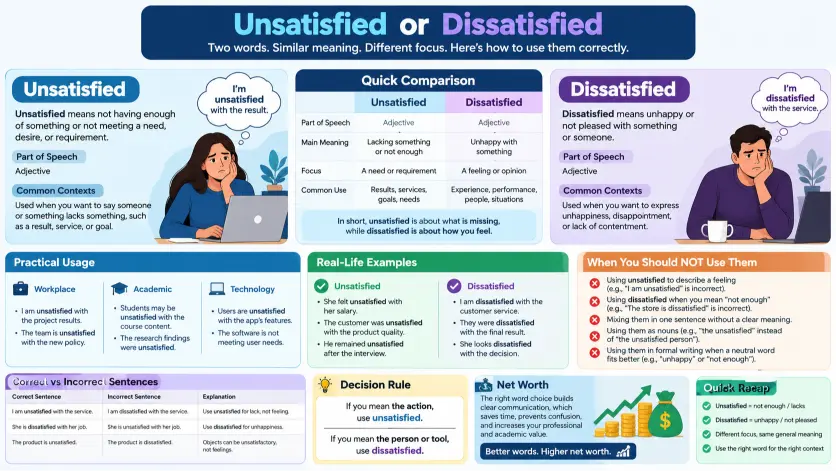
The main difference between unsatisfied and dissatisfied is often a matter of emphasis rather than a strict grammatical rule. Unsatisfied commonly describes a need, desire, requirement, or expectation that remains unfulfilled. For example, a person may feel unsatisfied with an explanation because important questions remain unanswered. Dissatisfied, on the other hand, often expresses disappointment or unhappiness with a product, service, experience, or situation. For instance, a customer may be dissatisfied with the quality of a recent purchase. However, the words overlap considerably, and both can describe people who feel that something is not good enough. Context is therefore essential when deciding which term communicates your meaning most naturally.
In this guide, you will learn what unsatisfied and dissatisfied mean, how they differ, and when each word is appropriate. You will also explore practical sentence examples, common usage mistakes, and simple techniques for choosing the correct term in everyday and professional writing. By examining established definitions, standard English usage, and real-world communication scenarios, this explanation will help you develop a more confident understanding of both words. Whether you are an English learner, a student, a content writer, or someone who wants to improve everyday communication, you will discover how to express dissatisfaction or an unmet need with greater accuracy and clarity.
Unsatisfied vs Dissatisfied: What’s the Difference?
Although unsatisfied and dissatisfied are related adjectives, their primary emphasis differs. The first commonly highlights something incomplete or unfulfilled, while the second emphasizes a negative reaction to a situation or outcome.
What Does Unsatisfied Mean?
Unsatisfied is an adjective describing a person, need, desire, condition, or requirement that has not been fulfilled adequately.
In other words, something remains missing, incomplete, or insufficient. Consequently, the term often focuses on the gap between what someone needs and what they have received.
Examples include:
- The students remained unsatisfied because the lesson did not answer their questions.
- Her curiosity was unsatisfied after reading the incomplete explanation.
- The committee was unsatisfied with the evidence submitted by the applicant.
- His hunger remained unsatisfied after a very small meal.
In each example, the central idea is an unmet need, expectation, or requirement. Although disappointment may accompany that condition, the emphasis remains on what is still lacking.
What Does Dissatisfied Mean?
Dissatisfied is an adjective describing unhappiness, disappointment, or displeasure with a person, service, product, situation, or outcome.
Rather than emphasizing only an unmet need, this word highlights a negative evaluation of an experience or result.
Examples include:
- The customer was dissatisfied with the restaurant’s service.
- Several employees were dissatisfied with the new workplace policy.
- The researcher was dissatisfied with the quality of the initial results.
- She felt dissatisfied with her final examination performance.
Here, the emphasis falls on the person’s unfavorable reaction. Something may have been delivered or completed, yet the individual still considers the result disappointing.
Comparison Table
| Feature | Unsatisfied | Dissatisfied |
|---|---|---|
| Part of speech | Adjective | Adjective |
| Main emphasis | An unmet need or expectation | Unhappiness or disappointment |
| Typical context | Requirements, curiosity, desires | Services, experiences, results |
| Emotional emphasis | Not necessarily strong | Usually more explicit |
| Formal writing | Appropriate | Appropriate |
| Everyday conversation | Common | Common |
| Relationship between terms | Sometimes interchangeable | Sometimes interchangeable |
Quick Recap
Unsatisfied emphasizes something that remains unfulfilled.
Dissatisfied emphasizes an unfavorable reaction to an experience or outcome.
Both words can describe disappointment, depending on the situation.
Therefore, examine whether the sentence focuses on a missing requirement or a negative evaluation before choosing either adjective.
Is Unsatisfied vs Dissatisfied a Grammar, Vocabulary, or Usage Issue?
The distinction between these words is primarily a matter of vocabulary and usage rather than grammatical correctness. Both are established English adjectives, and both can appear naturally in formal documents, academic writing, and casual conversations.
Are Unsatisfied and Dissatisfied Interchangeable?
Sometimes, yes. Nevertheless, they aren’t interchangeable in every context.
Consider these examples:
- The customer was unsatisfied with the product.
- The customer was dissatisfied with the product.
Both sentences are grammatically correct. The first can suggest that the product failed to meet expectations, while the second emphasizes the customer’s disappointment with it.
However, consider a different example:
* His hunger remained unsatisfied.
This construction naturally emphasizes an unfulfilled physical need. Although it is possible to describe someone as dissatisfied with a meal, that alternative shifts attention toward the person’s opinion of the food or dining experience.
Similarly, a person can have unsatisfied curiosity because a question remains unanswered. Meanwhile, someone who is dissatisfied with an explanation may have received an answer but considers it inadequate.
Formal Versus Informal Usage
Both terms are suitable for formal communication. For instance, business reports may describe dissatisfied customers, while a technical assessment may identify unsatisfied requirements.
In casual conversation, either adjective can communicate frustration or unmet expectations. However, speakers often choose dissatisfied when discussing complaints, poor treatment, or disappointing experiences.
Academic Versus Casual Usage
Academic writers should select the term that reflects the evidence being discussed. For example, an incomplete experiment may leave a research question unsatisfied, whereas disappointing experimental results may leave the researcher dissatisfied.
Likewise, in casual speech, a person might say they are dissatisfied with a film because they disliked its ending. By contrast, they might say their curiosity remains unsatisfied when the film leaves important questions unanswered.
Ultimately, grammatical correctness is only the first consideration. Precise meaning determines the better choice.
Practical Usage of Unsatisfied
The adjective unsatisfied works particularly well when a requirement, desire, expectation, or question remains unfulfilled. Although it can express frustration, its central focus is often the missing element.
Workplace Example
A project manager might write:
“The client remains unsatisfied because the final report does not address two requested specifications.”
Here, the problem is identifiable: essential information is missing. Therefore, the adjective communicates an incomplete outcome rather than merely a negative opinion.
Academic Example
A student might explain:
“My curiosity about the historical event remained unsatisfied because the textbook provided limited evidence.”
In this case, the student’s desire for knowledge has not been fulfilled. Consequently, unsatisfied accurately communicates the remaining information gap.
Technology Example
A software tester might report:
“Three user requirements remain unsatisfied because the application does not support the requested export format.”
This example illustrates how the adjective can describe unmet technical conditions. Furthermore, it makes the problem easier to identify because the missing functionality is specified.
Usage Recap
Choose unsatisfied when the sentence emphasizes an incomplete requirement, an unmet desire, an unanswered question, or an insufficient outcome. However, when the primary concern is someone’s negative judgment of an experience, dissatisfied may communicate the intended meaning more precisely.
Practical Usage of Dissatisfied
The adjective dissatisfied is especially useful when describing a person’s unfavorable reaction to a product, service, decision, relationship, or result. Although an unmet expectation may explain the feeling, the emphasis falls on the person’s dissatisfaction.
Workplace Example
A human resources manager might state:
“Several employees are dissatisfied with the revised scheduling policy.”
The employees are expressing an unfavorable opinion about a workplace decision. Therefore, dissatisfied fits naturally because their reaction is the main subject.
Academic Example
A student might write:
“I was dissatisfied with my essay because the argument lacked sufficient supporting evidence.”
The essay has been completed, but the student considers its quality inadequate. Thus, the adjective communicates disappointment with the finished work.
Technology Example
A customer might report:
“Users were dissatisfied with the mobile application because its navigation was confusing.”
The application exists and performs its intended function to some extent. Nevertheless, users evaluate the experience negatively, making dissatisfied an appropriate choice.
Usage Recap
Use dissatisfied when describing disappointment, displeasure, or a negative assessment. In particular, the word works naturally in customer reviews, employee surveys, product evaluations, and personal reflections.
When You Should NOT Use Unsatisfied or Dissatisfied
Although the two adjectives cover many situations, certain uses can create confusion or weaken a sentence. Therefore, consider these common mistakes before selecting either term.
1. Do not automatically replace one adjective with the other. An unanswered question and a disappointing answer describe different problems. Choose the word that reflects the intended emphasis.
2. Do not use dissatisfied when you mean merely incomplete. If a software feature has not been implemented, an unsatisfied requirement may describe the technical problem more directly than a statement about someone’s feelings.
3. Do not assume unsatisfied always describes an emotionless condition. People can feel frustration when their needs remain unmet. The word simply places greater emphasis on the unfulfilled need.
4. Do not assume dissatisfied means every expectation has been met. A person can be unhappy precisely because a product failed to deliver what was promised.
5. Do not confuse dissatisfaction with dissatisfaction’s cause. A customer may be dissatisfied because delivery was late, but the delay itself is the cause rather than the feeling.
6. Do not force either word into every negative situation. Sometimes incomplete, inadequate, unhappy, disappointed, or frustrated communicates the intended meaning more precisely.
7. Do not use the adjectives without explaining important context in professional reports. Instead of writing that users were dissatisfied, identify the specific problem, such as slow loading, unclear instructions, or unreliable performance.
8. Do not treat either term as a verb. Both are adjectives. For example, write “The customer was dissatisfied,” rather than “The customer dissatisfied with the service” when no auxiliary verb or other suitable grammatical construction supports the sentence.
These distinctions help writers communicate the actual problem rather than relying on a general expression of dissatisfaction.
Common Mistakes and Decision Rules
Even experienced writers sometimes confuse the two terms because their meanings overlap. Fortunately, a few carefully selected examples make the difference easier to understand.
| Correct sentence | Incorrect or less precise sentence | Explanation |
|---|---|---|
| My curiosity remained unsatisfied. | My curiosity remained dissatisfied. | Curiosity is an unfulfilled desire for information. |
| The customer was dissatisfied with the service. | The customer was unsatisfied with the service. | The second sentence is possible, but the first emphasizes the customer’s negative evaluation. |
| Several requirements remain unsatisfied. | Several requirements remain dissatisfied. | Requirements can remain unfulfilled, but they do not experience emotions. |
| She was dissatisfied with her examination result. | She was unsatisfied with her examination result. | Both can work, although dissatisfied more clearly communicates disappointment. |
| His hunger remained unsatisfied. | His hunger remained dissatisfied. | Hunger is a physical need rather than a feeling capable of evaluating an experience. |
| The employees were dissatisfied with management. | The employees were unsatisfied with management. | Both may be correct, but dissatisfied naturally expresses their unfavorable opinion. |
The Decision Rule
Which word should you choose?
Use unsatisfied
When you mean a need, desire, expectation, question, or requirement remains unfulfilled.
Use dissatisfied
When you mean a person feels unhappy, disappointed, or displeased with a situation or result.
This rule provides a useful starting point. However, context still matters because a single experience can involve both an unmet need and a negative emotional response.
Unsatisfied and Dissatisfied in Modern Technology and Intelligent Tools
Modern digital products frequently generate feedback about user expectations and satisfaction. Consequently, understanding these adjectives helps product teams describe usability problems, feature gaps, and customer experiences accurately.
For example, a user may remain unsatisfied when an application lacks a requested accessibility feature. In this situation, the problem concerns an unfulfilled requirement.
Conversely, a user may be dissatisfied with the application because its interface is difficult to navigate, even when all essential features are available.
Similarly, automated customer support systems can categorize feedback by distinguishing missing functionality from negative evaluations. Nevertheless, the words alone do not prove why a customer feels a particular way. Reliable analysis requires the actual feedback, relevant context, and supporting evidence.
Therefore, businesses should identify specific causes instead of assuming that every complaint represents the same problem.
Etymology and Meaning Development
Both adjectives developed through familiar English word formation patterns. The prefix un commonly expresses negation or the absence of a condition, while dis can indicate reversal, opposition, or a negative state.
The word satisfied is associated with the idea of having enough or having a need fulfilled. Accordingly, unsatisfied conveys the absence of fulfillment.
Meanwhile, dissatisfied describes a state of being displeased or not satisfied with something. Over time, this adjective became especially common in discussions of consumer experiences, workplace relationships, public opinion, and personal evaluations.
Although the two words share a common semantic foundation, their usual emphasis differs. The distinction is not an absolute grammatical rule, but a useful pattern of contemporary English usage.
Expert Perspective and Practical Case Studies
An Expert Style Explanation
“A precise adjective does more than describe a feeling. It identifies whether the problem lies in an unmet requirement or in a person’s evaluation of an experience.”
This is an explanatory statement rather than a quotation attributed to a named linguist. It summarizes the central distinction in a practical way.
Case Study One: Customer Service
Imagine that a customer orders a replacement laptop charger. The package arrives on time, but the charger is incompatible with the customer’s computer.
The customer is unsatisfied because the essential requirement has not been fulfilled. Furthermore, the customer may be dissatisfied with the seller because the product description was misleading.
These descriptions communicate two related but distinct issues: the missing outcome and the negative reaction.
Practical result: A support team that records both the compatibility problem and the customer’s evaluation can distinguish product defects from service complaints. However, any measured improvement would need to be established through actual support data rather than assumed.
Case Study Two: Academic Research
Consider a university researcher investigating whether a new teaching method improves student comprehension. After collecting the initial results, the researcher discovers that the evidence does not answer the original research question.
The research question remains unanswered, so the investigator’s curiosity may remain unsatisfied. Additionally, the researcher may be dissatisfied with the study’s limitations or the quality of the evidence.
Practical result: Separating these concerns helps researchers explain whether additional data are needed or whether the existing methodology requires improvement. Nevertheless, the choice of adjective alone does not establish the validity of the findings.
Both cases illustrate why precise vocabulary matters in professional communication. Rather than simply labeling an experience negatively, writers should identify what remains incomplete and how the people involved evaluate the outcome.
Error Prevention Checklist
Before finalizing a sentence, use this checklist to confirm that the chosen adjective communicates the intended meaning.
Always Use Unsatisfied When
- A requirement has not been fulfilled.
- A question remains unanswered.
- A physical need remains unmet.
- A person’s curiosity still requires an explanation.
- A requested feature is missing.
- A condition necessary for completion has not been achieved.
Never Use Dissatisfied When
- You are describing an inanimate requirement as though it experiences emotions.
- The sentence concerns an unanswered question and you intend to emphasize only the missing information.
- You are describing hunger itself as an emotional judgment.
- You need to identify a technical requirement that has not been completed.
- You have not established that a person actually feels disappointed or displeased.
The word dissatisfied remains appropriate when people evaluate these situations negatively. For example, a customer can be dissatisfied with a missing feature even though the feature itself cannot experience dissatisfaction.
Therefore, focus on the grammatical subject and the intended meaning before making your final decision.
Related Grammar Confusions You Should Master
Learning similar word distinctions can strengthen vocabulary, improve sentence clarity, and reduce common writing mistakes. In addition, these comparisons help readers recognize differences between grammatical form and contextual meaning.
- Affect vs Effect: Affect usually functions as a verb, while effect commonly functions as a noun.
- Advice vs Advise: Advice is a noun, whereas advise is a verb.
- Fewer vs Less: Fewer generally refers to countable items, while less commonly refers to quantities or amounts.
- Disinterested vs Uninterested: Disinterested often means impartial, whereas uninterested means lacking interest.
- Anxious vs Eager: Anxious can express worry, while eager generally expresses enthusiastic anticipation.
- Compliment vs Complement: A compliment expresses praise, while a complement completes or enhances something.
- Infer vs Imply: A speaker implies something, while a listener infers it.
- Envious vs Jealous: Envious generally concerns wanting what another person has, while jealous often involves fear of losing something valued.
- Further vs Farther: Further often relates to degree or additional development, while farther commonly refers to physical distance.
- Accept vs Except: Accept means to receive or agree to something, while except means to exclude.
Similarly, comparing related adjectives can reveal subtle differences in tone and emphasis. Therefore, learning vocabulary in context is often more effective than memorizing isolated definitions.
Frequently Asked Questions
1. What is the difference between unsatisfied and dissatisfied?
Unsatisfied emphasizes an unmet need, expectation, or requirement. Dissatisfied emphasizes unhappiness or disappointment with an experience or result. However, both terms can overlap when someone receives something that fails to meet expectations.
2. Is unsatisfied grammatically correct?
Yes. Unsatisfied is a standard English adjective. For example, “The customer remained unsatisfied because the issue was unresolved” is grammatically correct and communicates an unmet expectation.
3. Is dissatisfied more negative than unsatisfied?
Not necessarily. Dissatisfied often makes a negative emotional reaction more explicit, whereas unsatisfied can emphasize an incomplete need. Nevertheless, the strength of either expression depends on the context and the surrounding sentence.
4. Can I use unsatisfied and dissatisfied interchangeably?
Sometimes. For instance, both can describe a customer who did not receive the expected quality. However, unsatisfied may emphasize the unmet expectation, while dissatisfied highlights the customer’s negative evaluation.
5. Should I write unsatisfied customer or dissatisfied customer?
Both expressions are possible. However, dissatisfied customer is often the more natural choice when discussing complaints, service quality, consumer opinions, or customer experience. Unsatisfied customer may be appropriate when emphasizing an unmet need.
6. Is it unsatisfied with or dissatisfied with?
Both constructions are grammatically correct. For example, you can be unsatisfied with an incomplete explanation or dissatisfied with an unpleasant experience. The preposition with works naturally with either adjective.
7. Can a person be both unsatisfied and dissatisfied?
Yes. A person can have an unmet expectation and feel disappointed about it. For example, a customer whose refund has not arrived may be unsatisfied because the refund remains outstanding and dissatisfied with the company’s handling of the situation.
8. Which word is better for academic writing?
Neither adjective is universally superior. Use unsatisfied when discussing unmet research needs, unanswered questions, or incomplete requirements. Choose dissatisfied when describing a researcher’s negative evaluation of a result, method, or experience.
9. What is the opposite of unsatisfied or dissatisfied?
Depending on the context, possible opposites include satisfied, fulfilled, content, pleased, and happy. Satisfied is generally the closest direct opposite of both adjectives, although the best alternative depends on the sentence.
Conclusion:
Understanding unsatisfied or dissatisfied becomes easier when you focus on the main idea behind a sentence. Although both adjectives describe situations in which expectations may not have been met, their emphasis differs.
Unsatisfied generally highlights an incomplete need, an unanswered question, or an unfulfilled requirement. By comparison, dissatisfied communicates a negative judgment, disappointment, or displeasure with an experience or outcome.
For example, a customer may be unsatisfied because a requested feature is missing. Meanwhile, that customer may be dissatisfied with the company’s response to the problem. Both descriptions can be accurate because they identify different aspects of the same experience.
Ultimately, neither word is universally better. Instead, choose the adjective that reflects the intended meaning, consider the grammatical subject, and provide enough context for readers to understand the situation. With regular practice, this distinction becomes easier to recognize in academic writing, workplace communication, customer feedback, and everyday English.









