Have you ever wondered whether to write flare or flair? These two English words sound exactly alike, making them easy to confuse in everyday writing. However, their meanings are quite different. One can describe a sudden burst of light, a fire, or a worsening problem, while the other refers to a natural talent, distinctive style, or creative ability. Choosing the wrong word can change your sentence’s meaning and make your writing less precise. Fortunately, understanding the difference is easier than you might think.
The key to using flare or flair correctly is to connect each spelling with its meaning. Flare commonly describes something that suddenly bursts out, becomes brighter, or grows more intense, as in a flare of anger or a flare in symptoms. Flair, on the other hand, describes a special ability or an appealing way of doing something, as in a flair for fashion or a flair for storytelling. Recognizing these patterns will help you distinguish the words in emails, school assignments, professional documents, and everyday conversations.
In this guide, you will discover the definitions of both words, explore practical sentence examples, and learn simple techniques for remembering which spelling to use. The explanations focus on standard English usage, with examples that demonstrate how context determines the correct choice. Whether you are a student, an English learner, or a professional looking to improve your writing, this comparison will help you avoid common mistakes and communicate with greater confidence. By the end, you will know when to use flare and when flair is the better choice.
Flare vs Flair: What’s the Difference?
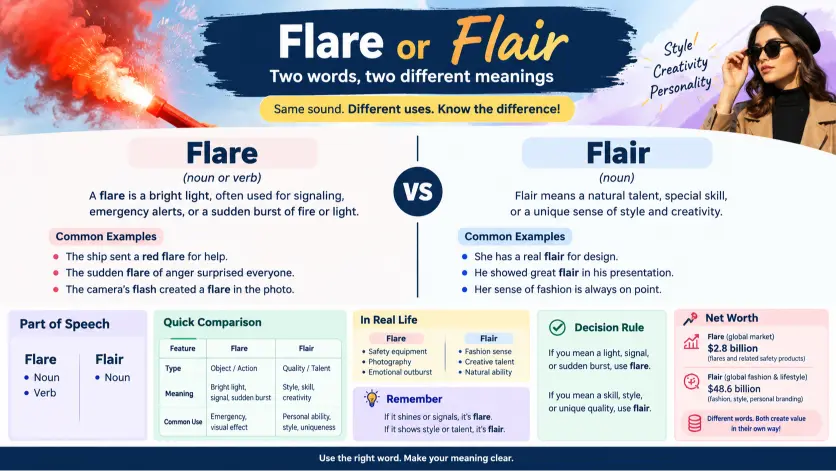
The difference between flare and flair lies in their meanings and grammatical functions. Although both words are pronounced identically, they aren’t interchangeable. A flare usually describes a sudden burst, an increase in intensity, or an object that produces a bright signal. By contrast, flair refers to a distinctive talent, an artistic touch, or a natural ability to do something exceptionally well.
For example, a sudden increase in anger is a flare of temper, whereas an exceptional ability to decorate a room is a flair for interior design. Therefore, understanding the context makes the correct spelling much easier to identify.
Definitions and Parts of Speech
Flare (noun and verb): As a noun, flare describes a sudden burst of light, fire, emotion, or activity. It can also refer to a signaling device or a shape that widens outward. As a verb, flare means to burn brightly, spread outward, or suddenly become more intense.
Examples include a flare from an emergency signal, a flare of jealousy, and trousers that flare at the bottom.
Flair (noun): Flair means a natural talent, an impressive ability, or a distinctive way of doing something. It often describes creativity, personal style, elegance, or an unusual gift for a particular activity.
Examples include a flair for writing, a flair for fashion, and a flair for entertaining guests.
Comparison Table
| Feature | Flare | Flair |
|---|---|---|
| Main meaning | Sudden burst or widening shape | Talent or distinctive style |
| Part of speech | Noun and verb | Noun |
| Pronunciation | /fler/ | /fler/ |
| Common expression | A flare of anger | A flair for languages |
| Typical context | Light, heat, conflict, signals | Creativity, skill, presentation |
| Example | The fire began to flare. | She has a flair for painting. |
Quick Recap
Flare describes a burst, an increase in intensity, or something that spreads outward.
Flair identifies talent, creativity, or an individual style.
Both words sound alike, but their meanings differ significantly.
When describing a skill, choose flair. When describing a burst or sudden increase, choose flare.
Is Flare vs Flair a Grammar, Vocabulary, or Usage Issue?
The confusion between flare and flair is primarily a vocabulary and spelling issue rather than a grammatical one. Both words are correctly spelled English words, and each follows normal grammatical rules in its appropriate context. However, selecting the wrong word creates a semantic error because the intended meaning changes.
Are Flare and Flair Interchangeable?
No, these words aren’t interchangeable in standard English. Although their pronunciation is identical, their meanings remain distinct.
For instance, consider the sentence, “He has a flair for public speaking.” Here, flair describes his natural ability to communicate effectively. Replacing it with flare would suggest a burst or sudden increase, which doesn’t convey the intended compliment.
Similarly, “The flames began to flare” describes an increase in the fire’s intensity. Using flair instead would make the sentence incorrect in its intended meaning.
Formal and Informal Usage
Both spellings are acceptable in formal and informal English. Nevertheless, the correct choice depends on the situation being described.
In professional correspondence, a person might demonstrate a flair for negotiation. Meanwhile, a report about an industrial accident might describe a flare caused by burning gas.
In casual conversation, someone could mention a flare of frustration or compliment a friend’s flair for decorating. Consequently, neither word belongs exclusively to formal or informal language.
Academic and Everyday Contexts
In academic writing, flare often appears in scientific, medical, environmental, and engineering contexts. For example, researchers may investigate solar flares, while a medical report might describe a flare up of symptoms.
Conversely, flair frequently appears in discussions of literature, visual arts, communication, and performance. A teacher might praise a student’s flair for storytelling, while a design critic could recognize an artist’s distinctive flair.
In everyday speech, the same distinction applies. A sudden flash calls for flare, whereas exceptional talent calls for flair.
Practical Usage: When to Use Flare
Use flare whenever you mean a sudden burst of light, fire, emotion, or activity. Additionally, choose this word when describing something that widens toward its edge or a situation that suddenly becomes more intense.
1. Workplace Examples
In a workplace safety report, flare may describe a sudden burst of flame or a visible signal.
Example: “The technician noticed a flare near the gas equipment and immediately followed the emergency procedure.”
Similarly, in a discussion about workplace relationships, flare can describe an abrupt emotional reaction.
Example: “A flare of disagreement interrupted the meeting.”
In both examples, the word refers to an event or increase in intensity rather than a person’s talent.
2. Academic Examples
In science, flare commonly describes a sudden release of energy or a burst of light.
Example: “The astronomers recorded a solar flare during their observations.”
Likewise, medical researchers may use the expression flare up to describe the sudden worsening of a condition.
Example: “The study examined factors associated with a flare up of inflammatory symptoms.”
Therefore, academic readers should interpret the word according to the relevant scientific or medical context.
3. Technology Examples
In photography, lens flare refers to unwanted or intentional light effects produced when bright light enters a camera lens.
Example: “The photographer reduced lens flare by adjusting the camera angle.”
In digital design, developers might also discuss simulated lens flare effects used in games, films, or image editing applications.
Example: “The designer added a subtle flare effect to make the scene appear brighter.”
Usage Recap
Choose flare for sudden brightness, burning, widening shapes, or increases in intensity. In addition, remember that it can function as either a noun or a verb.
Practical Usage: When to Use Flair
Use flair when describing natural talent, an impressive ability, or a distinctive approach. In particular, this word works well when discussing creative expression, personal presentation, communication, and professional strengths.
1. Workplace Examples
In a professional setting, flair often highlights an individual’s ability to perform a task with originality or skill.
Example: “The marketing manager has a flair for developing memorable campaigns.”
Similarly, a colleague might be recognized for making complex information accessible.
Example: “Her flair for explaining technical concepts helped the team understand the new process.”
These examples emphasize ability and style rather than a sudden event.
2. Academic Examples
In education, flair can describe a student’s particular strength in writing, languages, mathematics, or artistic work.
Example: “The student demonstrated a flair for creative writing throughout the semester.”
A literature teacher might also recognize a writer’s distinctive storytelling approach.
Example: “The novelist brings considerable flair to descriptions of ordinary life.”
Consequently, the word often communicates praise for an individual’s talent or expressive ability.
3. Technology Examples
In technology and digital design, flair describes an original or attractive presentation.
Example: “The developer added visual flair to the application’s dashboard without compromising readability.”
Likewise, a website designer might use color, typography, and animation to give a product a distinctive identity.
Example: “The designer’s flair for minimalist layouts made the website feel elegant and accessible.”
Usage Recap
Choose flair when describing talent, creativity, or distinctive style. Because it functions as a noun, it commonly appears in expressions such as “a flair for design” and “with considerable flair.”
When You Should NOT Use Flare or Flair
Although the distinction is straightforward, several common situations can lead to mistakes. Therefore, review these examples before choosing either spelling.
- When describing natural talent, don’t use flare. Write “He has a flair for music,” not “He has a flare for music.”
- When describing burning flames, don’t use flair. Write “The fire began to flare,” not “The fire began to flair.”
- When discussing solar activity, avoid flair. The established scientific term is solar flare.
- When complimenting personal style, avoid flare unless a burst or outward shape is intended. Write “She dresses with flair.”
- When describing a sudden increase in tension, don’t substitute flair. A flare of anger describes an abrupt emotional reaction.
- When describing trousers that widen toward the bottom, use flare. The expression “flared trousers” refers to their shape, not their fashionable appeal.
- When discussing photography, use lens flare. Flair would incorrectly suggest a talent or distinctive style rather than a light effect.
- When describing an impressive presentation, use flair if you mean creativity. For example, “The speaker presented the findings with flair.”
Ultimately, the surrounding sentence provides the strongest clue. Ask yourself whether you’re describing an event, a burst, or a shape, or whether you’re describing talent and style.
Common Mistakes and Decision Rules
The following examples demonstrate how a small spelling difference can affect meaning.
| Correct sentence | Incorrect sentence | Explanation |
|---|---|---|
| She has a flair for painting. | She has a flare for painting. | Flair means artistic talent. |
| The flames began to flare. | The flames began to flair. | Flare describes burning more intensely. |
| The camera captured a lens flare. | The camera captured a lens flair. | Lens flare is the established term. |
| His flair for teaching impressed the class. | His flare for teaching impressed the class. | Flair describes a natural ability. |
| A flare of anger surprised everyone. | A flair of anger surprised everyone. | Flare describes a sudden emotional outburst. |
| The trousers flare at the ankles. | The trousers flair at the ankles. | Flare describes an outward widening shape. |
| She decorated the room with flair. | She decorated the room with flare. | Flair describes an attractive, distinctive style. |
| The pilot released a signal flare. | The pilot released a signal flair. | A flare can be a signaling device. |
A Simple Decision Rule
If you mean a burst, an increase in intensity, or something that widens, use flare.
If you mean talent, creativity, or distinctive style, use flair.
For example, a designer can have a flair for creating dramatic effects, while a dramatic burst of light can be called a flare. Once you identify the intended meaning, choosing the correct spelling becomes much easier.
Flare and Flair in Modern Technology and Digital Communication
Modern technology provides many opportunities to use both words correctly. However, digital interfaces, automated writing tools, and spellcheckers can sometimes overlook contextual differences because the two spellings are legitimate English words.
For example, a spellchecker might accept “a flare for photography” even though “a flair for photography” is the intended expression. Likewise, it might accept “lens flair” without recognizing that the established technical term is lens flare.
Therefore, writers should review the meaning of the entire sentence rather than relying solely on spelling suggestions. In technical documentation, consistent terminology is especially important because a mistaken word may confuse readers about equipment, visual effects, or safety procedures.
In digital marketing and design, flair usually describes originality or presentation quality. Meanwhile, flare appears in discussions of camera effects, emergency signals, and scientific phenomena.
As a result, contextual proofreading remains essential whenever two correctly spelled words share the same pronunciation.
Etymology: Where Do Flare and Flair Come From?
Although flare and flair sound identical today, their histories and established meanings differ.
Flare developed in English with senses associated with spreading, burning, or shining suddenly. Over time, the word acquired additional meanings involving bursts of light, sudden increases in intensity, signaling devices, and outward widening shapes.
Flair entered English through French, where flair was associated with the sense of smell and the ability to detect or recognize something. Its meaning later developed toward instinct, discernment, natural aptitude, and distinctive style.
Consequently, the historical development of each word helps explain its modern use. Flare is associated with an observable burst or expansion, whereas flair is associated with an individual’s special ability or distinctive approach.
Although their origins are different, their identical pronunciation makes them a classic example of homophones.
An Expert Perspective on Choosing the Correct Word
A useful editorial principle is to select vocabulary according to meaning rather than sound. In language instruction, this approach helps writers distinguish homophones without relying on memorized spelling rules alone.
As a practical editorial guideline:
“Choose the word that communicates your intended meaning, not simply the spelling that sounds right.”
This is a general writing principle rather than a quotation attributed to a particular linguist. It emphasizes the importance of context, precise vocabulary, and careful proofreading.
For instance, a writer describing a colleague’s exceptional communication skills should choose flair. By contrast, a journalist reporting a sudden burst of flames should choose flare. In both cases, the meaning determines the spelling.
Two Practical Case Studies
The following illustrative case studies show how choosing the right word improves clarity. They are teaching examples, not reports of independently measured research results.
Case Study 1: Editing a Professional Biography
A company is preparing a short biography for a creative director. The original sentence reads:
“Jordan has a flare for branding and visual storytelling.”
Although the sentence is understandable, the spelling is incorrect for the intended meaning. The editor changes it to:
“Jordan has a flair for branding and visual storytelling.”
The revised sentence accurately describes professional talent. Moreover, it communicates the intended compliment without distracting readers with a vocabulary mistake.
Result: The corrected version uses the established expression “a flair for” and makes the person’s creative strength clear.
Case Study 2: Improving a Photography Tutorial
A photography instructor writes:
“Adjust the camera angle to reduce lens flair.”
Because the tutorial discusses unwanted light effects, the correct technical term is lens flare. The revised instruction reads:
“Adjust the camera angle to reduce lens flare.”
This change aligns the wording with standard photography terminology. Consequently, readers are less likely to confuse a visual effect with an individual’s artistic ability.
Result: The corrected sentence communicates the intended technical instruction accurately and consistently.
Error Prevention Checklist
Before publishing a sentence containing either word, review the following checklist.
Always Use Flare When
- Describing a sudden burst of light or fire.
- Referring to solar flares or signal flares.
- Explaining a flare up in symptoms or emotions.
- Describing trousers or another object that widens outward.
- Discussing lens flare in photography.
Never Use Flair When
- Referring to a burning flame or sudden burst of light.
- Naming a signal flare or solar flare.
- Describing a sudden increase in the intensity of a fire.
- Using the established expression “lens flare.”
- Describing a flare up when you mean a sudden worsening or increase.
Remember Flair When
- Praising someone’s natural ability.
- Describing creativity or originality.
- Discussing a distinctive personal style.
- Complimenting a presentation, performance, or design.
- Using expressions such as “a flair for languages” or “with considerable flair.”
This simple review takes only a moment. Nevertheless, it can prevent many common spelling and vocabulary errors.
Related Grammar Confusions You Should Master
Once you understand flare and flair, learning other commonly confused words can improve your writing further.
- Their vs there: Their indicates possession, while there identifies a place or introduces certain sentence structures.
- Affect vs effect: Affect is usually a verb meaning to influence, whereas effect is usually a noun meaning a result.
- Principal vs principle: Principal can mean a school leader or something most important, while principle refers to a rule or belief.
- Compliment vs complement: A compliment expresses praise, while a complement completes or enhances something.
- Stationary vs stationery: Stationary means not moving, whereas stationery refers to writing materials.
- Advice vs advise: Advice is a noun referring to guidance, while advise is a verb meaning to offer guidance.
- Loose vs lose: Loose describes something not firmly attached, while lose means to misplace something or fail to retain it.
- Breath vs breathe: Breath is a noun, while breathe is a verb.
- Weather vs whether: Weather describes atmospheric conditions, whereas whether introduces alternatives or uncertainty.
- Peak vs pique: Peak refers to a highest point, while pique can describe provoking interest or causing irritation.
Like flare and flair, these pairs become easier to distinguish when you focus on meaning, grammatical function, and sentence context.
Frequently Asked Questions
1. What is the difference between flare and flair?
Flare describes a burst of light, fire, emotion, or intensity, while flair means natural talent, creativity, or distinctive style. Although both words sound alike, their meanings are different. Use the intended meaning to determine the correct spelling.
2. Is it a flare or a flair for something?
The correct expression is “a flair for something.” For example, “She has a flair for graphic design” means she has a natural talent or special ability in that area. Flare doesn’t normally express this meaning.
3. Do flare and flair sound the same?
Yes. Flare and flair are homophones, meaning they share the same pronunciation but have different meanings and spellings. Therefore, listeners generally rely on context to understand which word a speaker intends.
4. Is flair a real word?
Yes. Flair is a standard English noun that describes natural aptitude, skill, creativity, or distinctive style. For example, “He has a flair for languages” expresses his particular ability to learn or use languages.
5. What does flare mean in a sentence?
Flare can describe a sudden burst or increase in intensity. For example, “The flames began to flare when the wind increased.” It can also refer to a signal device, a lens effect, or an outward widening shape.
6. Is it lens flare or lens flair?
The correct technical expression is lens flare. It describes a visual effect caused by bright light entering a camera lens and producing unwanted or intentional reflections and bright artifacts in an image.
7. Should I write a flare of anger or a flair of anger?
Write “a flare of anger.” This expression describes a sudden outburst or increase in anger. Flair refers to talent or distinctive style, so it doesn’t convey the intended emotional meaning.
8. What does flair mean in fashion?
In fashion, flair usually refers to distinctive style, originality, or an individual’s ability to combine clothing and accessories attractively. For example, “She dresses with flair” means her clothing choices express creativity or personal style.
9. Is flare a noun or a verb?
Flare can be both a noun and a verb. As a noun, it can describe a burst of light or a signaling device. As a verb, it means to burn brightly, widen outward, or become suddenly more intense.
Conclusion:
Choosing between flare and flair becomes simple once you understand the intended meaning. Flare refers to a burst of light, fire, emotion, or intensity, and it can also describe something that widens outward. Flair, on the other hand, expresses natural talent, creativity, or distinctive style.
Although the two words sound alike, their meanings aren’t interchangeable. Therefore, use flare when discussing lens effects, solar activity, signal devices, or sudden emotional changes. Meanwhile, choose flair when praising someone’s artistic ability, professional strengths, or personal presentation.
Ultimately, the most reliable approach is to consider the meaning of the complete sentence before selecting a spelling. With this distinction in mind, you can communicate more accurately in academic writing, workplace documents, technical explanations, and everyday conversation.









