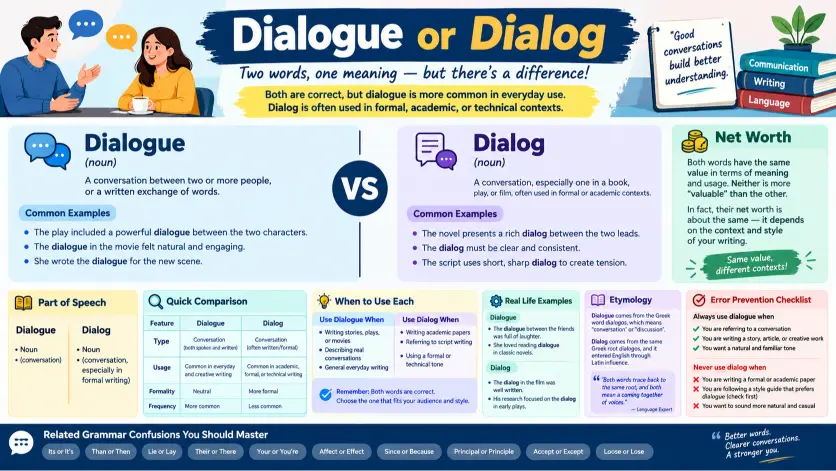
Have you ever paused while writing a story, essay, or professional email because you were unsure whether to use dialogue or dialog? You are not alone. Both spellings are correct, and they share the same basic meaning: a conversation between two or more people or the written representation of that conversation. However, their usage can vary depending on regional spelling preferences, writing conventions, and context. Understanding these differences can help you write more confidently and avoid unnecessary spelling corrections.
The main distinction between dialogue or dialog is often regional rather than grammatical. Dialogue is the standard spelling in British English and is also widely used in American English, particularly in literature, screenwriting, and discussions about communication. Dialog is an accepted alternative, especially in American English, and appears frequently in computing, software interfaces, and technical documentation. Although the two forms are generally interchangeable, consistency matters when following a publication’s style guide or an organization’s writing standards.
In this guide, you will learn what both words mean, how they differ in everyday and professional writing, and when each spelling is most appropriate. Clear sentence examples, practical comparisons, and simple memory tips will help you recognize the preferred form for your audience. Whether you are a student, author, content writer, or English learner, understanding these spelling conventions will make your writing more accurate and consistent. By the end, you will be able to choose dialogue or dialog with confidence and explain why your choice fits the context.
Dialogue vs Dialog: What’s the Difference?
The difference between dialogue and dialog is primarily regional and stylistic rather than grammatical. Both words refer to a conversation, an exchange of ideas, or spoken lines in a literary or dramatic work. However, their preferred spelling varies according to national conventions and professional contexts.
In British English, dialogue is the standard spelling. Similarly, many international publications, academic institutions, and publishers use dialogue regardless of their location. In American English, both forms exist, although dialogue remains common in ordinary writing. Meanwhile, dialog appears frequently in computing terminology, software interfaces, and technical documentation.
Definition of Dialogue
Dialogue (noun): Dialogue refers to a conversation between two or more people, an exchange of opinions, or the spoken words exchanged by characters in a book, play, screenplay, or other narrative.
For example, “The dialogue between the characters reveals their conflicting motivations.”
Furthermore, dialogue can describe constructive communication between groups with different perspectives. For instance, “The community leaders opened a dialogue about improving public services.”
Therefore, the term applies to both literal conversations and broader exchanges of ideas.
Definition of Dialog
Dialog (noun): Dialog has the same fundamental meaning as dialogue. It describes a conversation or exchange of ideas, although its shorter spelling is especially familiar in American computing and software development.
For example, “The application displays a confirmation dialog before deleting a file.”
Similarly, a developer might write, “The dialog allows users to change their account settings.”
Consequently, dialog is a legitimate spelling rather than a misspelling. Nevertheless, writers should consider their intended audience and the conventions of their field before selecting it.
Comparison Table
| Feature | Dialogue | Dialog |
|---|---|---|
| Part of speech | Noun | Noun |
| Core meaning | Conversation or exchange of ideas | Conversation or exchange of ideas |
| British English | Standard spelling | Less common |
| American English | Common and widely accepted | Common in computing contexts |
| Creative writing | Preferred by most general style guides | Less common in literary prose |
| Software terminology | Used in general technical writing | Frequently used for interface elements |
| Pronunciation | Usually /ˈdaɪəlɒɡ/ or /ˈdaɪəlɔːɡ/ | Usually the same regional pronunciation |
| Example | The dialogue feels realistic. | The dialog box displays an error. |
Quick Recap
Dialogue and dialog share the same basic meaning.
Dialogue is the usual choice in British English and general prose.
Dialog is especially common in American software terminology.
Neither spelling is inherently incorrect.
Ultimately, audience expectations and consistency determine the best choice.
Is Dialogue vs Dialog a Grammar, Vocabulary, or Usage Issue?
The distinction between dialogue and dialog is primarily a spelling and usage issue. Both forms are nouns, and both follow standard grammatical patterns. The choice doesn’t normally change the meaning of a sentence, although it may affect how closely the writing follows a particular style guide.
Are Dialogue and Dialog Interchangeable?
Generally, yes. Both words can describe a conversation, an exchange of ideas, or spoken exchanges between characters. Therefore, either spelling may communicate the intended meaning.
For example:
“The dialogue between the researchers continued for an hour.”
“The dialog between the researchers continued for an hour.”
Both sentences are understandable and grammatically correct. However, a publication may require one spelling throughout its content.
In software documentation, dialog may be preferred when referring to a specific interface component. In contrast, dialogue is often more natural when discussing conversations between people or characters.
Formal and Informal Usage
Both forms appear in formal and informal communication. Nevertheless, dialogue is generally the safer choice for essays, reports, books, journalism, and professional correspondence when no specific spelling preference has been established.
Meanwhile, dialog frequently appears in technical writing, programming discussions, and software development environments.
For example, a business report might describe dialogue between department managers. A technical manual, however, could explain how to close a dialog box.
Although these preferences aren’t absolute rules, following the conventions of the intended audience improves consistency.
Academic and Casual Writing
In academic writing, dialogue is commonly used in discussions of literature, communication, education, politics, and social research. For example, a literary analysis might examine dialogue to understand a character’s personality.
In American computing courses, dialog may appear in discussions of graphical user interfaces, programming libraries, and application design. Nevertheless, academic institutions can establish their own preferred spelling.
In casual conversation, either spelling is acceptable when the intended meaning is clear. However, writers should avoid alternating between the two forms without a reason.
Practical Usage: When to Use Dialogue
Choose dialogue when writing about conversations, communication, fictional speech, or exchanges of ideas. Additionally, this spelling is a strong default for general prose, especially when addressing an international audience or following British English conventions.
1. Workplace Example
In business communication, dialogue often describes constructive discussion between colleagues, managers, customers, or organizational groups.
Example: “Open dialogue between employees and management can help resolve misunderstandings.”
Similarly, a project report might state, “The team encouraged dialogue before finalizing the new policy.”
In both examples, the word emphasizes communication rather than a particular software feature.
2. Academic Example
In literary studies, dialogue refers to the spoken exchanges between characters in a written or performed work.
Example: “The author’s dialogue reveals the protagonist’s growing uncertainty.”
Likewise, researchers studying conflict resolution might examine how dialogue supports cooperation between groups.
Example: “The study explored the role of dialogue in resolving disagreements among community members.”
Consequently, dialogue works naturally across many academic disciplines.
3. Technology Example
Although dialog is common in software terminology, dialogue can also appear in general technical explanations.
Example: “The training application encourages dialogue between students and instructors.”
Another example is, “The digital platform supports dialogue during collaborative learning activities.”
Here, the word describes communication between people using technology rather than a graphical interface element.
Usage Recap
Use dialogue for ordinary conversations, literary speech, collaborative communication, and general informational writing. When in doubt, this spelling is a dependable choice outside contexts with established terminology.
Practical Usage: When to Use Dialog
Choose dialog when the shorter spelling fits the conventions of your document, especially in American computing and software development. Although it can describe a conversation, it is particularly familiar when referring to a graphical interface element.
1. Workplace Example
In a software company, technical documentation might describe how an application asks users to confirm an action.
Example: “The dialog displays a warning before the account is permanently deleted.”
Similarly, a developer’s instructions might say, “Select Save in the settings dialog to apply your changes.”
These examples use dialog to identify an interface component.
2. Academic Example
In a computer science course, students might learn about the design of interface components.
Example: “The assignment requires students to create a dialog that collects user preferences.”
Likewise, a research paper about user experience might discuss the effectiveness of dialog windows in guiding users through complex tasks.
Example: “The researchers compared two dialog designs to determine which offered clearer instructions.”
However, academic writing about conversations between literary characters would usually favor dialogue.
3. Technology Example
In programming, dialog commonly appears in the names of software components, methods, classes, and interface features.
Example: “The application opens a file selection dialog when the user clicks Import.”
Similarly, a developer might document a confirmation dialog that appears before a sensitive operation.
Nevertheless, exact terminology depends on the programming language, platform, or framework. Some environments use Dialog in component names, while others use different naming conventions.
Usage Recap
Use dialog when it matches American computing terminology, software documentation, or a project’s established style. For ordinary conversation and creative writing, dialogue is generally the more familiar choice.
When You Should NOT Use Dialogue or Dialog
Although the two spellings share a meaning, several situations require extra care. Consider the following common mistakes before choosing either form.
- Don’t assume dialog is always incorrect. It is an accepted spelling, particularly in American technical writing.
- Don’t assume dialogue is exclusively British. American writers also use dialogue extensively in literature, journalism, education, and general prose.
- Don’t switch spellings randomly. A document that uses dialogue in one section and dialog in another may appear inconsistent unless the difference reflects established terminology.
- Don’t confuse dialogue with a monologue. Dialogue involves an exchange between participants, whereas a monologue is an extended speech by one speaker.
- Don’t use either word when you mean debate without considering context. Dialogue emphasizes communication and exchange, while debate often involves presenting competing arguments.
- Don’t replace an established software term without checking the documentation. If a programming framework calls a component Dialog, preserve that official spelling in relevant technical explanations.
- Don’t confuse dialogue with direct quotation alone. Dialogue refers to the exchange of speech, while a quotation reproduces someone’s exact words.
- Don’t treat the shorter spelling as an automatic improvement. Concision matters in writing, but consistency, clarity, and audience expectations matter more.
By considering the purpose of the sentence, you can select a spelling that fits both its meaning and its context.
Common Mistakes and Decision Rules
The following table illustrates how both forms can be used correctly and how unrelated terms can create confusion.
| Correct sentence | Incorrect or unsuitable sentence | Explanation |
|---|---|---|
| The dialogue between the characters is convincing. | The dialog between the characters is always wrong. | Dialog is an accepted spelling, although dialogue is more usual in general prose. |
| The application opens a confirmation dialog. | The application opens a confirmation dialogue, even though its required component name is Dialog. | Preserve exact platform or project terminology when it is specified. |
| The students began a dialogue about climate policy. | The students began a monologue about climate policy, when several people exchanged views. | A monologue is an extended speech by one speaker. |
| The author improved the dialogue in the novel. | The author improved the debate in the novel, when the intended meaning is simply the characters’ speech. | Debate implies competing arguments rather than conversation in general. |
| The settings dialog contains three options. | The settings dialog box contains three options, but the style guide prohibits the term “dialog box.” | Follow the terminology required by the applicable style guide. |
| The two communities started a dialogue. | The two communities started a dialog in a British English document requiring British spelling. | Dialogue is the conventional choice under that spelling preference. |
A Simple Decision Rule
If you mean a conversation, an exchange of ideas, or the spoken words of characters, use dialogue as your default.
If you mean a software interface component and the relevant American technical convention uses dialog, choose dialog.
This is a practical guideline rather than an absolute grammatical rule. Since both spellings are accepted, the intended audience and the document’s style requirements should determine the final choice.
Dialogue and Dialog in Modern Technology and Digital Tools
Technology has helped make the distinction between dialogue and dialog more visible. In everyday writing, dialogue usually describes communication between people. In software development, however, dialog frequently names an interface element that prompts users to enter information, select an option, or confirm an action.
For example, a confirmation dialog might ask whether a user wants to discard unsaved changes. Similarly, a file selection dialog can help someone locate a document.
Nevertheless, terminology varies between platforms and programming frameworks. Some use Dialog as a component name, while others prefer different labels. Therefore, developers should consult the documentation for their chosen environment rather than assuming that every interface follows the same convention.
Meanwhile, dialogue remains appropriate when describing communication through messaging applications, collaborative platforms, educational systems, or virtual meetings.
The essential distinction is contextual: dialogue is widely used for human communication, whereas dialog is particularly familiar as a technical label in American computing.
Etymology: Where Do Dialogue and Dialog Come From?
The word dialogue comes through French from Greek dialogos, which refers to conversation or discourse. Its historical components are associated with the exchange of speech and ideas. Over time, dialogue became established in English as a term for conversations, dramatic speech, and intellectual discussion.
The shorter form dialog developed as a variant spelling. English has several examples of words that possess shortened American variants, although their popularity and use differ by context.
In computing, dialog became particularly familiar through software terminology. Developers adopted the spelling for interface components that present information or request user input. As a result, the shorter form became common in technical environments even while dialogue remained widespread elsewhere.
Therefore, the difference between these spellings reflects linguistic history, regional preference, and specialized usage rather than a change in fundamental meaning.
An Expert Perspective on Choosing the Correct Spelling
A useful editorial principle is to distinguish between an accepted spelling variant and an actual spelling error.
“Consistency is more important than choosing the longer or shorter form when both spellings are accepted.”
This is a general editorial guideline, not a quotation attributed to a specific linguist.
For example, a British publication may consistently use dialogue throughout its articles. Meanwhile, an American software manual may use dialog when referring to interface components. Both approaches can be appropriate because each follows an identifiable convention.
However, alternating between the spellings without considering context can distract readers. Therefore, writers should establish a spelling preference before preparing a long document and apply it consistently.
When quoting a source, naming a software component, or following a required style guide, preserve the spelling demanded by that context.
Two Practical Case Studies
The following illustrative case studies demonstrate how spelling choices can improve consistency and technical clarity. They are examples for instruction, not independently measured research findings.
Case Study 1: Editing an International Business Report
A company prepares a report about communication between its regional offices. The original draft alternates between dialogue and dialog across different sections.
For example, one paragraph refers to “open dialogue between departments,” while another describes “constructive dialog between managers.”
Although both spellings are valid, the inconsistent presentation may distract readers. The editor adopts dialogue as the document’s standard spelling because the report addresses an international audience and discusses human communication rather than software components.
The revised document uses dialogue consistently in headings, body paragraphs, and summaries.
Result: The report follows a clear editorial convention, reducing unnecessary spelling variation and making the text more polished.
Case Study 2: Preparing American Software Documentation
A development team writes instructions for an application that displays confirmation windows. Its technical specification uses the term Dialog for the relevant interface component.
Initially, the documentation alternates between dialog, dialogue, and dialog box. However, the team reviews the component terminology and selects the form required by its project documentation.
The revised instructions explain how to open the confirmation dialog, review its options, and select the appropriate response.
Result: The documentation uses consistent component terminology, making it easier for developers and users to connect the instructions with the actual interface.
Error Prevention Checklist
Before submitting a report, essay, technical manual, or article, review the following points.
Always Use Dialogue When
- Writing about conversations between people.
- Describing exchanges between characters in a novel or play.
- Discussing constructive communication between groups.
- Preparing general prose for an international audience.
- Following a publication’s requirement to use the conventional full spelling.
Never Use Dialog When
- A required style guide explicitly mandates dialogue.
- You’re changing an official component name that must remain exact.
- You’re using the shorter spelling simply because you assume it is always more professional.
- You’re discussing a conversation but have accidentally introduced inconsistent spelling without a contextual reason.
Check Before Publishing
- Confirm the preferred spelling for the intended audience.
- Review the publication’s editorial guidelines.
- Preserve official terminology in technical documentation.
- Apply one spelling consistently within each relevant context.
- Distinguish dialogue from related terms such as monologue, discussion, and debate.
These checks help maintain clarity without incorrectly treating an accepted variant as a spelling mistake.
Related Grammar Confusions You Should Master
Learning other commonly confused words can strengthen your vocabulary and improve editorial accuracy.
- Practice vs practise: In British English, practice is generally a noun, while practise is a verb. American English uses practice for both functions.
- Color vs colour: Color is standard in American English, whereas colour is conventional in British English and several other varieties.
- Center vs centre: Center is the American spelling, while centre is standard in British English.
- Organize vs organise: Organize is standard in American English. Both organize and organise occur in other varieties, depending on the applicable spelling convention.
- Program vs programme: Program is standard in American English and computing. Programme is common in British English for many noncomputing meanings.
- License vs licence: In British English, license is generally the verb and licence is the noun. American English uses license for both.
- Affect vs effect: Affect is usually a verb meaning to influence, whereas effect is usually a noun meaning a result.
- Compliment vs complement: A compliment expresses praise, while a complement completes or enhances something.
- Their vs there: Their indicates possession, whereas there refers to a place or appears in certain grammatical constructions.
- Monologue vs dialogue: A monologue is an extended speech by one speaker, while dialogue involves an exchange between participants.
By understanding regional spelling patterns and differences in meaning, writers can make more confident vocabulary choices.
Frequently Asked Questions
1. What is the difference between dialogue and dialog?
Dialogue and dialog are accepted spellings of the same noun. Both refer to conversations or exchanges of ideas. Dialogue is the conventional spelling in British English and general prose, whereas dialog is especially common in American computing terminology.
2. Is dialog grammatically correct?
Yes. Dialog is a recognized English spelling, not a grammatical error. It is especially familiar in American software development and technical documentation. Nevertheless, dialogue may be preferable when a publication follows British spelling conventions or uses the traditional form in general prose.
3. Should I use dialogue or dialog in American English?
Both forms are acceptable in American English. Dialogue is widely used in books, journalism, academic writing, and everyday communication. Dialog is particularly common when referring to software interface components. Therefore, follow the style guide and context of your document.
4. Is dialogue the British spelling and dialog the American spelling?
That distinction is useful but incomplete. Dialogue is standard in British English, while dialog is common in American computing. However, dialogue is also widely accepted in the United States, so the two forms don’t divide neatly along national boundaries.
5. Why do computers use the term dialog box?
The term dialog box describes an interface window that displays information or requests user input. The shorter spelling became common in American computing terminology. However, software platforms and frameworks may use different names for similar components.
6. Is dialog a misspelling of dialogue?
No. Dialog is an accepted variant spelling. It isn’t inherently incorrect, although a particular editor, teacher, publisher, or style guide may require dialogue. The appropriate choice depends on the context and the relevant spelling convention.
7. Should I write dialogue or dialog in an academic essay?
For an essay discussing literature, communication, or social issues, dialogue is generally a dependable choice. However, a computer science paper may use dialog when discussing interface components. Always check your institution’s style requirements before submitting the work.
8. What is the plural of dialogue or dialog?
The standard plurals are dialogues and dialogs, respectively. Both follow ordinary English pluralization rules. For example, “The play contains several memorable dialogues” and “The application displays multiple dialogs” are both grammatically possible in their appropriate contexts.
9. Can dialogue refer to communication between groups?
Yes. Dialogue can describe an exchange of ideas between individuals, organizations, communities, or political groups. For example, “The initiative encouraged dialogue between local residents and public officials.” In this context, the word emphasizes communication and mutual understanding.
Conclusion:
Choosing between dialogue and dialog is easier when you understand that both are accepted spellings with the same fundamental meaning. Dialogue remains the most dependable choice for general writing, literary discussions, academic essays, and communication between people. By contrast, dialog is particularly familiar in American computing and software documentation.
However, neither spelling is universally superior. The right choice depends on the intended audience, the subject matter, and any applicable style guide. Therefore, select the form that suits your context and maintain consistency throughout your document.
Ultimately, remember this simple principle: use dialogue as your general default, and choose dialog when it matches an established technical convention or editorial requirement. With that distinction in mind, you can write confidently and avoid unnecessary spelling confusion.









