Have you ever experienced a period when opportunities, money, or work seemed to arrive in abundance, only to find yourself facing a sudden shortage later? This familiar pattern is captured by the expression feast or famine. It describes a situation in which people experience either plenty of something or very little of it, with few comfortable periods in between. From unpredictable workloads to fluctuating income, this phrase helps explain why some situations feel inconsistent and difficult to manage. Although it sounds simple, its meaning goes beyond food and reflects a common pattern in everyday life.
The phrase feast or famine is commonly used in conversations about business, freelancing, employment, finances, and the availability of resources. For example, a freelance writer might have several projects to complete one month and struggle to find clients the next. Similarly, a seasonal business may experience overwhelming demand during busy periods and very few sales during quieter months. In both cases, the expression highlights the contrast between abundance and scarcity. Understanding this distinction makes it easier to recognize the phrase in conversations, articles, professional discussions, and other forms of writing.
In this guide, you will learn the meaning of feast or famine, explore its origins, and discover how to use it naturally in different contexts. You will also find practical sentence examples, related expressions, and guidance on avoiding common usage mistakes. The explanations follow standard English usage and illustrate how context shapes the meaning of an idiom. Whether you are an English learner, a student, a freelancer, or a professional, this guide will help you understand the expression and use it confidently in everyday communication.
Feast or Famine: What’s the Difference?
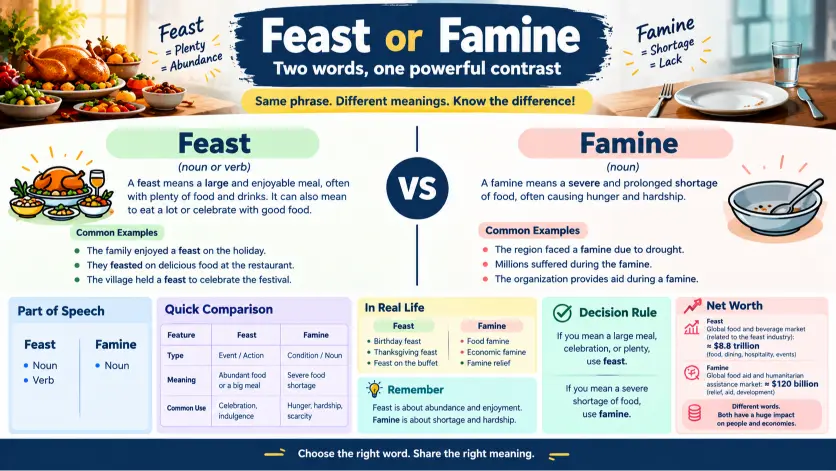
Unlike two commonly confused words with different spellings, feast and famine are separate words that combine to create a meaningful expression. A feast represents an abundant supply of food or an occasion involving plentiful eating. Conversely, a famine refers to an extreme shortage of food that affects a population.
When used together, the expression describes an unpredictable pattern of extremes. For instance, a freelance designer might experience several weeks of overwhelming client requests followed by a month without paid assignments. This situation illustrates the meaning of feast or famine.
Definitions and Parts of Speech
Feast (noun and verb): As a noun, feast refers to a large, elaborate meal or an abundance of something enjoyable. As a verb, it means to eat lavishly or enjoy something in great quantity.
Example: “The family prepared a feast to celebrate the wedding.”
Famine (noun): Famine describes an extreme and prolonged shortage of food affecting a large population. More broadly, the word sometimes appears figuratively to describe a severe lack of something necessary or desirable.
Example: “The region suffered a famine after several years of drought.”
Feast or famine (idiom): This expression describes alternating periods of abundance and scarcity, often involving work, money, demand, opportunities, or resources.
Example: “Freelance photography can be a feast or famine business.”
Comparison Table
| Feature | Feast | Famine | Feast or famine |
|---|---|---|---|
| Part of speech | Noun or verb | Noun | Idiomatic expression |
| Main meaning | Abundance or a large meal | Severe food shortage | Alternating abundance and scarcity |
| Common context | Celebrations and plentiful supplies | Hunger and food insecurity | Unpredictable circumstances |
| Example | We enjoyed a feast. | The drought caused famine. | Orders arrive in a feast or famine pattern. |
| Emotional association | Usually positive | Usually negative | Often describes uncertainty |
Quick Recap
Feast means abundance, while famine means an extreme shortage of food.
Together, feast or famine describes a pattern of having either plenty or very little.
The expression often refers to unpredictable work, income, demand, or opportunities.
Therefore, use it when describing extremes rather than a stable, predictable situation.
Is Feast or Famine a Grammar, Vocabulary, or Usage Issue?
Understanding feast or famine is primarily a matter of vocabulary and idiomatic usage. The expression combines two contrasting concepts to communicate a broader idea. Although the individual words have their own grammatical functions, their combined meaning extends beyond a literal description of food.
Are Feast and Famine Interchangeable?
No. Feast and famine have opposing meanings, so substituting one for the other changes the message.
For example, “The restaurant prepared a feast” describes an abundant meal. However, “The restaurant experienced a famine” suggests an extreme shortage of food, which communicates a very different situation.
When combined idiomatically, the expression emphasizes alternating extremes. Therefore, it doesn’t simply mean abundance or scarcity alone.
Formal and Informal Usage
The expression is widely understood in both professional and casual communication. Nevertheless, its suitability depends on the audience and context.
In a business meeting, a manager might explain that sales follow a feast or famine pattern. Similarly, a freelancer might use the phrase informally to describe inconsistent assignments.
For highly formal research, however, terms such as “cyclical fluctuations,” “irregular demand,” or “alternating periods of abundance and scarcity” may offer greater precision.
Academic and Everyday Usage
In academic writing, the expression can illustrate unpredictable patterns in economics, employment, agriculture, or resource distribution. Nevertheless, researchers should define the phrase when technical precision is important.
In everyday conversation, the idiom sounds natural and concise. For example, someone might say, “It’s feast or famine with invitations this month,” meaning social invitations are either plentiful or almost nonexistent.
Consequently, the expression works across many settings, provided its figurative meaning is clear.
Practical Usage: When to Use Feast or Famine
Use feast or famine when circumstances swing between abundance and scarcity. In particular, the expression is useful when describing irregular workloads, unstable income, changing customer demand, or inconsistent access to opportunities.
1. Workplace Examples
Freelancers, contractors, sales professionals, and seasonal workers may experience unpredictable workloads. During busy periods, they might struggle to complete every assignment. Later, however, they may have little paid work available.
Example: “Our consulting business often experiences a feast or famine cycle, with several major projects arriving together and then weeks of limited demand.”
Similarly, a salesperson might describe an inconsistent customer pipeline using the same phrase.
Example: “Without a reliable lead generation process, the sales team faces feast or famine conditions.”
In both examples, the expression emphasizes inconsistency rather than a permanent shortage.
2. Academic Examples
Researchers can use the idiom when explaining unstable access to funding, research opportunities, or resources. However, they should clarify the meaning if the expression appears in a formal argument.
Example: “Early career researchers sometimes describe grant funding as a feast or famine environment.”
Likewise, an agricultural study might discuss alternating periods of abundant harvests and severe shortages. In that case, the idiom can summarize the pattern, although precise terms may be preferable when describing actual food insecurity.
Example: “The community experienced a feast or famine pattern as harvest yields fluctuated between favorable and poor seasons.”
3. Technology Examples
Technology businesses may experience uneven demand for services, software development, or computing resources. For example, an independent developer could receive several urgent projects simultaneously and then struggle to find new clients.
Example: “The freelance development market can feel like feast or famine when project requests arrive unpredictably.”
Similarly, an online retailer might face overwhelming orders during a promotional campaign followed by a quiet period.
Example: “The store’s seasonal traffic created a feast or famine pattern in customer support requests.”
Usage Recap
Use the idiom to describe unpredictable swings between plenty and scarcity. Moreover, choose a more precise expression when the situation involves measurable economic changes, serious food shortages, or technical research.
Practical Usage: Understanding Feast and Famine Separately
Although the complete idiom communicates a pattern of extremes, understanding each component helps you use it accurately.
1. Feast in the Workplace
Feast can describe an abundance of assignments, opportunities, or available resources when used figuratively.
Example: “The recruitment agency had a feast of new vacancies after several companies expanded their operations.”
Here, feast emphasizes plentiful opportunities rather than a literal meal.
2. Famine in Academic Writing
Famine has a serious literal meaning involving extreme food scarcity. Consequently, writers should avoid using the term casually when discussing actual hunger or humanitarian emergencies.
Example: “Prolonged drought and conflict contributed to famine in the affected region.”
The word can also describe a severe lack figuratively, although alternatives such as “shortage” may be more precise.
Example: “The department faced a famine of research funding.”
3. Feast or Famine in Technology
Technology professionals often use the complete idiom to describe irregular workloads or changing demand.
Example: “The software consultancy experienced feast or famine conditions because its client projects were poorly distributed throughout the year.”
However, technical reports should distinguish between a figurative description of business activity and actual resource constraints.
Usage Recap
Feast communicates plenty, whereas famine denotes severe food scarcity. Together, the expression describes alternating extremes, especially when a situation lacks consistency.
When You Should NOT Use Feast or Famine
Although this idiom is useful, it isn’t appropriate for every situation. Therefore, consider these common mistakes before including it in a sentence.
- When describing abundance alone: If a company consistently receives many orders, describe demand as strong rather than calling the situation feast or famine.
- When describing scarcity alone: If supplies remain limited without alternating periods of abundance, use “shortage” or “scarcity” instead.
- When discussing an actual famine: Don’t treat a humanitarian crisis as a casual metaphor. Describe the circumstances accurately and respectfully.
- When the pattern is predictable and stable: A business with steady seasonal demand may not experience the uncertainty suggested by the idiom.
- When technical precision is essential: In an academic report, “volatile demand” or “irregular income” may communicate the issue more precisely.
- When only one isolated event occurs: A single busy day followed by a normal day doesn’t necessarily establish a recurring feast or famine pattern.
- When writing for an unfamiliar audience: If readers might interpret the phrase literally, explain its figurative meaning.
- When describing a consistent surplus: Use “abundance” or “plentiful supply” if resources remain available without periods of scarcity.
Ultimately, the expression is most effective when a genuine contrast exists between having plenty and having very little.
Common Mistakes and Decision Rules
Writers sometimes use feast or famine too broadly, particularly when discussing business performance or personal finances. The following table demonstrates how to improve accuracy.
| Correct sentence | Incorrect sentence | Explanation |
|---|---|---|
| Freelance work can be feast or famine. | Freelance work can be feast or plenty. | The idiom contrasts abundance with scarcity. |
| Our sales follow a feast or famine pattern. | Our sales follow a feast and famine pattern. | The established expression uses “or” to emphasize alternatives. |
| The company experienced feast or famine conditions. | The company experienced a feast or famine of conditions. | The second construction is awkward in this context. |
| The restaurant prepared a feast. | The restaurant prepared a famine. | A feast is a plentiful meal, while famine means severe food scarcity. |
| Demand fluctuates between abundance and scarcity. | Demand is feast or famine every day. | The second sentence may be misleading if demand doesn’t actually fluctuate. |
| The freelancer experienced alternating periods of busy and quiet work. | The freelancer experienced a feast of famine. | The established idiom is “feast or famine.” |
A Simple Decision Rule
If you mean a situation with alternating periods of plenty and scarcity, use feast or famine.
If you mean abundance alone, use feast or abundance. If you mean a serious shortage of food, use famine.
For example, a business that receives a flood of orders followed by weeks without customers may experience feast or famine conditions. By contrast, a company with consistently high demand simply has abundant business.
This distinction prevents unnecessary exaggeration and helps readers understand the exact situation.
Feast or Famine in Modern Technology and Digital Work
Modern digital work offers many examples of feast or famine conditions. Freelancers may receive multiple project invitations after publishing a successful portfolio, only to experience a quiet period later. Similarly, online retailers can experience intense demand during major sales events followed by slower trading.
Automated scheduling systems, customer relationship management software, and financial planning applications can help organizations identify these fluctuations. Nevertheless, such tools don’t automatically eliminate inconsistent demand. Businesses still need reliable forecasting, diversified customer relationships, and realistic resource planning.
For example, a software developer might track incoming project requests and compare them with monthly revenue. By identifying recurring busy and quiet periods, the developer can build a more dependable schedule and maintain an appropriate financial reserve.
Therefore, feast or famine remains a useful expression for describing the uneven opportunities that can accompany independent work and rapidly changing digital markets.
Etymology: Where Does Feast or Famine Come From?
The words feast and famine have different historical roots, which helps explain their contrasting meanings.
Feast entered English through Old French, ultimately deriving from Latin festum, meaning a festival or celebration. Over time, its meaning became closely associated with celebratory meals and plentiful food. Today, it can also describe an abundance of nonfood items or experiences.
Famine came into English through Old French famine, with roots in Latin fames, meaning hunger. The word developed to describe severe food shortages and widespread hunger.
The combined expression draws on these contrasting ideas: a feast suggests plenty, whereas famine suggests deprivation. Consequently, the idiom provides a vivid way to describe situations that swing between extremes.
Although its exact first use as an idiom isn’t established here, its meaning follows naturally from the contrast between the two words.
An Expert Perspective on Feast or Famine
A useful principle in clear writing is to match the strength of an expression to the circumstances being described.
“Describe the pattern, not just the extremes: feast or famine is most useful when abundance and scarcity repeatedly alternate.”
This is an editorial guideline rather than a quotation attributed to a specific researcher. It highlights the importance of context when using idioms.
For instance, a freelancer who alternates between fully booked months and periods without assignments may reasonably describe the experience as feast or famine. However, someone who has simply enjoyed one successful month should avoid implying a recurring cycle without supporting evidence.
In other words, accurate context makes the expression more informative and credible.
Two Practical Case Studies
The following illustrative scenarios demonstrate how the idiom can clarify real world situations. They are teaching examples, not independently verified research findings.
Case Study 1: A Freelance Designer’s Irregular Income
A freelance graphic designer receives several large assignments during one month. Because the deadlines overlap, the designer works long hours and postpones other activities. During the following month, however, new inquiries decline sharply, creating concern about upcoming expenses.
Initially, the designer describes the situation as “a busy month followed by a quiet month.” While accurate, this description doesn’t fully capture the recurring uncertainty.
A clearer summary is: “My freelance business follows a feast or famine pattern because client projects arrive in unpredictable waves.”
The designer then reviews previous invoices, records seasonal trends, and sets aside a portion of income during profitable periods.
Result: The expression summarizes the workload pattern, while financial planning provides a practical response to its unpredictability.
Case Study 2: A Small Online Retailer
A small online retailer experiences a surge in orders during holiday promotions. As a result, the customer support team struggles to respond promptly, and temporary staffing becomes necessary. After the promotional period ends, order volume drops, leaving the company with more support capacity than it needs.
The owner describes the business as experiencing feast or famine demand. However, the team also needs specific information to make staffing decisions.
Therefore, the retailer compares weekly orders, support requests, and promotional dates. This information helps the business prepare staffing schedules for anticipated busy periods while adjusting capacity during quieter weeks.
Result: The idiom communicates the broader problem, while tracking demand provides information for operational planning.
Error Prevention Checklist
Before using the expression, review these practical guidelines.
Always Use Feast or Famine When
- Describing alternating periods of abundance and scarcity.
- Explaining unpredictable freelance workloads.
- Discussing inconsistent income or irregular customer demand.
- Summarizing fluctuating access to projects or opportunities.
- Referring to a pattern in which having plenty is followed by having very little.
Never Use Famine When
- You mean an ordinary quiet period with few customers.
- You’re describing a temporary decline that doesn’t involve severe food scarcity and would be clearer as a shortage.
- You want to describe talent, creativity, or a person’s distinctive style.
- The situation involves stable, predictable conditions rather than extremes.
Check Before Publishing
- Confirm that the circumstances genuinely alternate between plenty and scarcity.
- Decide whether the context is literal or figurative.
- Avoid exaggerating minor fluctuations.
- Use precise terms in technical and academic reports.
- Explain the expression if readers may not recognize it.
With these checks, you can use the idiom naturally without losing accuracy.
Related Grammar Confusions You Should Master
Learning other commonly confused expressions can strengthen your vocabulary and improve sentence clarity.
- Bane vs boon: Bane refers to a source of trouble, whereas boon means a benefit.
- Boom vs bust: Boom describes rapid growth or prosperity, while bust refers to a collapse or downturn.
- Surplus vs shortage: Surplus means more than is needed, whereas shortage means less than is required.
- Scarcity vs abundance: Scarcity indicates limited availability, while abundance means plentiful supply.
- Continuous vs continual: Continuous means uninterrupted, while continual generally describes something recurring frequently.
- Economic vs economical: Economic relates to the economy, while economical means efficient or inexpensive.
- Affect vs effect: Affect usually means to influence, whereas effect usually refers to a result.
- Fewer vs less: Fewer is generally used with countable items, while less is commonly used with uncountable quantities.
- Between vs among: Between often refers to distinct individual relationships, while among commonly refers to a group.
- Eminent vs imminent: Eminent means distinguished, whereas imminent means about to happen.
These distinctions help writers select words according to meaning rather than relying on sound or familiarity alone.
Frequently Asked Questions
1. What does feast or famine mean?
Feast or famine describes a situation in which abundance alternates with scarcity. The expression commonly refers to unpredictable workloads, irregular income, fluctuating customer demand, or inconsistent opportunities. It can be used in professional conversations as well as everyday speech.
2. Is feast or famine a positive or negative expression?
The idiom is generally neutral in meaning, although it often describes an undesirable lack of stability. Abundant periods can be positive, but the following shortages may create financial pressure, uncertainty, or operational difficulties.
3. How do you use feast or famine in a sentence?
You can write, “Freelance photography is often feast or famine, with several bookings arriving together and then weeks without new assignments.” This sentence illustrates alternating periods of abundance and scarcity.
4. Is feast or famine an idiom?
Yes. Feast or famine is an idiomatic expression because its combined meaning extends beyond a literal meal and a food shortage. It commonly describes situations in which resources, income, or opportunities fluctuate between extremes.
5. What is an example of feast or famine in business?
A small business may receive a large number of customer orders during a promotion but experience very few sales afterward. This irregular pattern can be described as feast or famine because demand alternates between busy and quiet periods.
6. What is the opposite of feast or famine?
Depending on the context, possible alternatives include stability, consistency, steady demand, predictable income, and balanced supply. These expressions describe situations without dramatic swings between abundance and scarcity.
7. Why do freelancers experience feast or famine cycles?
Freelancers may experience these cycles because projects arrive irregularly, clients have changing budgets, and some industries are seasonal. Additionally, limited marketing activity or dependence on a small number of clients can make workloads less predictable.
8. Can feast or famine describe emotions?
Yes, although it is more commonly used for resources, opportunities, and business activity. In an appropriate context, it can describe alternating periods of emotional intensity and relative calm. However, a more precise description may be preferable when discussing personal feelings.
9. Is feast or famine appropriate for formal writing?
Yes, when the audience understands the expression and its meaning suits the context. Nevertheless, academic and technical documents may benefit from precise alternatives such as “alternating periods of abundance and scarcity” or “fluctuating demand.”
Conclusion:
Feast or famine describes a pattern in which abundance and scarcity alternate, often creating uncertainty. Although the expression originates from contrasting ideas about plentiful food and severe hunger, it now applies widely to income, work, customer demand, and available opportunities.
For example, a freelancer who enjoys a month full of assignments followed by a period without clients may experience feast or famine conditions. Similarly, a retailer whose orders rise sharply during promotions and then decline may use the idiom to describe changing demand.
However, the expression shouldn’t be used for every increase or decrease. Instead, reserve it for situations involving a meaningful contrast between having plenty and having very little.
Ultimately, understanding the context helps you communicate the pattern accurately. Whether you’re writing a business report, explaining freelance challenges, or describing changing opportunities, feast or famine offers a concise and memorable way to express instability.









