Have you ever wondered whether to write recur or reoccur when describing something that happens again? These two English verbs look similar and share a common idea, so choosing between them can be confusing. Although both words can describe something happening again, they are not always used in exactly the same way. Understanding their meanings can help you communicate more clearly, avoid unnecessary repetition, and make better word choices in academic assignments, professional emails, and everyday conversations.
The main difference between recur and reoccur lies in their typical usage and emphasis. Recur often describes something that returns repeatedly or follows a recurring pattern, such as recurring headaches, familiar problems, or regular events. Reoccur emphasizes that something happens again after it has happened before, particularly when discussing a repeated incident or situation. However, their meanings overlap, and context often determines which word sounds more natural. Neither word is automatically incorrect simply because the other could also fit the sentence.
In this guide, you will explore the definitions of recur and reoccur, examine practical sentence examples, and learn how to distinguish their meanings with confidence. The explanations focus on standard English usage and provide helpful comparisons for students, professionals, writers, and English learners. You will also discover common mistakes, useful memory techniques, and situations in which one word may be more suitable than the other. By the end, you will have a clearer understanding of how to choose the right word for your intended meaning.
Recur vs Reoccur: What’s the Difference?
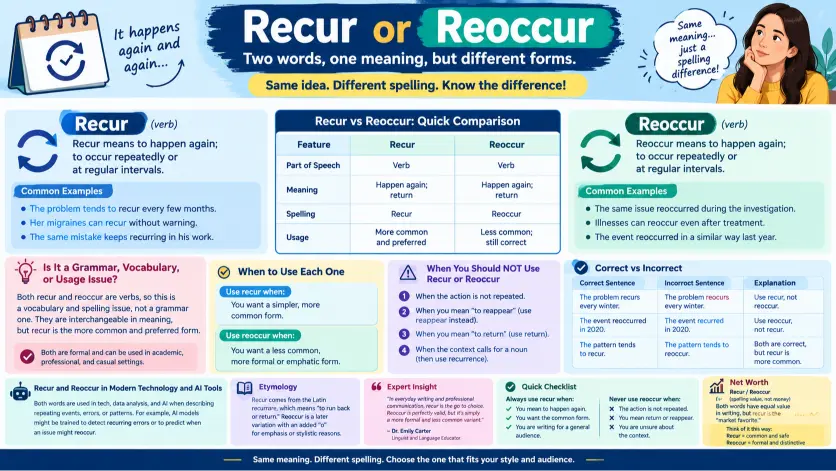
The main difference between recur and reoccur is the emphasis each verb places on repetition. Recur commonly describes something that returns repeatedly, follows a pattern, or happens at intervals. Reoccur generally means to happen again, often referring to a particular event that has already taken place.
For example, recurring headaches may return over time, whereas a technical problem may reoccur after someone has fixed it. Nevertheless, both words can describe repeated events, so context determines which expression sounds most natural.
Definitions and Parts of Speech
Recur (verb): Recur means to happen again, return, or appear repeatedly. It frequently describes patterns, recurring thoughts, symptoms, themes, and events that return over time.
Examples include recurring expenses, recurring dreams, and a problem that continues to return.
Reoccur (verb): Reoccur means to happen again after an earlier occurrence. It often emphasizes the repetition of a particular incident, mistake, malfunction, or event.
Examples include a reoccurring error, a reoccurring power outage, and a reoccurring incident at work.
Both verbs are grammatically correct. However, recur often emphasizes a pattern or repeated return, whereas reoccur can emphasize another occurrence of an earlier event.
Comparison Table
| Feature | Recur | Reoccur |
|---|---|---|
| Part of speech | Verb | Verb |
| Main meaning | To happen again or return repeatedly | To happen again |
| Typical emphasis | Repetition or a recurring pattern | Another occurrence of an event |
| Common expressions | Recurring theme, recurring expense | Reoccurring error, reoccurring incident |
| Formal usage | Common in academic and professional writing | Also acceptable in formal writing |
| Example | The same theme recurs throughout the novel. | The error may reoccur after the update. |
Quick Recap
Recur means to return or happen again, often as part of a pattern.
Reoccur means to happen again after a previous occurrence.
Both verbs are correct, and their meanings overlap.
Choose the word that best communicates whether you are emphasizing a recurring pattern or another instance of an event.
Is Recur vs Reoccur a Grammar, Vocabulary, or Usage Issue?
The distinction between recur and reoccur is primarily a vocabulary and usage issue. Both are standard English verbs, and neither is inherently grammatically incorrect. However, their meanings and typical contexts differ enough that choosing one over the other can make a sentence more precise.
Are Recur and Reoccur Interchangeable?
In many contexts, yes. Both words can describe something happening again. For example, “The problem may recur” and “The problem may reoccur” are both grammatically acceptable.
Nevertheless, recur often sounds more natural when describing an established pattern or something that repeatedly returns. By contrast, reoccur can be especially suitable when referring to another instance of a specific event.
Consider these examples:
“The same theme recurs throughout the book.”
“The same error may reoccur after the software update.”
The first sentence emphasizes a repeated theme across a work. Meanwhile, the second emphasizes another instance of a particular technical error.
Although the distinction is useful, it isn’t an absolute rule. Writers should consider context rather than treating the words as completely separate categories.
Formal and Informal Usage
Both words are acceptable in formal and informal English. However, recur frequently appears in professional reports, academic research, financial discussions, and descriptions of repeated patterns.
For instance, a manager might write, “Recurring delays have affected project delivery.”
Similarly, a technician might explain, “The fault could reoccur if the underlying cause remains unresolved.”
In casual conversation, someone might say, “That problem keeps recurring” or “I hope the issue doesn’t reoccur.” Both expressions sound natural.
Academic and Everyday Contexts
In academic writing, recur is particularly useful when discussing themes, historical patterns, research findings, and repeated observations.
For example, “The same cultural motif recurs across several literary works.”
Likewise, researchers might observe that a particular pattern recurs in multiple experiments.
Reoccur can also appear in scholarly writing, especially when describing the return of a particular event or outcome. For example, “The error reoccurred during the second trial.”
In everyday conversation, both words are understandable. Still, recur is often the more concise choice when repetition happens regularly or follows a recognizable pattern.
Practical Usage: When to Use Recur
Use recur when describing something that returns, happens repeatedly, or appears again as part of a pattern. In particular, the word works well for recurring themes, thoughts, expenses, problems, and events.
1. Workplace Examples
In professional communication, recur often describes problems that repeatedly affect a project or organization.
Example: “The same scheduling conflict continues to recur during monthly planning meetings.”
Similarly, a supervisor might explain, “Recurring communication problems have delayed several assignments.”
In both examples, the word highlights a repeated pattern rather than one isolated event.
2. Academic Examples
In literature, recur is commonly used to describe themes, symbols, and ideas that appear repeatedly.
Example: “Images of isolation recur throughout the author’s novels.”
Likewise, a historian might write, “Similar economic patterns recur during periods of financial instability.”
These sentences show how the verb helps describe repetition across different observations or extended periods.
3. Technology Examples
In software development, recur can describe a defect that repeatedly returns or appears under similar conditions.
Example: “The memory leak continues to recur whenever the application processes large files.”
Similarly, an engineer might report, “The connection failure tends to recur during periods of heavy network traffic.”
In these cases, recur emphasizes an ongoing pattern that may require a deeper investigation.
Usage Recap
Choose recur when something returns repeatedly or forms a recognizable pattern. It is particularly useful for describing themes, habits, symptoms, expenses, and persistent problems.
Practical Usage: When to Use Reoccur
Use reoccur when you want to express that an event happens again after an earlier occurrence. Although the word can describe repeated patterns, it often places emphasis on another instance of a particular incident.
1. Workplace Examples
In a workplace report, reoccur can describe an incident that happens again after corrective action.
Example: “The equipment failure reoccurred despite the maintenance team’s initial repair.”
Likewise, a project manager might write, “The reporting error could reoccur unless the validation process is improved.”
Both sentences emphasize another occurrence of a previously identified problem.
2. Academic Examples
In an academic study, reoccur can describe an event or outcome observed again during later testing.
Example: “The unexpected result reoccurred when the researchers repeated the experiment.”
Similarly, a laboratory report might state, “The measurement error reoccurred during the second test.”
These examples focus on another instance rather than an established recurring pattern.
3. Technology Examples
In technical support, reoccur is useful when describing an error that returns after a previous attempt to fix it.
Example: “The application error reoccurred after the latest software patch.”
A support specialist might also explain, “The authentication failure may reoccur if the configuration remains unchanged.”
Consequently, the term can help distinguish a new instance of an earlier fault from a problem that has never been resolved.
Usage Recap
Choose reoccur when emphasizing that something has happened again. It is particularly appropriate for incidents, errors, malfunctions, and specific events that return after an earlier occurrence.
When You Should NOT Use Recur or Reoccur
Although the two verbs overlap, several common mistakes can make your writing less precise. Therefore, consider these scenarios before choosing a word.
- Don’t assume that recur only means something happens regularly. It can also describe something returning after a single earlier occurrence.
- Don’t assume that reoccur is incorrect in formal writing. It is a recognized verb and can be appropriate in professional or academic contexts.
- Don’t use recur when you actually mean occur for the first time. If an event has never happened before, occur is generally the appropriate verb.
- Don’t use reoccur to describe a future possibility without considering the sentence structure. For example, “The problem may reoccur” is correct, but “The problem may reoccurred” is grammatically incorrect.
- Don’t confuse recurring with occurring. A recurring meeting happens repeatedly, while an occurring event is simply taking place.
- Don’t assume that every repeated event follows a fixed schedule. A problem can recur unpredictably, just as an incident can reoccur without a regular interval.
- Don’t select a word solely because it sounds more formal. Both are acceptable; clarity and context should guide your decision.
- Don’t overlook the underlying cause of a repeated problem. In technical or workplace reports, describing an error as recurring or reoccurring doesn’t explain why it happens. Identify the cause separately whenever possible.
Ultimately, both verbs communicate repetition. The key is to choose the expression that best reflects the situation and the emphasis you want to convey.
Common Mistakes and Decision Rules
The following table illustrates correct usage, common errors, and the reasoning behind each choice.
| Correct sentence | Incorrect sentence | Explanation |
|---|---|---|
| The same theme recurs throughout the novel. | The same theme recur throughout the novel. | The singular subject requires the verb recurs. |
| The error may reoccur after the update. | The error may reoccurred after the update. | A modal verb such as may takes the base form reoccur. |
| Similar problems recur every winter. | Similar problems recurs every winter. | A plural subject takes recur, not recurs. |
| The incident reoccurred the following week. | The incident reoccur the following week. | The past tense is reoccurred. |
| The problem has recurred several times. | The problem has recur several times. | The present perfect requires the past participle recurred. |
| The software error may recur. | The software error may recurs. | The base form follows may. |
| The result reoccurred during the second trial. | The result reoccured during the second trial. | The standard past tense spelling is reoccurred. |
| The same issue keeps recurring. | The same issue keeps recuring. | The correct spelling of the participle is recurring, with a double r after the prefix. |
A Simple Decision Rule
If you mean something that returns repeatedly or forms a pattern, use recur.
If you mean another occurrence of a previous event, consider reoccur.
For example, recurring expenses describe costs that return over time. Meanwhile, a technical error that appears again after a repair can be described as reoccurring.
However, these are preferences rather than rigid grammatical restrictions. Since the meanings overlap, either word may work when the context supports it.
Recur and Reoccur in Modern Technology and Digital Communication
In modern technical communication, recur and reoccur frequently describe software defects, network interruptions, system failures, and repeated test results. Nevertheless, writers should distinguish between a recurring issue and a newly observed occurrence when that difference matters.
For example, a software team might report that a database timeout recurs during periods of heavy traffic. This wording suggests a repeated pattern associated with particular conditions.
By contrast, a technician might write that the timeout reoccurred after a repair. Here, the emphasis falls on another instance of the same problem.
Automated proofreading tools and spellcheckers may accept both words without explaining their contextual differences. Therefore, writers should review the intended meaning instead of relying exclusively on spelling suggestions.
Furthermore, consistent terminology makes incident reports easier to interpret. When teams use recur for recurring patterns and reoccur for individual repeated events where appropriate, their documentation can communicate the situation more precisely.
Etymology: Where Do Recur and Reoccur Come From?
The histories of recur and reoccur explain why their meanings overlap.
Recur comes from the Latin recurrere, meaning to run back or return. The word entered English through forms derived from Latin and developed its familiar meaning of returning or happening again.
Reoccur combines the prefix re, meaning again, with occur, which comes through French from Latin occurrere, meaning to meet, present itself, or happen.
Consequently, both words contain the idea of repetition or another occurrence. However, their development has encouraged slightly different patterns of usage.
Recur is commonly associated with returning patterns, recurring themes, and repeated experiences. Reoccur more explicitly emphasizes the idea of something occurring again.
Nevertheless, these historical distinctions don’t establish an absolute rule for modern English. Actual usage and sentence context remain the best guides.
An Expert Perspective on Choosing the Correct Word
A useful editorial principle is to select the verb that expresses the intended relationship between an event and its repetition.
As a practical writing guideline:
“Use recur to emphasize a returning pattern, and use reoccur when another instance of an earlier event is the focus.”
This is an explanatory editorial principle, not a quotation attributed to a named linguist.
For example, recurring symptoms may suggest that a problem returns over time. Meanwhile, an error that reoccurred after a software repair emphasizes the appearance of the error again.
In either case, the surrounding details determine whether the distinction is important. When both words communicate the intended meaning equally well, consistency and natural phrasing should guide the final choice.
Two Practical Case Studies
The following illustrative case studies demonstrate how the distinction can improve communication. They are constructed teaching examples, not independently verified research findings.
Case Study 1: Preventing Repeated Workplace Delays
A project manager prepares a report about missed deadlines. The initial sentence reads:
“The same scheduling conflict reoccurs at the end of every month.”
Although this sentence is grammatically acceptable, the report focuses on an established monthly pattern. The manager revises it to:
“The same scheduling conflict recurs at the end of every month.”
The revised version emphasizes the repeated nature of the problem. Consequently, readers can recognize that the conflict is part of a pattern rather than merely another isolated incident.
Result: The wording more directly communicates a predictable recurrence and supports clearer discussion of preventive measures.
Case Study 2: Documenting a Software Fault
A technical support team records a fault that returns after an attempted repair. The original sentence reads:
“The application error recurred after the latest patch.”
The sentence is correct. However, suppose the writer wants to emphasize that the same previously identified error appeared again after the repair. The writer may instead choose:
“The application error reoccurred after the latest patch.”
Both versions are acceptable, but the second explicitly emphasizes another occurrence.
Result: The revised wording makes the sequence of events clear, helping readers understand that the error appeared again after corrective action.
Error Prevention Checklist
Before submitting a report, essay, or professional message, use the following checklist to verify your choice.
Always Use Recur When
- Describing themes that appear repeatedly.
- Discussing recurring expenses or scheduled obligations.
- Explaining patterns in research findings.
- Referring to thoughts, problems, or events that return.
- Emphasizing repetition over time.
Consider Reoccur When
- Describing another instance of an earlier incident.
- Reporting an error that appears again after a repair.
- Documenting a fault that returns during later testing.
- Emphasizing that a previous event has happened again.
- Explaining repeated incidents in a technical report.
Check the Grammar Before Publishing
- Use recur after modal verbs such as may, might, and can.
- Use recurs with a singular third person subject in the present tense.
- Use recurred as the past tense and past participle of recur.
- Use reoccurred as the past tense and past participle of reoccur.
- Use recurring and reoccurring as the corresponding participles and adjectives.
This final review helps prevent both vocabulary mistakes and ordinary verb form errors.
Related Grammar Confusions You Should Master
Learning other commonly confused word pairs can strengthen your command of English.
- Affect vs effect: Affect usually means to influence, while effect usually means a result.
- Ensure vs insure: Ensure means to make certain, whereas insure commonly refers to protection against financial loss.
- Continuous vs continual: Continuous describes something without interruption, while continual often describes repeated events with breaks between them.
- Repeated vs recurring: Repeated means happening more than once, while recurring often emphasizes something that returns over time.
- Historic vs historical: Historic describes something important in history, whereas historical refers more generally to the past.
- Everyday vs every day: Everyday is an adjective meaning ordinary, while every day is a phrase referring to each day.
- Further vs farther: Further often refers to additional extent or degree, while farther commonly describes physical distance.
- Imply vs infer: A speaker implies something, while a listener infers meaning from the information provided.
- Fewer vs less: Fewer generally applies to countable items, while less usually applies to uncountable quantities.
- Complement vs compliment: Complement means to complete or enhance something, while compliment means an expression of praise.
These distinctions demonstrate why meaning and context matter as much as spelling. By learning how words function in real sentences, writers can make more accurate choices.
Frequently Asked Questions
1. What is the difference between recur and reoccur?
Recur means to happen again or return, often as part of a pattern. Reoccur means to happen again after an earlier occurrence. Their meanings overlap, but recur often emphasizes repetition, while reoccur can highlight another instance of a particular event.
2. Is recur or reoccur grammatically correct?
Both recur and reoccur are grammatically correct English verbs. The appropriate choice depends on the intended meaning and context. Neither spelling is inherently wrong, and both appear in professional, academic, and everyday communication.
3. Are recur and reoccur interchangeable?
Yes, they can be interchangeable in many sentences because both describe something happening again. However, recur is often preferred for returning patterns, while reoccur may emphasize another occurrence of a specific event.
4. Should I use recur or reoccur for a recurring problem?
Either word can describe a problem that happens again. However, recur is often the more natural choice when discussing a persistent issue or a pattern of repeated problems. Reoccur can be useful when emphasizing that a particular problem appeared again after an earlier incident.
5. Is it recur or reoccur in academic writing?
Both words are suitable for academic writing. Recur commonly describes repeated themes, observations, or patterns, whereas reoccur can describe an event or result observed again during testing. Choose the term that most accurately reflects the evidence.
6. What is the past tense of recur and reoccur?
The past tense of recur is recurred, while the past tense of reoccur is reoccurred. For example, “The problem recurred yesterday” and “The error reoccurred after the update” are both correct.
7. Is recurring or reoccurring the correct spelling?
Both recurring and reoccurring are correct spellings. Recurring is widely used to describe patterns, scheduled events, and problems that return. Reoccurring is also valid, particularly when emphasizing that something happens again.
8. Does recur mean the same thing as repeat?
Their meanings overlap, but they aren’t identical in every context. Recur emphasizes returning or happening again, often over time. Repeat can mean to do, say, or perform something again, whether or not a recurring pattern exists.
9. How do I remember the difference between recur and reoccur?
Remember that recur is especially useful for recurring patterns, such as expenses or themes. Reoccur can remind you of an event occurring again. Since both words can describe repetition, focus on the context rather than relying on the distinction as an absolute rule.
Conclusion:
Choosing between recur and reoccur becomes easier when you consider what you want to emphasize. Recur commonly describes something that returns repeatedly, follows a pattern, or appears over time. Reoccur highlights another occurrence of an event that has already happened.
Although the words overlap, the distinction can improve precision in academic assignments, workplace reports, technical documentation, and everyday communication. For example, recurring expenses describe a repeated financial obligation, while a technical error may reoccur after a repair.
Ultimately, neither word is universally better or more correct. Instead, select the verb that best fits the context, maintain consistent wording, and check the surrounding grammar. With these principles in mind, you can use recur and reoccur confidently and communicate repeated events with greater clarity.









