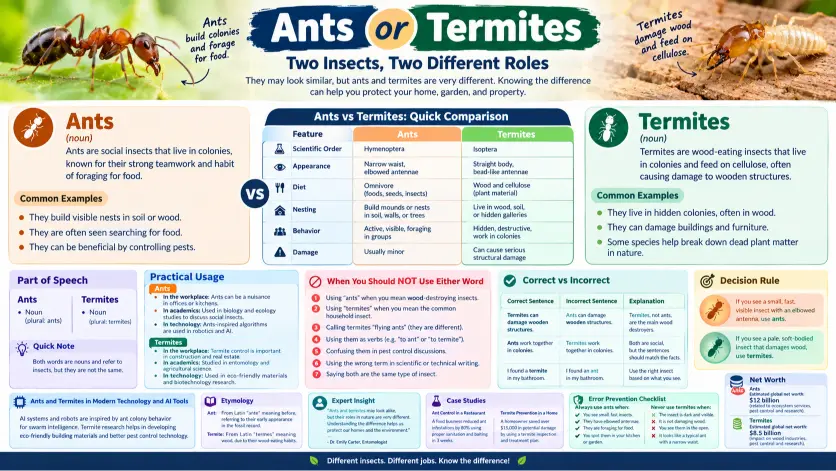
Have you spotted tiny insects crawling across your floor, gathering near a window, or emerging from a wooden surface? Before reaching for a pest control spray, it is important to determine whether you are dealing with ants or termites. Although these insects can look similar at first glance, they have different body shapes, behaviors, nesting habits, and effects on your property. Some ants are simply searching for food, while termites can silently damage wooden structures over time. Identifying the insect correctly is the first step toward choosing an effective solution and protecting your home from unnecessary expenses.
Understanding the differences between ants or termites becomes much easier when you know what to look for. Ants typically have distinctly pinched waists, elbowed antennae, and, in many species, visible food trails. Termites generally have straighter antennae, broader waists, and workers that feed on materials containing cellulose, including wood. Swarmers of both groups may have wings, so wing shape alone should not be your only identification clue. Mud tubes, discarded wings, hollow sounding wood, and the location of insect activity can provide additional evidence of a possible infestation.
In this guide, you will learn how to distinguish ants from termites by examining their appearance, wings, behavior, diet, nests, and the damage they may cause. You will also discover practical warning signs, prevention measures, and situations in which professional pest identification may be necessary. These evidence based identification tips can help homeowners, renters, and property managers make more informed decisions. Because different species behave differently, no single sign confirms every infestation. Looking at several clues together will give you a clearer understanding of which pest may be present and what steps to take next.
Ants vs Termites: What’s the Difference?
When comparing ants or termites, the most important clues are body shape, antennae, wings, feeding habits, and the signs they leave behind. Although both insects can appear in large groups, especially during warm weather, they belong to different insect groups and behave differently.
Ants belong to the family Formicidae within the order Hymenoptera, which also includes bees and wasps. They commonly forage for food, protect their nests, and establish trails between food sources and their colonies.
Termites belong to the infraorder Isoptera within the order Blattodea. They feed primarily on cellulose found in wood, dead plants, and other plant materials. Consequently, certain termite species can damage wooden structures when their colonies establish themselves in buildings.
Physical Differences Between Ants and Termites
Ants (noun): Ants are social insects recognized by their narrow waists, elbowed antennae, and three distinct body regions. Depending on the species, they may be black, brown, reddish, yellowish, or another color.
Termites (noun): Termites are social insects with relatively broad waists, straight or slightly curved antennae, and bodies that appear more uniformly shaped. Workers are often pale or cream colored, although reproductive adults and soldiers can look different.
Ants vs Termites Comparison Table
| Feature | Ants | Termites |
|---|---|---|
| Body shape | Narrow, pinched waist | Broad, relatively uniform waist |
| Antennae | Elbowed | Straight or gently curved |
| Wings | Front wings usually longer than hind wings in reproductive ants | Two pairs generally similar in length |
| Common diet | Sugars, proteins, fats, seeds, and other foods | Cellulose rich materials, including wood |
| Nest locations | Soil, wall cavities, trees, kitchens, and gardens | Soil, wood, wall cavities, and other suitable locations |
| Common warning signs | Food trails, visible workers, nest openings | Mud tubes, damaged wood, discarded wings |
| Structural risk | Some species damage wood or wiring indirectly through nesting | Certain species directly damage wooden structures |
| Body color | Often dark or reddish | Workers are commonly pale, but colors vary by caste and species |
Quick Recap
Ants usually have a pinched waist and bent antennae.
Termites generally have straight antennae and a broader waist.
Ants often search for a variety of foods, while termites consume cellulose rich materials.
Both insects form colonies, but their nesting habits and potential impact on buildings differ.
Therefore, inspect several features rather than relying on color or size alone.
Is Ants vs Termites a Identification or Pest Control Issue?
The distinction between ants and termites is primarily a biological identification issue, although it also affects pest management decisions. Unlike two words with different spellings, these are two different kinds of insects. Confusing them can lead to incorrect assumptions about the source of an infestation and the appropriate response.
Can Ants and Termites Be Mistaken for Each Other?
Yes. Winged ants and winged termites are particularly easy to confuse because both may swarm around windows, doors, outdoor lights, or other illuminated areas.
However, three physical clues help distinguish them. First, flying ants generally have a narrow waist, while termite swarmers have a broader body outline. Second, ant antennae are elbowed, whereas termite antennae are usually straight. Third, reproductive ants usually have forewings that are longer than their hind wings, while termite wings are generally similar in length.
Nevertheless, damaged wings or poor lighting can make identification difficult. Therefore, examine the insects closely or obtain professional assistance when the distinction remains uncertain.
Indoor and Outdoor Identification
Outdoors, ants commonly travel along paths between nests and food sources. They may also build soil mounds, occupy tree cavities, or nest beneath paving stones.
Termites, by contrast, may remain concealed inside soil, wood, or protected cavities. Subterranean species can build shelter tubes made from soil and other materials to maintain moisture while traveling between their nest and a food source.
Inside a building, the discovery of winged insects does not automatically prove a termite infestation. However, repeated swarms, mud tubes, hollow sounding wood, or unexplained structural deterioration warrant closer inspection.
Academic and Professional Contexts
In biology, the distinction matters because ants and termites have different evolutionary histories, physical structures, and feeding behaviors.
In construction and property maintenance, the difference becomes practical. Ant trails might indicate an accessible food source or a nesting site, while termite evidence may indicate concealed activity within wooden materials.
Consequently, identifying the insect accurately is the first step toward choosing an appropriate response.
Practical Identification: When to Suspect Ants
Ants are common around homes, gardens, commercial kitchens, and outdoor recreation areas. Although many species are harmless to buildings, others can contaminate food, sting, or establish nests in inconvenient locations.
1. Workplace Example
In a restaurant or food preparation facility, a line of ants traveling toward a storage cupboard often indicates that the insects have found an accessible food source.
For example, workers may notice ants near spilled syrup, crumbs, or an inadequately sealed container. Cleaning the area, storing food securely, and locating the entry point can help reduce the attraction.
However, repeatedly spraying visible ants without addressing the colony or food source may provide only temporary relief.
2. Academic Example
In a biology classroom, students might observe ants carrying food particles toward a nest.
This behavior demonstrates cooperative foraging and communication within a social insect colony. Depending on the species, ants may recruit nestmates to food using chemical trails.
Therefore, their organized movement can help students understand social behavior, resource gathering, and colony organization.
3. Technology Example
Digital pest monitoring systems can use cameras, motion sensors, or electronic traps to document insect activity in commercial facilities.
For example, a warehouse might record recurring ant activity near a loading entrance and compare observations over several days.
Although such tools can help identify patterns, images may not always provide enough detail to establish the exact species. Consequently, expert identification may still be necessary.
Usage Recap
Suspect ants when you see narrow waists, elbowed antennae, organized food trails, or characteristic ant nests. Nevertheless, remember that some ants, including carpenter ants, can excavate wood to create nesting galleries, even though they don’t consume wood as their primary food source.
Practical Identification: When to Suspect Termites
Termites deserve particular attention because certain species can gradually damage wooden structures without producing obvious surface evidence at first. Their concealed feeding habits mean that a problem may remain unnoticed until visible signs appear.
1. Workplace Example
A property manager might discover narrow earthen tubes running along a foundation wall in a storage building.
These structures could be subterranean termite shelter tubes. They help termites travel while protecting them from exposure and moisture loss.
Instead of assuming the tubes are harmless dirt deposits, the manager should arrange an appropriate inspection to determine whether termites are active.
2. Academic Example
In an ecology lesson, students may study how termites break down dead plant material and recycle nutrients.
Their digestive systems, often supported by specialized microorganisms, allow them to process cellulose that many animals cannot digest efficiently.
Consequently, termites play important ecological roles in decomposition, nutrient cycling, and soil processes, even though some species are considered serious structural pests.
3. Technology Example
Moisture meters, inspection cameras, and acoustic equipment can assist professionals investigating possible termite activity.
For example, an inspector might use a moisture meter to identify damp areas near timber and then examine nearby materials for additional evidence.
However, moisture readings alone don’t establish the presence of termites. Likewise, a camera may reveal concealed damage without identifying the insect responsible.
Usage Recap
Suspect termites when you discover mud tubes, discarded wings, damaged timber, or wood that appears hollow or weakened. Even so, confirm the cause before beginning treatment because moisture damage, decay, and other wood destroying organisms can produce similar warning signs.
When You Should NOT Confuse Ants or Termites
Misidentification can waste time and money. Therefore, avoid these common assumptions when examining insects around a home or commercial property.
- Don’t identify an insect by color alone. Both groups contain species with different colors, and reproductive termites can be darker than their workers.
- Don’t assume every flying insect is a termite. Winged ants, termites, and other insects may emerge during similar weather conditions.
- Don’t rely on size alone. Body size varies by species and caste, so shape and antennae usually provide more useful clues.
- Don’t assume all wood damage comes from termites. Carpenter ants, wood decay fungi, moisture, and other organisms can also damage timber.
- Don’t assume visible ants are responsible for structural damage. Many ant species forage for food without harming buildings, although some nest in wooden structures.
- Don’t assume termites always leave obvious mud tubes. Some drywood termites live directly inside wood and may leave small fecal pellets or discarded wings instead.
- Don’t treat every swarm with the same method. Different insect groups require different identification and management approaches.
- Don’t ignore repeated signs of activity. Recurring swarms, fresh wood damage, or persistent shelter tubes deserve investigation even when the insects themselves disappear.
Ultimately, careful observation is more reliable than guessing. If structural damage is suspected, a qualified pest management professional can identify the cause and recommend appropriate treatment.
Common Identification Mistakes and Decision Rules
The following table illustrates common misconceptions and the observations that provide better guidance.
| Correct observation | Incorrect assumption | Explanation |
|---|---|---|
| Ants have elbowed antennae. | Every small dark insect is an ant. | Color alone is insufficient for identification. |
| Termites generally have broad waists. | All winged insects with four wings are termites. | Wing shape and antennae also matter. |
| Carpenter ants excavate nesting galleries. | Carpenter ants eat wood like termites. | Carpenter ants remove wood to establish nests. |
| Subterranean termites may construct mud tubes. | Every soil tube contains termites. | Other organisms and environmental conditions may create similar features. |
| Some termites damage structural timber. | All termite species attack buildings. | Species differ in habitat, diet, and pest significance. |
| Ants commonly forage for varied foods. | Ants never affect buildings. | Some species nest in structural cavities or damage materials indirectly. |
| Termite workers are often pale. | Every termite must be white. | Reproductive adults and soldiers may have different coloration. |
| Discarded wings may indicate a swarm. | Discarded wings alone confirm an active infestation. | The source and age of the evidence require assessment. |
A Simple Decision Rule
If you see a narrow waist and elbowed antennae, suspect an ant.
If you see a broad waist and straight antennae, suspect a termite.
Next, check the wings, feeding evidence, nest location, and surrounding materials. If several clues disagree, avoid making a firm identification based on one characteristic.
This approach is especially useful when inspecting winged insects near windows or examining suspected wood damage.
Ants and Termites in Modern Technology and Pest Monitoring
Modern pest management increasingly combines direct observation with digital monitoring. Nevertheless, technology works best when its findings are interpreted correctly.
For instance, remote cameras can record repeated insect movement near a food storage area, while moisture sensors can flag damp conditions that may encourage termite activity. Similarly, inspection photographs allow property managers to compare visible damage over time.
However, these tools don’t automatically distinguish ants from termites in every situation. A blurry photograph may conceal the antennae or waist, and moisture readings cannot independently establish the cause of wood deterioration.
Therefore, digital monitoring should support rather than replace sound identification. When evidence suggests structural damage, trained inspectors can examine the building, determine the likely pest species, and recommend suitable control measures.
Etymology: Where Do Ants and Termites Come From?
The word ant comes from Old English ǣmette, reflecting an ancient English term for the familiar social insect. Related forms appear in other Germanic languages, illustrating the word’s long history in everyday speech.
The word termite entered English through French and ultimately derives from Latin termes, meaning a woodworm or wood destroying insect. The terminology reflects the long recognized association between these insects and their feeding activity in wood.
Despite the shared association with colonies, ants and termites are not close relatives in the way their superficial similarities might suggest. Modern biological classification places ants among the hymenopterans, while termites are classified within the order Blattodea, alongside cockroaches.
Consequently, their evolutionary relationships provide another reason to distinguish them carefully.
An Expert Perspective on Ant and Termite Identification
A useful principle in entomology is to identify an insect through multiple observable characteristics rather than a single impression.
“Reliable identification depends on examining body structure, behavior, and environmental evidence together.”
This is a general educational statement, not a quotation attributed to a named researcher. It reflects a practical principle for examining insects accurately.
For example, a narrow waist may suggest an ant, but antennae and wing proportions provide additional evidence. Likewise, a suspected termite mud tube should be evaluated alongside the condition of nearby wood and other signs of activity.
Therefore, a combined assessment offers a more dependable conclusion than visual guesswork alone.
Two Practical Case Studies
The following illustrative case studies demonstrate how accurate identification can guide appropriate action. They are hypothetical teaching examples rather than documented research trials.
Case Study 1: Ants Around a Commercial Kitchen
A restaurant manager notices a trail of small insects traveling from a wall opening toward a cupboard containing sweet ingredients.
At first, the manager assumes the insects are termites because they appear in a large group. However, a closer examination reveals elbowed antennae, narrow waists, and workers carrying food particles.
These characteristics strongly indicate ants. The manager arranges thorough cleaning, seals accessible food containers, checks entry points, and seeks professional advice about locating the nest.
Result: The identification directs attention toward food access, sanitation, and ant entry routes instead of an unnecessary termite focused response. The example demonstrates the value of choosing control measures based on the actual pest.
Case Study 2: Suspected Termites in a Wooden Storage Building
A building owner discovers thin brown tubes along an interior foundation and notices that a wooden frame sounds hollow when tapped.
Rather than assuming the evidence comes from ordinary deterioration, the owner requests an inspection. The inspector examines the tubes, checks accessible timber, and looks for additional evidence consistent with termite activity.
After identifying the likely source, the inspector recommends a treatment plan appropriate to the pest and the building’s construction.
Result: The investigation helps distinguish a potentially active termite problem from unrelated moisture damage and provides a basis for targeted management. The example highlights why inspection is preferable to choosing a treatment solely from a visual guess.
Error Prevention Checklist
Before deciding whether insects are ants or termites, use the following checklist.
Always Suspect Ants When
- The insects have narrow, pinched waists.
- Their antennae are clearly elbowed.
- Workers form trails toward food sources.
- You observe soil mounds or nests beneath stones.
- The insects carry varied food particles toward a colony.
Never Assume Termites Are Absent When
- You can’t see insects but discover suspicious shelter tubes.
- Wooden structures have unexplained internal damage.
- Reproductive insects or discarded wings appear indoors.
- Timber shows signs consistent with concealed feeding.
- A recurring swarm appears near a building.
Additional Checks
- Examine antennae, body shape, and wings whenever possible.
- Photograph the insects and the surrounding evidence.
- Avoid disturbing suspected structural infestations unnecessarily.
- Arrange professional identification when the evidence remains unclear.
- Follow appropriate safety instructions when using pest control products.
These precautions help you avoid unnecessary treatment and respond more effectively when a genuine infestation exists.
Related Insect Identification Confusions You Should Understand
Learning to distinguish ants from termites also helps develop better observation skills when examining other insects.
- Flying ants vs termites: Compare antennae, waist shape, and wing proportions rather than relying on flight behavior alone.
- Carpenter ants vs wood destroying termites: Carpenter ants excavate nesting galleries, while termites consume cellulose containing materials.
- Termites vs wood boring beetles: Termites are social insects, whereas wood boring beetles often leave distinctive exit holes and frass.
- Ants vs wasps: Ants generally have elbowed antennae, while wasps vary in body shape and may have a more elongated appearance.
- Termites vs cockroaches: Termites belong to the same broader insect order as cockroaches, but their body forms and social behaviors differ.
- Bees vs flying ants: Bees often have hairier bodies, while ants generally display a more visibly constricted waist.
- Silverfish vs termites: Silverfish have elongated bodies and three tail like appendages, unlike termites.
- Fleas vs ants: Fleas are wingless, laterally flattened insects adapted for jumping, while ants have distinct body segments and elbowed antennae.
- Termite swarmers vs other flying insects: Wing proportions and antennae help narrow the possibilities, although close examination may be necessary.
- Ant nests vs termite shelter tubes: Ants may excavate soil or occupy cavities, whereas subterranean termites often build protected travel tubes.
These comparisons are particularly helpful when several insect species appear in the same garden or building.
Frequently Asked Questions
1. How can you tell the difference between ants and termites?
Examine the waist, antennae, and wings. Ants generally have narrow waists and elbowed antennae, while termites have broader waists and straight antennae. Winged ants also usually have unequal wing pairs, whereas termite swarmers typically have four similarly sized wings.
2. Are termites worse than ants for your house?
Certain termite species pose a substantial structural risk because they consume cellulose containing materials, including wood. However, some ants, particularly carpenter ants, can also damage wooden structures by excavating nesting galleries. The actual risk depends on the species and the extent of activity.
3. Do ants eat wood like termites?
Most ants don’t consume wood as their primary food source. Carpenter ants, however, excavate wood to establish nests and remove the resulting debris. Termites can digest cellulose and use wood as a food source, making certain species particularly damaging to buildings.
4. What do termite wings look like compared with ant wings?
Termite swarmers generally have four wings that are similar in length and extend beyond the body. Reproductive ants typically have larger forewings and smaller hind wings. Both insects may shed their wings after swarming, so wing evidence should be considered alongside other characteristics.
5. Why are there flying ants or termites in my house?
Winged reproductive insects often emerge during particular seasonal conditions to find mates and establish new colonies. Their appearance may indicate a nearby nest, an outdoor swarm entering through openings, or an established colony within a structure. Repeated indoor termite swarms warrant professional investigation.
6. Do termites always leave mud tubes?
No. Subterranean termites commonly build mud tubes, but drywood termites can live within timber without constructing the same kind of external shelter tubes. Therefore, the absence of mud tubes doesn’t rule out every termite species.
7. Can carpenter ants be mistaken for termites?
Yes, particularly when reproductive insects have wings. However, carpenter ants have elbowed antennae and narrow waists, while termite swarmers have straighter antennae and broader waists. Carpenter ants excavate wood, whereas termites consume cellulose containing material.
8. What attracts ants and termites to a house?
Ants may enter in search of food, water, shelter, or suitable nesting locations. Termites are influenced by species specific needs, including access to cellulose, appropriate moisture, and protected nesting environments. Damp timber, structural gaps, and nearby colonies can contribute to pest activity.
9. Should I treat ants and termites the same way?
No. Although some general pest management practices overlap, effective control depends on accurate identification, the species involved, and the location of the colony. Food sanitation and exclusion can help manage many ant problems, while suspected structural termite activity often requires a specialized inspection and targeted treatment.
Conclusion:
Distinguishing ants from termites begins with a few essential characteristics. Ants generally have narrow waists, elbowed antennae, and varied feeding habits. Termites usually have broader waists, straighter antennae, and a diet centered on cellulose containing materials.
However, appearance alone doesn’t always reveal the full picture. Winged insects can look remarkably similar, while structural damage may have several possible causes. Therefore, examine body shape, antennae, wings, feeding evidence, and the surrounding environment before reaching a conclusion.
If you discover mud tubes, discarded wings, recurring swarms, or unexplained wood damage, arrange an appropriate inspection rather than assuming the problem is harmless. Ultimately, accurate identification helps you understand the risk, avoid unsuitable treatments, and protect your property more effectively.









