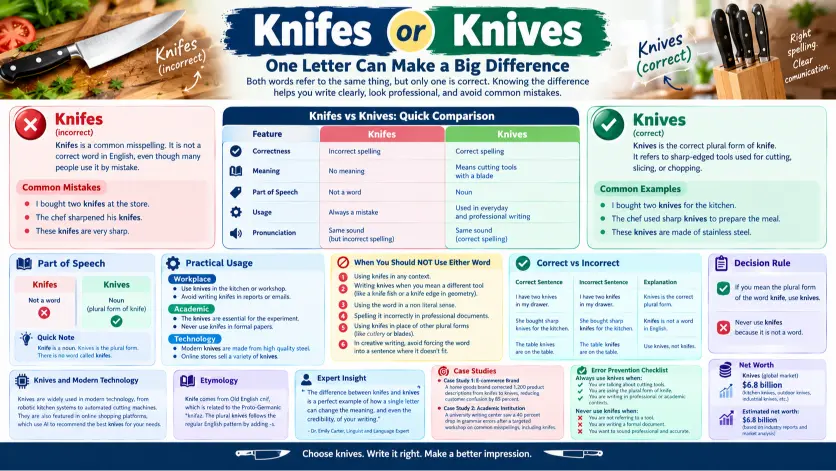
Have you ever paused while writing and wondered whether the correct spelling is knifes or knives? You are not alone. English contains many unusual plural forms, and words that end in the letter f can be particularly confusing. Although knifes may look like a reasonable plural spelling, the standard plural form of the noun knife is knives. Understanding this small spelling change can help you write more accurately in school assignments, workplace documents, online discussions, and everyday messages. The good news is that once you learn the rule, remembering the correct form becomes much easier.
The difference between knifes and knives comes down to English pluralization rules and the role of a word in a sentence. Knife is the singular noun, while knives is its standard plural form. For example, you would write, “The chef sharpened three knives,” rather than “The chef sharpened three knifes.” The spelling changes from f to v before adding es, following a pattern also found in words such as life and lives. However, English has exceptions, so it is useful to learn common patterns alongside individual words.
In this guide, you will discover why knives is correct, how the singular and plural forms work, and which spelling mistakes to avoid. You will also explore clear sentence examples, practical grammar explanations, and simple memory techniques to help you apply the rule confidently. These explanations follow standard English spelling conventions and are designed for students, English learners, teachers, and anyone who wants to improve their writing. By the end, you will know when to use knife and knives and why knifes is generally incorrect when you mean more than one knife.
Knifes vs Knives: What’s the Difference?
The main difference between knifes and knives is that knives is the standard plural form of knife, whereas knifes is generally considered a misspelling when referring to more than one cutting tool. This distinction comes from an English spelling pattern in which certain nouns ending in f or fe change their endings to ves in the plural.
For example, one knife becomes two knives. Similarly, one wife becomes two wives, and one leaf becomes several leaves. However, this pattern doesn’t apply to every noun ending in f, which is why learners sometimes find it confusing.
What Does Knifes Mean?
Knifes is not the standard plural spelling of the noun knife. Nevertheless, the spelling can occasionally appear as a nonstandard form or as a rare third person singular verb form of knife, meaning to cut or move through something with a knife like action.
For instance, the verb can appear in a sentence such as, “The runner knifes through the crowded field.” Here, knifes means moves sharply or cuts through a space metaphorically. However, this use is less common than the plural noun knives.
Therefore, context matters. When discussing multiple kitchen tools, pocket knives, or other cutting implements, use knives.
What Does Knives Mean?
Knives is the accepted plural noun form of knife. It refers to two or more tools with blades used for cutting, slicing, chopping, or similar tasks.
For example:
- The chef sharpened three knives before preparing dinner.
- Several knives were stored safely in the kitchen drawer.
- The camping kit contains folding knives for outdoor tasks.
In each sentence, knives refers to multiple cutting tools. Consequently, this is the spelling you should use in standard written English when the noun is plural.
Comparison Table
| Feature | Knifes | Knives |
|---|---|---|
| Standard plural of knife | No | Yes |
| Correct for multiple cutting tools | No | Yes |
| Part of speech | Rarely a verb form | Plural noun |
| Example | The athlete knifes through the crowd. | The chef washed the knives. |
| Common usage | Limited verb usage | Everyday and formal writing |
| Spelling pattern | Does not follow the standard plural rule | Changes fe to ves |
Quick Recap
Knives is the correct plural of knife.
Knifes is generally incorrect when used to mean multiple cutting tools.
Certain nouns ending in f or fe change to ves in the plural.
However, not every word ending in f follows this pattern.
Always consider the meaning and grammatical role before selecting a spelling.
Is Knifes vs Knives a Grammar, Vocabulary, or Usage Issue?
The difference between knifes and knives is primarily a spelling and vocabulary issue, although grammar also plays a role. Specifically, the noun knife has an irregular plural form that writers must learn rather than create by simply adding s.
Are Knifes and Knives Interchangeable?
No, these forms are not interchangeable when referring to multiple knives. Standard English requires knives as the plural noun.
For example, “The shop sells kitchen knives” is correct. By contrast, “The shop sells kitchen knifes” contains a spelling error because the sentence refers to multiple cutting tools.
However, the word knifes can function as a verb in particular contexts. For example, “The swimmer knifes through the water” uses the word to describe a sharp, cutting movement. Thus, the spelling may be valid as a verb form even though it isn’t the standard plural noun.
Formal and Informal Usage
In formal writing, including business reports, product descriptions, academic assignments, and instruction manuals, use knives for the plural noun. This spelling follows established English conventions.
Similarly, informal writing, including text messages and social media posts, should use knives when referring to multiple cutting tools. Although casual communication sometimes contains spelling mistakes, those errors don’t make knifes an accepted plural.
Academic and Everyday Contexts
In academic writing, the distinction matters when discussing cooking equipment, historical tools, manufacturing, or household objects. For example, a history paper might examine the development of bronze knives across ancient civilizations.
In everyday conversation, the same rule applies. Someone preparing a meal might say, “I need two sharp knives.” In both situations, the plural spelling remains unchanged.
Therefore, the safest approach is to remember the established form instead of relying on the most obvious spelling pattern.
Practical Usage: When to Use Knifes
Although knifes is not the accepted plural of knife, it can appear as a verb in specific grammatical contexts. Understanding this limited use helps explain why the spelling sometimes appears in published or informal material.
1. Workplace Examples
In sports reporting or workplace descriptions, knifes may describe someone moving quickly and sharply through a space.
Example: “The delivery worker knifes through the crowded warehouse aisle.”
Here, the word functions as a verb describing movement. It doesn’t refer to multiple cutting tools.
However, when a workplace inventory lists several cutting tools, the correct sentence is:
“The maintenance team inspected the knives before storing them.”
Consequently, the intended meaning determines whether knifes can be appropriate.
2. Academic Examples
In literary analysis, a writer might use knifes as a verb to describe movement or a figurative action.
Example: “The protagonist knifes through the silence with a sudden accusation.”
This sentence uses figurative language to suggest a sharp interruption. Nevertheless, the wording is stylistic rather than a conventional way to discuss physical cutting tools.
For a straightforward academic sentence about plural objects, write:
“The archaeological collection contains several knives.”
3. Technology Examples
In a technical or digital context, a writer might use knifes as a verb in descriptive prose.
Example: “The virtual athlete knifes through the water during the simulation.”
This wording describes movement in a game or animation. However, when a digital inventory identifies several blade tools, knives is the correct plural.
For example: “The application displays all available knives in the equipment inventory.”
Usage Recap
Use knifes only when the grammatical context supports its rare verb use. For the plural noun, always choose knives.
Practical Usage: When to Use Knives
Knives is the correct choice whenever you refer to more than one knife. Because this form is common in cooking, retail, outdoor activities, history, and manufacturing, learning it correctly improves everyday writing.
1. Workplace Examples
In a restaurant, knives are essential tools for food preparation.
Example: “The head chef checked the knives before opening the kitchen.”
Similarly, a retail inventory might record the number of products available.
Example: “The store received twenty new knives for its kitchenware section.”
In both examples, knives correctly identifies multiple items.
2. Academic Examples
In history and archaeology, knives may refer to cutting tools from different periods or cultures.
Example: “Researchers discovered several stone knives at the excavation site.”
In a science or design course, the word can also describe tools used for controlled cutting tasks.
Example: “The laboratory technician stored the precision knives in a designated cabinet.”
Therefore, the same plural spelling applies across different academic subjects.
3. Technology Examples
Modern product catalogs and inventory systems commonly use knives to categorize cutting tools.
Example: “The online catalog groups kitchen knives by blade material and intended use.”
Similarly, digital modeling software might display multiple virtual objects.
Example: “The designer created three knives for the equipment model.”
In each case, knives is the standard plural noun.
Usage Recap
Choose knives whenever you mean two or more cutting tools. Whether you’re writing a recipe, product description, academic report, or digital inventory, the spelling remains the same.
When You Should NOT Use Knifes or Knives
Correct spelling depends on meaning, sentence structure, and number. Therefore, review these common mistakes to avoid confusing the two forms.
- Don’t write knifes for multiple cutting tools. Write “The drawer contains several knives.”
- Don’t replace knives with knifes in recipes. For example, “Use two sharp knives” is correct.
- Don’t assume every noun ending in f takes ves. Words such as roofs and beliefs normally retain the f and add s.
- Don’t use knives as a singular noun. Write “one knife” rather than “one knives.”
- Don’t use knifes as the plural in product listings. A catalog should identify “pocket knives” or “kitchen knives.”
- Don’t confuse a verb with a plural noun. In “The runner knifes through the crowd,” knifes describes movement rather than multiple objects.
- Don’t change the spelling of knife in a compound expression without checking standard usage. For example, pocket knives is the usual plural of pocket knife.
- Don’t assume a spellchecker will explain the intended meaning. Both strings may be recognized in particular contexts, so review the whole sentence.
Ultimately, remember that the ordinary plural is knives. The less common verb form knifes has a separate grammatical role.
Common Mistakes and Decision Rules
The following table illustrates how the two spellings work in different contexts.
| Correct sentence | Incorrect sentence | Explanation |
|---|---|---|
| The chef sharpened the knives. | The chef sharpened the knifes. | Knives is the standard plural noun. |
| I bought three knives. | I bought three knife. | A plural quantity requires the plural form. |
| One knife is missing. | One knives is missing. | Knife is singular. |
| The runner knifes through the crowd. | The runner knives through the crowd. | Knifes is the verb form in this context. |
| The store sells pocket knives. | The store sells pocket knifes. | The plural noun remains knives. |
| The museum displayed ancient knives. | The museum displayed ancient knifes. | Knives is the accepted plural. |
| She placed the knives in a drawer. | She placed the knifes in a drawer. | Knives is required for multiple tools. |
| The chef cleaned one knife. | The chef cleaned one knives. | One takes a singular noun. |
A Simple Decision Rule
If you mean two or more cutting tools, use knives.
If you mean someone or something moving sharply through a space as a verb, knifes may be appropriate.
For instance, “The athlete knifes through the defense” uses a verb. Conversely, “The chef packed the knives” uses a plural noun.
This distinction prevents a spelling correction from accidentally changing the intended meaning.
Knifes and Knives in Modern Technology and Digital Tools
Digital writing tools, inventory platforms, and online stores often process large amounts of text. Consequently, correct spelling matters when users search for products, categorize equipment, or prepare written instructions.
For example, a retailer might organize its catalog under kitchen knives, folding knives, and professional knives. If the product category is incorrectly labeled knifes, customers may encounter inconsistent terminology.
Likewise, grammar checkers can identify some spelling mistakes, but they may not fully understand unusual or figurative verb usage. A sentence such as “The swimmer knifes through the water” may be correct in context, even though the word looks unusual.
Therefore, proofreading should involve both spelling and meaning. In product databases, standardizing the plural form as knives improves consistency. In creative writing, however, the verb knifes may remain appropriate when it accurately describes movement.
Etymology: Why Does Knife Become Knives?
The plural form knives reflects the historical development of English spelling and pronunciation. The singular word knife comes through Middle English from Old English and related Germanic forms, with historical influences that shaped its modern spelling.
Many English nouns ending in f or fe developed plural forms in which the final consonant changed to a v sound before the plural ending. This pattern appears in words such as knife and knives, wife and wives, and life and lives.
However, the pattern isn’t universal. Other nouns, including roof and chief, generally form their plurals by adding s, producing roofs and chiefs.
As a result, learners can’t rely on one rule for every noun ending in f. Instead, it’s helpful to recognize common patterns while memorizing established exceptions.
The spelling knives is therefore a conventional plural form rather than an arbitrary mistake or optional alternative.
An Expert Perspective on the Knifes vs Knives Distinction
A useful principle in English language instruction is to distinguish between a word’s grammatical function and its spelling.
As a general editorial guideline:
“Correct spelling depends on both established word forms and the meaning a sentence is intended to convey.”
This is an illustrative teaching statement, not a quotation attributed to a named linguist.
For example, the sentence “The chef collected the knives” uses a plural noun. In contrast, “The athlete knifes through the defense” uses a verb to describe movement.
Although the words look similar, their grammatical roles differ. Therefore, writers should consider the sentence’s subject, verb, and intended meaning before deciding whether a form is correct.
Two Practical Case Studies
The following illustrative case studies demonstrate how the spelling distinction can improve clarity. They are educational examples rather than independently measured research findings.
Case Study 1: Correcting a Kitchen Product Catalog
A kitchenware retailer prepares an inventory page containing this heading:
“Professional Kitchen Knifes”
The heading uses a nonstandard plural form. An editor changes it to:
“Professional Kitchen Knives”
The revised heading follows standard English spelling and looks consistent with other product categories. Additionally, the correction improves the quality of the product description and reduces an avoidable spelling error.
Result: The product category now uses the accepted plural form, making the listing clearer and more professionally presented.
Case Study 2: Editing a Student’s History Assignment
A student writes the following sentence in a report about ancient tools:
“Archaeologists found several stone knifes near the settlement.”
The teacher corrects the sentence to:
“Archaeologists found several stone knives near the settlement.”
The change preserves the original meaning while correcting the plural spelling. Furthermore, it gives the student a useful example of the f or fe to ves pattern.
Result: The sentence becomes grammatically appropriate and demonstrates correct use of the plural noun in academic writing.
Error Prevention Checklist
A short review can help prevent mistakes whenever knife appears in your writing.
Always Use Knives When
- Referring to two or more cutting tools.
- Writing recipes that mention multiple blades.
- Describing kitchen equipment or outdoor gear.
- Preparing product listings or equipment inventories.
- Discussing historical or archaeological collections.
- Using compound expressions such as pocket knives and kitchen knives.
Never Use Knifes When
- Writing the ordinary plural noun of knife.
- Describing several blades in a recipe.
- Labeling a product category containing multiple knives.
- Preparing an academic sentence about multiple cutting tools.
- Correcting a plural noun without checking the intended grammatical role.
Check Knifes Carefully When
- It appears as a verb in descriptive writing.
- It describes someone moving sharply through a space.
- A spelling checker flags a sentence that may be figurative.
- You need to distinguish a plural noun from a present tense verb.
Ultimately, memorize the phrase “one knife, two knives.” This simple pattern provides a reliable reminder for most everyday situations.
Related Grammar Confusions You Should Master
Learning other commonly confused words can strengthen spelling accuracy and grammatical awareness.
- Leaf vs leaves: Leaf becomes leaves in the plural, while the verb leaves has a different grammatical function.
- Wife vs wives: Wife changes to wives in standard plural usage.
- Life vs lives: Life becomes lives as a plural noun, although lives can also be a verb.
- Wolf vs wolves: Wolf generally becomes wolves in the plural.
- Roof vs roofs: Roof normally forms its plural by adding s.
- Chief vs chiefs: Chief follows the regular plural pattern.
- Child vs children: Child has an irregular plural that doesn’t simply add s.
- Person vs people: People is the usual plural of person in everyday English.
- Mouse vs mice: Mouse changes to mice in the standard plural form.
- Tooth vs teeth: Tooth becomes teeth rather than tooths in standard plural usage.
These examples demonstrate why English plural forms require attention to established spelling patterns. Although some patterns are predictable, others must be learned individually.
Frequently Asked Questions About Knifes or Knives
1. Is it knifes or knives?
Knives is the correct plural of knife in standard English. Knifes is generally incorrect when referring to multiple cutting tools. However, knifes can function as a verb in certain contexts, such as describing someone moving sharply through a crowd.
2. Why does knife become knives instead of knifes?
Knife follows a common English plural pattern in which certain nouns ending in f or fe change that ending to ves. Therefore, one knife becomes two knives. Nevertheless, not every noun ending in f follows this pattern.
3. Is knifes ever a correct word?
Yes, knifes can be correct as the third person singular present tense of the verb knife. For example, “The runner knifes through the defense” uses the verb to describe sharp movement. However, knifes isn’t the standard plural of knife.
4. What is the plural of knife in English?
The plural of knife is knives. For example, “The kitchen contains several knives.” This spelling is used in formal writing, casual conversation, product descriptions, and academic work.
5. What is the difference between a knife and knives?
Knife is the singular noun referring to one cutting tool, whereas knives is the plural noun referring to two or more. For example, “I bought one knife” contrasts with “I bought three knives.”
6. Do all words ending in f change to ves?
No. Although words such as knife, leaf, and wife generally change to ves in the plural, others follow the regular pattern. For example, roof becomes roofs and chief becomes chiefs. Therefore, it’s important to learn each word’s accepted plural form.
7. Is it pocket knifes or pocket knives?
Pocket knives is the standard plural expression. Since the main noun is knife, its plural form is knives. Therefore, the compound expression changes from pocket knife to pocket knives.
8. How can I remember the correct spelling of knives?
Remember the simple phrase “one knife, two knives.” You can also compare knife with wife and life, which become wives and lives. Reviewing these familiar examples makes the spelling pattern easier to recall.
9. Is knives correct in academic and professional writing?
Yes. Knives is the accepted plural form in academic assignments, workplace documents, product descriptions, recipes, and technical writing. Using knifes as the plural noun would generally be considered a spelling mistake.
Conclusion:
The correct plural spelling is knives, not knifes. Although the spelling may seem unusual, it follows a familiar English pattern in which certain nouns ending in f or fe change to ves in the plural.
For example, one knife becomes two knives, just as one wife becomes two wives. However, remember that the spelling knifes can still appear as a verb meaning to move sharply through a space.
Therefore, consider the meaning and grammatical role before making a decision. When discussing multiple cutting tools, choose knives. When describing a sharp movement with the verb knife, knifes may be appropriate.
By remembering “one knife, two knives,” you can avoid a common spelling mistake and write more confidently in academic, professional, and everyday contexts.









