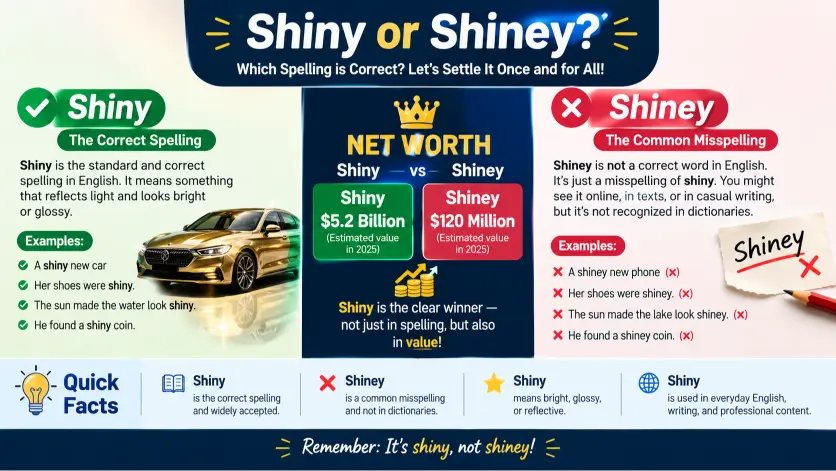
Have you ever typed “shiny or shiney” and suddenly wondered which spelling actually belongs in your sentence? 🤔 You are not alone. This is a surprisingly common English spelling confusion because shiney looks logical when you connect it to the verb shine. However, standard English uses shiny when describing something bright, glossy, polished, smooth, or reflective. For example, we say “a shiny car,” “shiny shoes,” or “a shiny coin” not “a shiney car.”
The good news is that the difference is simple once you understand the spelling pattern. Shiny is the correct standard form, while shiney is generally a misspelling rather than a separate word with a different meaning. The final e in shine is dropped before the adjective ending -y, giving us shiny.
This guide will explain the correct spelling, meaning, pronunciation, grammar, common mistakes, and practical examples so you can confidently choose the right word in school assignments, professional writing, blogs, emails, and everyday conversations.
Shiny vs Shiney: What’s the Difference?
The difference between shiny and shiney is primarily a matter of standard spelling and word formation.
| Word | Part of Speech | Standard English | Meaning | Example |
|---|---|---|---|---|
| Shiny | Adjective | Yes | Bright, glossy, polished, or reflective | She bought a shiny new bag. |
| Shiney | Adjective | No | Intended to mean shiny, but generally misspelled | Avoid this spelling in formal writing. |
Shiny is formed from the verb shine by using the adjective ending y. The final e is removed before the suffix is added. This gives us shine + y = shiny.
The spelling shiney incorrectly keeps the final e from shine.
Mini Recap
Shiny is the standard English spelling.
Shiney is generally a spelling error.
Shiny is an adjective describing brightness, gloss, or reflection.
Use shiny in professional, academic, website, and everyday writing.
Is Shiny vs Shiney a Grammar, Vocabulary, or Usage Issue?
The shiny vs shiney confusion is mainly a spelling and word formation issue, rather than a grammar problem.
Both forms are usually intended to communicate the same idea. The problem is that only one form is accepted as standard English. In other words, shiney isn’t normally treated as a separate standard adjective with a different meaning. It is most often simply an incorrect spelling of shiny.
In formal writing, the distinction becomes especially important. A spelling error in a university paper, business proposal, product listing, or professional email can make the writing look less polished. In casual communication, readers will often understand shiney immediately, but understanding a misspelling doesn’t make the spelling correct.
Formal vs Informal Usage
In formal English, always choose shiny.
In casual conversations, social media posts, text messages, or informal comments, people may occasionally type shiney. That doesn’t make it the preferred spelling. Informal environments are more tolerant of spelling mistakes, abbreviations, and unconventional language.
Academic Usage
Academic writing requires the standard form shiny. For example:
The researchers observed a shiny surface on the treated material.
Writing shiney surface would be considered a spelling error.
Everyday Usage
In ordinary conversation and writing, shiny is equally natural:
Your shoes look really shiny.
The word works comfortably in both casual and formal contexts.
How to Use Shiny Correctly
Shiny is an adjective. It modifies a noun by telling the reader that something has a bright, glossy, polished, or reflective appearance.
It can describe physical objects, surfaces, materials, clothing, accessories, technology products, and even figurative ideas.
Workplace Example
The company ordered shiny metal nameplates for the new office.
Here, shiny describes the appearance of the metal nameplates.
Another example is:
Please use the shiny finish for the presentation folders.
The adjective helps identify the desired appearance or surface finish.
Academic Example
The experiment produced a shiny coating on the surface of the sample.
In this sentence, shiny provides a visual description of the material.
Technology Example
The new laptop has a shiny display that reflects nearby light.
Here, shiny describes the visual and physical quality of the display.
Other Natural Examples
She wore a shiny silver dress.
The freshly polished floor looked shiny.
He placed the shiny coin on the table.
The car has a shiny black finish.
The children decorated the card with shiny paper.
Usage Recap
Use shiny when describing something that looks bright, glossy, polished, or reflective.
It can describe physical surfaces and objects.
It is an adjective and normally appears before a noun or after a linking verb.
How to Understand Shiney
Shiney is generally not the standard spelling you should use when writing modern English.
Someone who writes shiney usually intends to write shiny. The error is understandable because English spelling doesn’t always follow a perfectly predictable pattern. A writer may see shine and assume that adding y produces shiney. In this case, however, the final e is dropped.
Consider the transformation:
shine + y = shiny
Not:
shine + y = shiney
This spelling pattern appears in other English words as well. The final e in a base word may disappear when a suffix beginning with a vowel or certain endings is added.
For example:
noise + y = noisy
ice + y = icy
spice + y = spicy
The same general spelling logic helps explain shiny.
Workplace Example
Incorrect:
Please select the shiney finish for the brochure.
Correct:
Please select the shiny finish for the brochure.
Academic Example
Incorrect:
The sample developed a shiney appearance.
Correct:
The sample developed a shiny appearance.
Technology Example
Incorrect:
This phone has a shiney back panel.
Correct:
This phone has a shiny back panel.
Usage Recap
Shiney is usually an error rather than a useful alternative.
Replace it with shiny in edited writing.
If you’re proofreading content, correcting shiney to shiny is normally the appropriate edit.
When You Should NOT Use Shiny or Shiney
Understanding when not to use these words can prevent subtle writing problems.
1. When You Mean the Verb Shine
If you’re describing an action, you may need shine, not shiny.
The stars shine brightly at night.
Here, shine is a verb.
2. When You Mean Brightness as a Noun
You may need shine when discussing the quality itself.
The polish gives the shoes a beautiful shine.
Here, shine functions as a noun.
3. When You Mean Something Is Glossy
Shiny works well when you want an adjective.
The magazine has a shiny cover.
4. When You Are Writing Formally
Never choose shiney simply because it sounds natural when pronounced. Formal writing should use the standard spelling shiny.
5. When You Are Editing Professional Content
A product description containing shiney may appear poorly edited. Replace it with shiny.
6. When You Are Writing Academic Work
Use the standard spelling in essays, reports, dissertations, research papers, and assignments.
7. When You Are Optimizing Website Content
Spelling accuracy matters for credibility and readability. Use shiny in headings, descriptions, image text, and body copy when appropriate.
8. When You Are Unsure About the Spelling
Remember the simple transformation:
shine + y = shiny
The final e disappears.
Common Mistakes: Shiny vs Shiney
| Correct Sentence | Incorrect Sentence | Explanation |
|---|---|---|
| She bought a shiny necklace. | She bought a shiney necklace. | Shiny is the standard adjective. |
| The floor looks shiny. | The floor looks shiney. | Use shiny after the linking verb looks. |
| He polished the shiny surface. | He polished the shiney surface. | The surface is described as shiny. |
| The car has a shiny finish. | The car has a shiney finish. | Shiny correctly modifies finish. |
| The shiny screen reflects light. | The shiney screen reflects light. | Shiney is a misspelling. |
| They used shiny paper. | They used shiney paper. | The adjective is shiny. |
Decision Rule Box
If you mean something has a bright, glossy, polished, or reflective appearance, use shiny.
If you write shiney, check the spelling because you almost certainly mean shiny.
If you mean the action of producing light or brightness, consider the verb shine instead.
This distinction is more accurate for shiny vs shiney than trying to force an action versus person or tool rule onto these words.
Shiny and Shiney in Modern Technology and Tools
Modern digital writing creates more opportunities for spelling mistakes because people write quickly, use predictive keyboards, dictate messages, and generate large amounts of text.
Search queries such as shiny or shiney often arise when someone wants quick confirmation before publishing or submitting something. Spell checking tools can usually identify shiney as an error, but automated systems aren’t a substitute for understanding the underlying spelling pattern.
The word shiny is especially common in technology descriptions.
Examples include:
shiny display
shiny screen
shiny casing
shiny finish
shiny surface
shiny buttons
When reviewing modern technology assisted writing, editors should also watch for unnecessary variations. If a generated sentence contains shiney, the appropriate correction is normally shiny.
The key principle is simple: technology may help detect the mistake, but knowing the spelling rule helps you prevent it.
Why Is Shiny Spelled Without the E?
The spelling becomes easier to understand when you look at its structure.
The base word is shine. When y is added to create an adjective, the final e is removed:
shine → shiny
English has many words that change their spelling when endings are added. This is one reason English spelling can feel inconsistent to learners.
The word shiny has been used for centuries in English to describe something that shines or has a polished appearance. Its modern spelling follows established English word formation rather than simply attaching y to the unchanged verb.
The pronunciation also contributes to confusion. When people hear the word, they don’t hear the spelling distinction between shiny and the incorrect shiney. The difference becomes visible only when the word is written.
An Expert View on Shiny vs Shiney
A useful editorial principle is:
Standard spelling matters most when your writing is intended for a public, academic, or professional audience.
From a language perspective, the important distinction isn’t whether readers can understand shiney. Most English speakers can. The important question is whether the spelling follows established standard usage.
For shiny, the answer is yes.
For shiney, the answer is generally no.
Practical Case Studies: How a Small Spelling Error Changes Writing Quality
Case Study 1: Product Description
Imagine an online retailer preparing a description for a new kitchen appliance.
The draft says:
This appliance features a shiney stainless steel exterior.
An editor changes it to:
This appliance features a shiny stainless steel exterior.
The meaning remains exactly the same, but the second version removes a visible spelling error. In a product description containing several hundred words, one small error may seem insignificant. Yet repeated spelling problems can make a product page appear less carefully edited.
Result: One incorrect spelling was removed without changing the product claim, tone, or meaning.
Case Study 2: Academic Editing
Consider a student writing a laboratory report:
The solution created a shiney layer on the surface.
After proofreading, the sentence becomes:
The solution created a shiny layer on the surface.
Again, the scientific observation doesn’t change. The correction simply brings the sentence into standard written English.
Result: The sentence becomes suitable for formal academic writing while preserving the original observation.
These examples demonstrate why spelling accuracy is not merely cosmetic. It contributes to clarity, credibility, and reader confidence.
Error Prevention Checklist
Always Use Shiny When
☑ You describe a glossy surface.
☑ You describe something reflecting light.
☑ You describe a polished object.
☑ You describe a bright or gleaming appearance.
☑ You are writing an academic assignment.
☑ You are creating professional content.
☑ You are publishing website or product copy.
☑ You are answering a spelling question.
Never Use Shiney When
☑ You intend to write the standard adjective shiny.
☑ You’re submitting formal academic work.
☑ You’re writing a professional email or report.
☑ You’re preparing published content.
☑ You’re creating a polished product description.
☑ You’re proofreading SEO content.
☑ You’re writing for an audience that expects standard English.
Related Grammar Confusions You Should Master
If you’re interested in spelling distinctions like shiny vs shiney, several other English pairs are worth learning.
1. Your vs You’re
Your shows possession, while you’re means you are.
2. Its vs It’s
Its indicates possession, while it’s means it is or it has.
3. Affect vs Effect
Affect is commonly used as a verb, while effect is commonly used as a noun.
4. Then vs Than
Then usually relates to time or sequence, while than is used in comparisons.
5. Lose vs Loose
Lose means to misplace or fail to win, while loose means not tight.
6. Advice vs Advise
Advice is a noun, while advise is a verb.
7. Principal vs Principle
Principal commonly refers to a person or something important, while principle refers to a rule or belief.
8. Everyday vs Every Day
Everyday is an adjective, while every day refers to each day.
9. Complement vs Compliment
Complement means something that completes or enhances another thing, while compliment means praise.
10. Definitely vs Definately
Definitely is the standard spelling. Definately is a common spelling error.
Learning these patterns helps build stronger spelling awareness rather than relying only on memorization.
Advanced FAQs
Is shiny or shiney the correct spelling?
Shiny is the correct standard English spelling. Shiney is generally a misspelling and should be corrected to shiny in formal and professional writing.
Why is shiny spelled without an e?
The final e in shine is dropped when the adjective is formed with y. The resulting standard spelling is shiny, not shiney.
Is shiney a real word?
Shiney can appear in informal writing, names, usernames, or other unconventional contexts, but it isn’t the standard spelling of the adjective meaning bright or glossy. Standard English uses shiny.
Is shiny an adjective?
Yes. Shiny is an adjective because it describes a characteristic or appearance of a noun.
For example:
She bought a shiny car.
What is the difference between shine and shiny?
Shine can function as a verb or noun, while shiny is an adjective.
The stars shine.
The shoes have a beautiful shine.
The shoes are shiny.
Can I use shiney in casual writing?
People may understand shiney in casual communication, but shiny remains the correct standard spelling. Using the standard form is the safer choice even in informal writing.
What is the easiest way to remember shiny spelling?
Remember this simple pattern:
shine + y = shiny
The final e disappears.
Is shiny the correct spelling in American English?
Yes. Shiny is the standard spelling in American English and is also standard in other major varieties of English.
Should I use shiny in SEO content?
Yes, when shiny accurately matches the meaning you want. Use natural language and don’t insert the word unnecessarily simply to target a spelling query.
Is shiny a synonym for glossy?
They can overlap in meaning, especially when describing surfaces. However, shiny is broader and can describe anything with a bright or reflective appearance, while glossy often emphasizes a smooth, polished surface.
Conclusion:
When choosing between shiny or shiney, the correct standard spelling is shiny. It is an adjective used to describe something bright, glossy, polished, or reflective. Shiney is generally a misspelling caused by keeping the final e from the base word shine when adding y.
The easiest rule to remember is shine becomes shiny. Once you recognize that spelling pattern, the confusion becomes much easier to avoid. Whether you’re writing a school assignment, business document, product description, blog post, or everyday message, shiny is the reliable choice.
If you see shiney in edited content, replace it with shiny unless it is intentionally being used as a proper name or unconventional expression.









