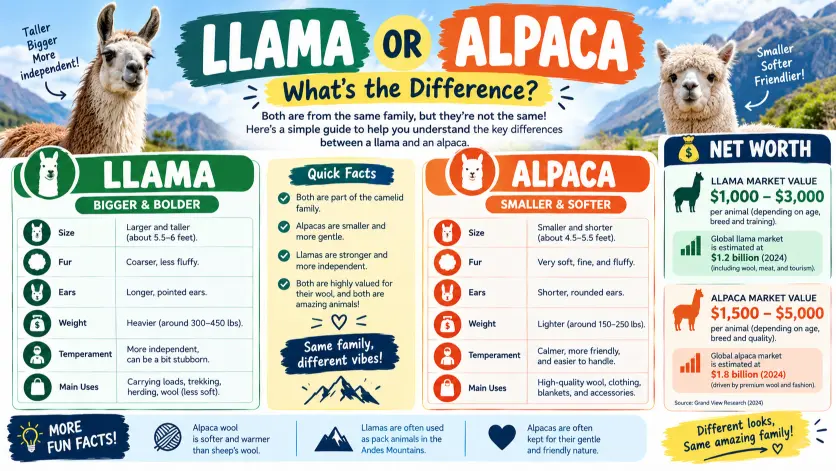
Have you ever looked at a fluffy, long-necked animal and wondered, “Is that a llama or alpaca?” You’re not alone. These adorable South American camelids look remarkably similar, but they have several important differences in size, appearance, behavior, and purpose. Llamas are generally taller and heavier, with longer, banana-shaped ears, while alpacas are smaller and known for their dense, exceptionally soft fleece.
Knowing the difference between a llama or alpaca becomes much easier once you understand a few simple clues. Their ears, face shape, body size, coat, and typical uses can quickly reveal which animal you’re looking at.
Llamas have traditionally been valued as pack and guardian animals, whereas alpacas are primarily associated with high-quality fiber production. In this guide, we’ll break down the differences in simple language, explore their similarities, and share practical tips to help you identify them confidently.
Llama vs Alpaca: What’s the Difference?
A llama is a noun referring to a larger domesticated South American camelid traditionally used for transportation, guarding, and fiber production. An alpaca is also a noun, but it generally refers to a smaller domesticated camelid that is especially valued for its fine, soft fiber.
Although llamas and alpacas look similar at first glance, they aren’t simply two names for the same animal. Both belong to the camelid family and share a common ancestry, but selective breeding has resulted in noticeable differences in their size, facial structure, ears, coat, temperament, and traditional uses.
The easiest way to remember the difference is to think of the llama as the larger and sturdier animal, while the alpaca is generally smaller and especially known for its soft, high quality fiber.
| Feature | Llama | Alpaca |
|---|---|---|
| Scientific name | Lama glama | Vicugna pacos |
| Typical size | Larger and taller | Smaller and more compact |
| Traditional purpose | Pack animal, guarding, and fiber | Primarily fiber production |
| Face | Longer face | Shorter face |
| Ears | Longer and curved | Shorter and more rounded |
| Fiber | Generally coarser | Generally finer and softer |
| Body build | Strong and relatively tall | Smaller and more compact |
| Overall appearance | Robust and athletic | Fluffy and compact |
Quick recap: Llamas and alpacas are closely related but distinct animals. Llamas are generally larger and stronger, while alpacas are smaller and especially valued for their fine fiber. Their similar appearance can cause confusion, but their size, facial features, ears, and traditional uses make them easier to distinguish.
Quick Recap
A llama and an alpaca are related, but they aren’t identical animals.
The llama is usually larger, taller, and more strongly built.
The alpaca is smaller and especially prized for its fine fiber.
Both are domesticated camelids originating in South America.
Is Llama vs Alpaca a Grammar, Vocabulary, or Usage Issue?
The question llama or alpaca is primarily a vocabulary and usage issue, rather than a grammar problem.
Both words are nouns, and both identify real animals. Grammar determines how these nouns function within a sentence, while vocabulary determines which word accurately communicates the intended meaning.
For example:
Correct: The llama carried supplies across the mountain.
Correct: The alpaca produced exceptionally soft fiber.
Changing the nouns would alter the meaning because the animals have different physical characteristics and traditional roles.
The two terms are therefore not interchangeable when you’re trying to identify a particular animal. Saying that an alpaca is a llama isn’t simply an informal grammatical variation. It’s an inaccurate identification.
In casual conversation, someone unfamiliar with camelids might use the terms loosely. However, formal writing, academic work, journalism, animal care, agriculture, and educational content should use the correct term.
In academic contexts, precision matters even more. A biology paper discussing alpaca fiber should not replace the word alpaca with llama simply because both animals belong to the camelid family.
Llama: Meaning, Uses, and Practical Examples
The word llama refers to a domesticated South American camelid scientifically known as Lama glama. Llamas have historically played important roles in Andean communities, particularly as pack animals.
Their relatively large bodies and strong legs make them well suited to carrying loads over difficult terrain. They can also be kept as livestock and may be raised for fiber.
Llamas are often recognizable by their elongated faces and distinctive banana shaped ears. Their bodies can have different coat colors and patterns, ranging from white and brown to gray, black, and combinations of several shades.
Workplace Example
In a workplace discussion about agriculture, someone might write:
The farm uses llamas to help protect its livestock from predators.
This sentence correctly identifies the animal being discussed.
Another example could be:
The agricultural team evaluated the llama herd before expanding the farm’s fiber operation.
Here, llama functions as a straightforward singular noun.
Academic Example
In an academic article, you might see:
Llamas have played an important historical role in transportation across parts of the Andes.
The term is appropriate because the sentence focuses on the animal’s historical and cultural role.
Technology Example
Technology can create unexpected vocabulary confusion. A search engine, image recognition system, educational application, or AI tool may classify an image incorrectly when a photograph shows a camelid from an unusual angle.
For example, an image classification system might identify a fluffy llama as an alpaca because both animals have similar silhouettes.
That doesn’t make the words interchangeable. It simply demonstrates why visual context and accurate terminology matter.
Llama Usage Recap
Use llama when you’re specifically referring to Lama glama.
Think of a larger, stronger South American camelid.
The word is appropriate in scientific, agricultural, educational, and everyday contexts when the animal is correctly identified.
Alpaca: Meaning, Uses, and Practical Examples
An alpaca is a domesticated South American camelid scientifically known as Vicugna pacos. Alpacas are generally smaller than llamas and are particularly famous for their luxurious fiber.
Their fiber is valued because it can be exceptionally soft, warm, lightweight, and available in a wide range of natural colors. Alpaca fiber is used in clothing, textiles, blankets, accessories, and other products.
Alpacas generally have a more compact appearance than llamas. Their faces are typically shorter, their ears are less elongated, and their bodies often appear much fluffier because of their dense coats.
Workplace Example
A textile business might say:
The company sources alpaca fiber for premium winter garments.
That wording is accurate because alpacas are strongly associated with fiber production.
A farm manager could also write:
The staff checks each alpaca regularly to maintain the quality of the herd’s fiber.
Academic Example
An academic discussion could state:
Alpaca domestication is closely connected with the agricultural history of the Andean region.
This terminology is appropriate because the sentence specifically concerns alpacas and their historical development.
Technology Example
An online shopping platform might categorize an item as an alpaca product when the material description identifies alpaca fiber. An AI writing tool may also associate alpacas with luxury textiles because of the animal’s strong connection to fiber production.
However, technology should not be treated as the final authority on animal identification. Context, reliable references, and physical characteristics remain important.
Alpaca Usage Recap
Use alpaca when referring specifically to Vicugna pacos.
Think of a smaller, fluffy camelid especially associated with fine fiber.
The word is suitable for scientific writing, farming discussions, textile descriptions, education, and everyday conversation.
When You Should NOT Use Llama or Alpaca
The biggest mistake is assuming that the two terms are interchangeable simply because both animals look similar.
Here are common situations where choosing the wrong word creates confusion.
1. When Identifying a Specific Animal
If the animal is an alpaca, don’t call it a llama merely because it has a long neck and thick coat.
2. When Discussing Fiber
Don’t automatically use llama when your subject is alpaca fiber. The source animal matters when discussing textile materials.
3. When Writing About Historical Transportation
If your subject concerns traditional pack animals in the Andes and specifically identifies llamas, replacing llama with alpaca can change the historical meaning.
4. When Describing Animal Size
Calling an alpaca a llama can create an inaccurate impression about its typical body size and build.
5. In Academic Writing
Scientific and educational writing requires precise terminology. Similar appearance isn’t enough to justify treating the terms as synonyms.
6. In Product Descriptions
A product made with alpaca fiber should not be described as llama fiber unless that material claim is actually supported.
7. In Animal Care Information
Care recommendations can differ according to species, so accurate identification is important before applying general husbandry information.
8. In Image Captions
A photograph caption should identify the animal correctly. A visually similar animal can still be the wrong species.
Common Mistakes: Llama or Alpaca
The following examples show how confusing llama and alpaca can lead to inaccurate descriptions and word choices.
| Correct sentence | Incorrect sentence | Explanation |
|---|---|---|
| The alpaca has a dense coat. | An alpaca is simply a small llama. | Alpacas and llamas are related but distinct domesticated camelids, not different sizes of the same animal. |
| Llamas were traditionally used as pack animals. | Alpacas were traditionally used mainly as pack animals. | Llamas have a much stronger historical association with carrying loads, while alpacas have primarily been valued for their fiber. |
| Alpaca fiber is valued for its softness. | Llama and alpaca fiber are exactly the same. | Both animals produce usable fiber, but their fiber can differ in fineness, texture, and quality. |
| The photograph shows an alpaca. | The photograph shows an alpaca because the animal is fluffy. | Fluffiness alone isn’t enough to identify an alpaca because llamas can also have thick, fluffy coats. |
| The llama is generally larger than the alpaca. | The alpaca is always larger than the llama. | Llamas are generally larger, although individual animals can vary in size. |
| The farmer raises alpacas for their fiber. | The farmer raises llamas for alpaca fiber. | Alpaca fiber specifically comes from alpacas, so the animal name should match the material being discussed. |
| The animal has the typical build of a llama. | Every long necked camelid is a llama. | Other camelids can also have long necks, so identification should consider several physical characteristics. |
| The article explains the differences between llamas and alpacas. | Llama and alpaca are interchangeable words. | The terms refer to distinct animals and should not normally be treated as synonyms. |
Decision Rule Box
If you’re identifying the larger, sturdier domesticated camelid traditionally associated with carrying loads, use “llama.”
If you’re identifying the smaller camelid especially known for its fine, soft fiber, use “alpaca.”
This is a better decision rule for these words than trying to apply an action versus person distinction. Both terms identify animals, so their correct use depends on which animal you mean.
Llama or Alpaca in Modern Technology and Tools
Modern technology has made the llama or alpaca distinction surprisingly relevant.
Image recognition systems often work by comparing visual patterns. Since llamas and alpacas share similar body shapes, coats, long necks, and facial features, an automated system can sometimes confuse them.
Modern technology language tools can also encounter the same problem. If a prompt provides limited context, a system may produce a generic description involving either animal. Better results come from supplying distinguishing information such as body size, ear shape, facial structure, fiber characteristics, and intended context.
There is another technology related meaning worth knowing. Llama is also used as a name for modern technology models, particularly in discussions about Meta’s Llama family of large language models. In that context, llama isn’t referring to an animal at all.
This creates an interesting vocabulary situation. The same spelling can refer to an animal or an modern technology depending on context.
For example:
The llama is standing in the field.
Here, the word refers to an animal.
The developer tested a Llama model.
Here, the word refers to modern technology.
Context determines meaning.
Llama or Alpaca: Etymology and Word History
The word llama comes into English through Spanish llama, which is connected to an Indigenous South American language, particularly Quechua terminology associated with the animal.
Alpaca also entered English through Spanish and ultimately has Indigenous South American linguistic roots. The history of both terms reflects the long relationship between Andean peoples and domesticated camelids.
Their shared linguistic history makes sense because these animals have been important in South American agriculture and culture for centuries.
Understanding etymology can help explain why English speakers encounter these words as distinct borrowed terms rather than as ordinary English synonyms.
Expert Style Insight
“Similarity in appearance does not make two animal names interchangeable.”
That principle applies well beyond camelids. Vocabulary accuracy depends on the identity and meaning of the thing being described, not simply on visual resemblance.
Two Practical Case Studies
Case Study 1: Textile Description
Imagine a clothing retailer preparing a product description for a winter sweater.
The supplier confirms that the material contains alpaca fiber. If the retailer describes the sweater as being made from llama fiber, the description becomes factually misleading.
The correction is simple:
Better: Made with soft alpaca fiber for warmth and comfort.
The lesson is that material terminology should identify the correct source animal.
Case Study 2: Educational Animal Identification
Consider a school preparing an educational poster featuring photographs of South American camelids.
One photograph shows a large animal with a strong build and distinctive curved ears. Another shows a smaller, densely coated animal.
Labeling both photographs “alpaca” removes an important educational distinction.
A more accurate poster would identify the animals separately as llama and alpaca while explaining their shared camelid background.
The concrete result is better learning because students can associate physical characteristics with the correct vocabulary instead of memorizing two names as if they were synonyms.
Llama or Alpaca: Error Prevention Checklist
Always use “llama” when
✓ You mean Lama glama.
✓ You’re discussing the larger domesticated camelid traditionally used for carrying loads.
✓ Your source specifically identifies the animal as a llama.
✓ You are describing llama fiber or llama related agriculture.
Always use “alpaca” when
✓ You mean Vicugna pacos.
✓ You’re discussing the smaller domesticated camelid known for fine fiber.
✓ You’re describing alpaca textiles.
✓ Your source specifically identifies the animal as an alpaca.
Never assume
✓ Similar appearance means identical species.
✓ Every fluffy camelid is an alpaca.
✓ Every large camelid is a llama without considering other camelids.
✓ AI image recognition is automatically correct.
Related Grammar Confusions You Should Master
The llama or alpaca question is one example of a larger vocabulary lesson: related things often receive different names for good reasons.
Other useful distinctions include:
- Affect or effect
- Then or than
- Its or it’s
- Your or you’re
- Further or farther
- Advice or advise
- Compliment or complement
- Principal or principle
- Stationary or stationery
- Elicit or illicit
These pairs can cause errors because the words look or sound similar while carrying different meanings or grammatical functions.
Learning the difference isn’t simply about passing a grammar test. Precise word choice makes professional writing clearer and prevents readers from misunderstanding what you mean.
Advanced FAQs
What is the difference between a llama and an alpaca?
A llama is generally larger and stronger, while an alpaca is smaller and particularly valued for its fine fiber. They are related South American camelids but are distinct animals with different physical characteristics and traditional uses.
Is an alpaca just a small llama?
No. An alpaca isn’t simply a smaller version of a llama. Alpacas and llamas are separate domesticated camelids with different scientific classifications, physical characteristics, breeding histories, and traditional purposes.
Which is bigger, a llama or an alpaca?
A llama is generally larger and taller than an alpaca. Individual size varies, but overall body structure is one useful clue when distinguishing the two animals.
Are llamas and alpacas the same species?
No. Llamas and alpacas are different domesticated camelids. The llama is scientifically known as Lama glama, while the alpaca is scientifically known as Vicugna pacos.
Which has softer fiber, llama or alpaca?
Alpaca fiber is generally known for being particularly fine and soft. Llamas also produce useful fiber, but the characteristics can vary considerably according to the individual animal and its coat.
Can llamas and alpacas live together?
Yes. Llamas and alpacas can be kept together in suitable livestock settings, although responsible care requires appropriate space, nutrition, social conditions, fencing, and veterinary attention.
Why do llamas and alpacas look so similar?
They look similar because they are closely related South American camelids. Both have long necks, distinctive ears, woolly coats, and similar general body shapes, although their proportions and features differ.
Which animal is used as a pack animal, llama or alpaca?
Llamas have a much stronger traditional association with carrying loads. Their larger and sturdier build makes them better suited to this role than alpacas.
Is llama or alpaca the correct word for soft luxury fiber?
When referring specifically to the well known fine fiber associated with alpacas, alpaca is the more precise term. However, llamas can also produce fiber that is used for textiles.
How can you quickly tell a llama from an alpaca?
Look at overall size, body build, face shape, and ears. Llamas are generally larger with longer faces and more elongated ears, while alpacas tend to be smaller, more compact, and fluffier.
Conclusion:
The easiest way to remember llama or alpaca is to focus on identity rather than appearance. A llama is generally the larger, stronger domesticated camelid historically associated with carrying loads and other agricultural roles. An alpaca is generally smaller and especially valued for its soft, fine fiber.
They share an Andean heritage and belong to the same broader camelid family, but they aren’t synonyms. When writing an academic paper, product description, educational article, animal caption, or everyday message, choosing the correct term improves both accuracy and credibility.
If you’re unsure, don’t rely on fluffiness alone. Consider the animal’s size, facial structure, ears, fiber, and context. Once you connect llama with the larger, sturdier animal and alpaca with the smaller, fiber focused animal, the distinction becomes much easier to remember.









