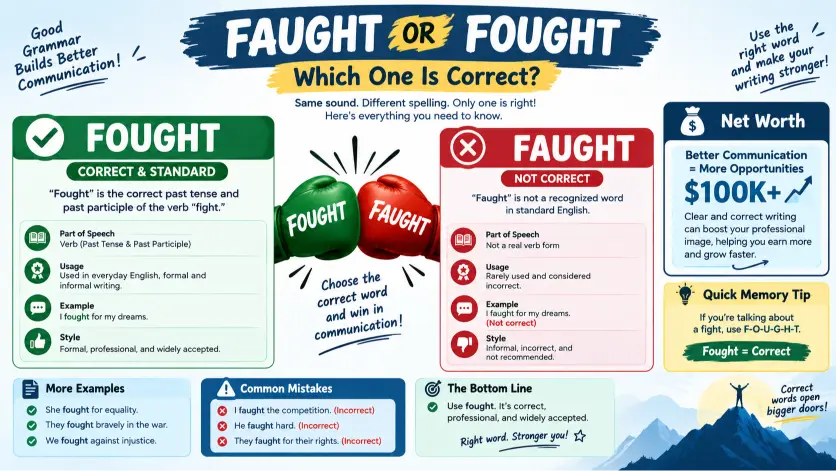
Have you ever written “faught” and wondered whether it is actually correct? You are not alone. This spelling confusion is common because “fought” does not sound exactly the way it looks. If you are searching for faught or fought, the answer is simple: “fought” is the correct standard spelling, while “faught” is generally considered a misspelling. “Fought” is the past tense and past participle of the verb “fight,” and it describes taking part in a physical, verbal, or figurative struggle. For example, “They fought for their rights” uses the correct form.
Understanding why fought is correct can make your English writing more accurate and confident. In this guide, we will explain the difference between faught and fought, their meanings, pronunciation, grammar, and correct sentence usage.
You will also see clear examples and an easy memory tip to help you avoid this spelling mistake in the future. Whether you are a student, writer, English learner, or simply checking a sentence, this guide will give you a straightforward answer.
Faught or Fought: What Is the Correct Spelling?
The correct word is fought.
If you’re writing about something that happened in the past and the base verb is fight, use fought. For example:
She fought for her rights.
They fought against the opposing team.
We fought hard to finish the project on time.
The spelling faught may look reasonable because English contains many words in which the vowel combination “au” represents a sound similar to the one heard in fought. However, English spelling doesn’t always follow predictable patterns. The past tense of fight developed historically as fought, and that is the spelling used in standard English today.
This distinction matters because spelling errors can change how polished your writing appears. A single incorrect word in an email, essay, application, article, or professional report can make the reader question the accuracy of the rest of the text.
The good news is that this particular confusion is easy to eliminate once you connect fought with its base form, fight.
Fought vs Faught: What’s the Difference?
The main difference is simple: fought is a standard English word, while faught is generally a misspelling of fought.
| Word | Part of Speech | Status | Meaning | Example |
|---|---|---|---|---|
| Fought | Verb | Correct | Past tense and past participle of fight | They fought bravely. |
| Faught | Verb | Incorrect in standard English | Intended as the past form of fight | They faught bravely. |
The word fought is an irregular verb form. It does not follow the ordinary pattern of adding “ed” to the base verb. You don’t say fighted. Instead, English changes the form from fight to fought.
Mini recap
Fight is the present form.
Fought is the past form.
Fought is also the past participle.
Faught should not be used as the standard spelling.
Is Fought vs Faught a Grammar, Vocabulary, or Usage Issue?
Primarily, this is a spelling and usage issue, although understanding the grammar behind the words makes the distinction much easier.
The two forms aren’t interchangeable in standard English. Fought is the accepted past tense and past participle of fight. Faught doesn’t function as an alternative spelling in ordinary modern English.
This isn’t a situation where one word is formal and the other is casual. You shouldn’t use faught in casual conversation simply because the setting is informal. Native speakers may make the spelling mistake in text messages or online posts, but that doesn’t make it an accepted variant.
In academic writing, professional communication, journalism, business documents, and carefully edited online content, fought is the appropriate form.
Consider these examples:
The two teams fought for the championship.
The researchers fought to obtain reliable results.
The company fought to protect its reputation.
The word can describe physical conflict, disagreement, competition, resistance, or a determined effort. Its meaning changes according to context, but its spelling remains fought.
How to Use Fought Correctly
Fought is the past tense and past participle of fight. It can describe something that happened in the past or something that has been experienced as part of a perfect tense construction.
Workplace example
The marketing team fought to meet the deadline.
Here, fought describes a difficult effort that took place in the past.
Another example is:
She fought hard to resolve the customer complaint.
The word doesn’t necessarily mean physical combat. It can describe determination, persistence, or strong effort.
Academic example
The researchers fought against several limitations during the study.
In academic writing, fought can be useful when describing resistance or struggle, although formal writers may sometimes prefer words such as addressed, overcame, or challenged, depending on the intended tone.
Technology example
The development team fought to eliminate the software bug before release.
Here, the word expresses sustained effort rather than physical conflict.
Usage recap
Use fought when describing a past action connected to fight.
It can refer to physical conflict, competition, disagreement, resistance, or determined effort.
The word works in casual, professional, and academic contexts when the meaning is appropriate.
How to Use Fight Correctly
While fought refers to a completed or past action, fight is the base form and present tense form of the verb.
For example:
They fight for equality.
Athletes fight for every point.
The base form can also appear after auxiliary verbs:
We will fight for a better solution.
She wants to fight for her team.
They must fight to preserve the system.
Notice the difference:
They fight every day.
They fought yesterday.
The first sentence describes a present or habitual action. The second describes an action in the past.
Workplace example
We fight to provide better service to our customers.
This describes an ongoing effort.
Academic example
Researchers fight to reduce uncertainty in complex studies.
This presents the effort as ongoing or general.
Technology example
Security teams fight against emerging cyber threats.
Again, the action is presented as ongoing.
Usage recap
Use fight for the base form and present tense.
Use fought for the past tense and past participle.
Never replace fought with faught simply because the pronunciation seems to support another spelling.
When You Should NOT Use Faught or Fought
Understanding when a word doesn’t belong is just as important as knowing when it does.
1. Don’t use faught as the past tense of fight
Incorrect:
They faught during the match.
Correct:
They fought during the match.
2. Don’t use fought when you mean fight in the present
Incorrect:
They fought for justice every day.
If you’re describing a current or habitual action, the intended form may be:
They fight for justice every day.
3. Don’t use fought after a modal when the base form is required
Incorrect:
We must fought harder.
Correct:
We must fight harder.
After modal verbs such as must, can, should, and will, use the base form.
4. Don’t use fought after to
Incorrect:
She wants to fought for her family.
Correct:
She wants to fight for her family.
5. Don’t treat faught as a casual alternative
Incorrect:
I faught with my brother yesterday.
Correct:
I fought with my brother yesterday.
Informal communication doesn’t turn a misspelling into a standard spelling.
6. Don’t confuse fight with other past forms
English has many irregular verbs, and learners sometimes create forms by analogy. Because words such as teach become taught, some writers may incorrectly assume that fight becomes faught. It doesn’t.
7. Don’t add “ed” to fight
Incorrect:
They fighted yesterday.
Correct:
They fought yesterday.
8. Don’t change the spelling because of pronunciation
The pronunciation of fought can make the spelling difficult to predict. Remember the written form rather than trying to construct it from sound.
Common Mistakes and Decision Rules
The following examples show how errors commonly occur.
| Correct sentence | Incorrect sentence | Explanation |
|---|---|---|
| They fought yesterday. | They faught yesterday. | Faught is not the standard past form. |
| We fight for our customers. | We fought for our customers. | Use fight for a present or habitual action. |
| She fought hard. | She fighted hard. | Fight has an irregular past form. |
| They must fight back. | They must fought back. | A modal requires the base verb. |
| He wants to fight. | He wants to fought. | The infinitive uses the base form. |
| The teams have fought before. | The teams have faught before. | Fought is the past participle. |
Decision Rule Box
If you mean the present or base action, use FIGHT.
If you mean a completed past action, use FOUGHT.
Never use FAUGHT as the standard past form of FIGHT.
A useful memory trick is to learn the three principal forms together:
fight → fought → fought
Once this pattern becomes familiar, the spelling becomes much easier to recall.
Fought and Faught in Modern Technology and Tools
Modern writing tools have made spelling mistakes easier to detect, but they haven’t eliminated them.
Spell checkers, grammar applications, word processors, search engines, and modern writing assistants can often identify faught as an error and suggest fought. However, technology isn’t a substitute for understanding the underlying grammar.
This distinction becomes especially important when using automated writing tools. A tool may correct the spelling but still leave a sentence with the wrong tense.
For example:
The company fought to improve its service.
This is grammatically appropriate if the effort occurred in the past.
But:
The company must fought to improve its service.
is incorrect because must needs the base verb fight.
Technology can help identify surface errors, but writers still need to understand why a correction is necessary.
Why Do People Spell Fought as Faught?
The error is understandable because English spelling contains many words with the letters au.
Consider words such as:
caught
taught
bought
brought
These familiar patterns can encourage learners to assume that fight follows the same spelling pattern.
The problem is that irregular verbs don’t always develop according to a modern learner’s expectations.
The pronunciation of fought can also contribute to the confusion. When someone hears the word without seeing it written, they may attempt to reconstruct the spelling based on familiar patterns.
Another reason is the relationship between fight, fought, and other irregular verbs. Learners often remember the pronunciation before they remember the written form.
The solution isn’t complicated: memorize the complete verb pattern rather than treating the past tense as a predictable spelling exercise.
The Etymology of Fight and Fought
The history of fight explains why its past form looks unusual.
The verb comes from Old English and has Germanic roots. Over centuries, English developed several strong and irregular verb patterns in which the vowel changed to indicate past time.
That historical development is why modern English contains forms such as:
sing → sang
begin → began
write → wrote
fight → fought
These forms don’t follow the regular “add ed” pattern.
The spelling fought therefore isn’t an arbitrary modern invention. It reflects the historical development of the verb within English.
This is also why trying to create faught based solely on the pronunciation or on another verb’s spelling pattern leads to an error.
Expert Perspective on Fought
“The safest way to master irregular verbs is to learn their principal forms together rather than guessing the past form from pronunciation.”
For language learners, this approach is particularly useful. Instead of memorizing fight by itself, remember:
fight, fought, fought
This gives you the present form, past form, and past participle as a single grammatical unit.
From an editing perspective, this is more reliable than depending on spell check alone because it helps prevent both spelling and tense errors.
Two Practical Case Studies
Case Study 1: Professional Email
Consider a workplace email that says:
Our team faught hard to complete the project.
The intended meaning is understandable, but the spelling error immediately reduces the professional quality of the sentence.
Corrected version:
Our team fought hard to complete the project.
The correction requires changing only one letter combination, but the result is significantly more appropriate for professional communication.
The practical result is clearer, standard English that doesn’t distract the reader with an avoidable spelling error.
Case Study 2: Academic Writing
Imagine a student writes:
The participants faught against several obstacles during the experiment.
The grammatical structure is mostly understandable, but faught is incorrect.
Correct version:
The participants fought against several obstacles during the experiment.
The correction preserves the intended meaning while bringing the sentence into standard written English.
These examples demonstrate an important principle: even when a spelling mistake doesn’t prevent understanding, it can still affect perceived accuracy and credibility.
Error Prevention Checklist
Use this quick checklist whenever you’re unsure about the correct form.
Always use FIGHT when:
- You mean the base form of the verb.
- The action is present or habitual.
- The word follows to.
- The word follows a modal such as can, should, must, or will.
- You’re giving an instruction or describing a general action.
Examples:
They fight every weekend.
We need to fight for our rights.
You must fight for your position.
Always use FOUGHT when:
- The action happened in the past.
- You’re describing a completed fight.
- You’re using the present perfect or past perfect.
- You’re describing past resistance or effort.
Examples:
They fought yesterday.
She has fought for equality.
He had fought against the decision.
Never use FAUGHT when:
- You mean the standard past tense of fight.
- You’re writing professionally.
- You’re submitting academic work.
- You’re publishing edited content.
- You’re preparing an application or formal document.
The simplest correction is always:
faught → fought
Fought in Different Contexts
One reason this verb appears frequently in English is that fight has a broad range of meanings.
It can describe physical conflict:
The soldiers fought bravely.
It can describe competition:
The two teams fought for first place.
It can describe disagreement:
The brothers fought over the decision.
It can describe resistance:
The community fought against the proposed changes.
It can describe determination:
She fought to achieve her goal.
It can even describe an internal struggle:
He fought to control his emotions.
In every one of these contexts, the past form remains fought.
The meaning may change depending on the surrounding words, but the spelling doesn’t.
Related Grammar Confusions You Should Master
If you’re working on English spelling and irregular verbs, several other commonly confused forms are worth studying.
1. Bought vs buy
Bought is the past form of buy.
2. Brought vs bring
Brought is the past form of bring.
3. Caught vs catch
Caught is the past form of catch.
4. Taught vs teach
Taught is the past form of teach.
5. Thought vs think
Thought is the past form of think.
6. Wrote vs write
Wrote is the simple past form of write, while written is its past participle.
7. Lay vs lie
These verbs are frequently confused because their forms and meanings overlap in complicated ways.
8. Affect vs effect
This is one of the most common vocabulary and usage distinctions in English.
9. Then vs than
The words sound similar in some accents but have different grammatical functions.
10. Their vs there vs they’re
These words are pronounced similarly in many varieties of English but serve completely different roles.
Learning these distinctions together can significantly improve spelling accuracy and overall written fluency.
Frequently Asked Questions
Is fought the correct spelling?
Yes. Fought is the correct standard spelling for the past tense and past participle of fight. Faught is normally a misspelling and should not be used in standard English.
Is faught a word in the English dictionary?
In standard modern English, faught is not the accepted past form of fight. When writers intend the past form of fight, they should use fought.
What is the past tense of fight?
The past tense of fight is fought.
Example:
They fought yesterday.
What is the past participle of fight?
The past participle is also fought.
Example:
They have fought before.
The complete pattern is:
fight → fought → fought
Why is it fought and not faught?
English irregular verbs don’t always follow predictable spelling patterns. Fought developed historically as the past form of fight, so its spelling must be learned as part of the irregular verb pattern.
Can I use faught in informal writing?
It’s best not to. Informal writing may contain spelling mistakes, but faught isn’t a standard alternative spelling of fought.
Is fought a verb?
Yes. Fought is a verb form. It is the simple past and past participle of fight.
Which is correct: I faught or I fought?
The correct sentence is:
I fought.
For example:
I fought for what I believed was right.
Is fought past or present tense?
Fought is a past form. It functions as the simple past and past participle of fight.
How can I remember the spelling of fought?
Learn the complete irregular verb sequence:
fight, fought, fought
You can also connect fought directly with the base verb fight rather than trying to spell the past form from its pronunciation.
Final Verdict: Faught or Fought?
When choosing between faught or fought, the correct standard English spelling is fought. It is the past tense and past participle of fight, while faught is a common spelling mistake and should not be used in formal or standard writing. Remember the simple pattern fight, fought, fought.
Use fight when talking about a present, future, or base action, and use fought when describing something that happened in the past or when forming a perfect tense. Although faught may seem logical because words such as caught, bought, and taught use similar letter patterns, it isn’t the accepted spelling of the past form of fight. Once you remember this simple verb pattern, you’ll be able to use fought confidently in essays, emails, professional writing, and everyday English.









