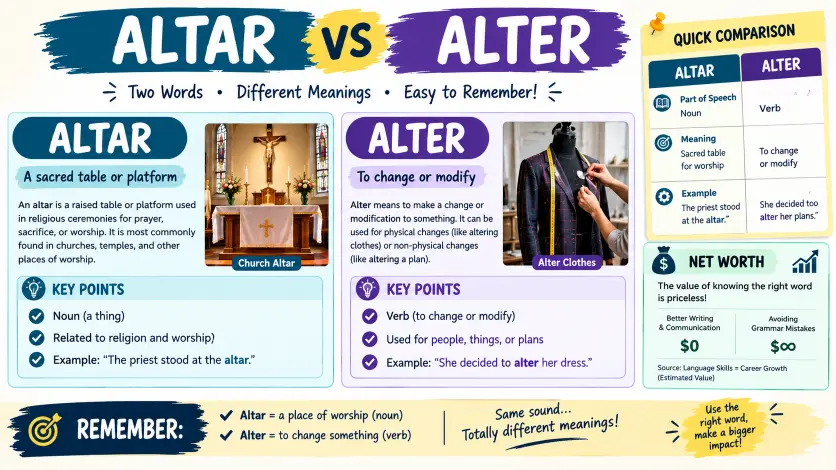
Have you ever stopped while writing a sentence and wondered, “Is it altar or alter?” You’re not alone. These two words sound the same in many varieties of English, but they have completely different meanings and grammatical roles. Altar is a noun used for a sacred table, platform, or place associated with religious worship and ceremonies, while alter is a verb meaning to change, modify, or adjust something.
The confusion becomes especially common in sentences about weddings, churches, clothing, plans, and everyday changes. For example, “The couple stood at the altar” is correct, while “She decided to alter her wedding dress” uses the other spelling correctly. Understanding whether the word names a thing/place or describes an action makes the difference much easier to remember.
In this guide, we’ll break down altar vs. alter, including their meanings, parts of speech, examples, common mistakes, and a simple memory trick so you can confidently choose the right word every time.
Altar or Alter: What Is the Difference?
The easiest way to understand these two words is to remember that altar is a thing, while alter describes an action. Although they are pronounced similarly, they belong to different parts of speech and appear in completely different contexts.
An altar is a noun. It usually refers to a sacred or ceremonial table, platform, or structure where religious rituals, prayers, offerings, or ceremonies take place. For example, a couple may stand before an altar during a wedding ceremony.
Alter is a verb. It means to change, adjust, modify, or make something different without necessarily replacing it completely. You might alter a dress, alter a plan, alter a document, or alter your approach to a problem.
The confusion often happens because the spelling differs by only one letter. When people hear either word in conversation, they may not immediately know which spelling belongs in writing.
| Word | Part of Speech | Meaning | Example |
|---|---|---|---|
| Altar | Noun | A sacred or ceremonial structure | The couple stood before the altar. |
| Alter | Verb | To change or modify something | We need to alter the original plan. |
Quick recap
Altar names a physical or symbolic place or structure.
Alter describes the act of changing something.
If you can put the before the word and are naming a ceremonial structure, altar may be correct.
If you are describing a change or modification, alter is the correct choice.
Is Altar or Alter a Grammar, Vocabulary, or Usage Issue?
The confusion between altar or alter is primarily a vocabulary and usage issue, although grammar also helps you identify the correct word.
The two words are not interchangeable. Their meanings are separate, and replacing one with the other can make a sentence incorrect or unintentionally humorous.
Altar functions primarily as a noun. It can appear after articles such as the or an, or after possessive words such as their and her.
For example:
The priest approached the altar.
Here, altar identifies a specific ceremonial structure.
Alter functions as a verb. It can take an object that is being changed.
For example:
The designer decided to alter the pattern.
Here, alter describes an action performed on the pattern.
In formal writing, academic writing, workplace communication, and professional documents, using the correct spelling is especially important. Casual conversation may hide the distinction because the words are pronounced similarly, but written English makes the difference visible.
A useful test is to ask yourself one simple question: Am I talking about a ceremonial structure, or am I talking about changing something?
If you’re naming the structure, choose altar. If you’re describing the act of changing, choose alter.
How to Use Altar Correctly
Altar is a noun associated most strongly with religion, worship, ceremonies, weddings, and symbolic offerings. It can describe a physical structure in a church, temple, or another place of worship.
For example:
The flowers were placed carefully on the altar.
The word can also appear in figurative expressions. A person may say that someone has sacrificed something on the altar of success, meaning that the person gave up something valuable in pursuit of another goal.
Workplace example
Although altar is less common in ordinary workplace communication, it can appear when a company is discussing religious traditions, cultural events, ceremonies, or symbolic language.
The event coordinator arranged flowers around the altar before the ceremony.
Academic example
In academic writing, altar commonly appears in research involving religion, anthropology, history, literature, art, or archaeology.
Archaeologists discovered evidence of an ancient altar near the temple ruins.
Technology example
Technology writing rarely uses altar literally, but the word can appear in discussions of digital religious communities, virtual ceremonies, historical databases, or cultural preservation.
The museum created a digital reconstruction showing how the ancient altar may have appeared.
Usage recap
Use altar when you need a noun for a sacred or ceremonial structure.
Think place, structure, ceremony, worship, or offering.
A simple memory connection is: altar is an object.
How to Use Alter Correctly
Alter is a verb meaning to change, modify, adjust, or make something different. It is much more common in everyday English than altar.
You can alter clothing, schedules, plans, designs, documents, behavior, settings, strategies, and many other things.
For example:
We need to alter the schedule because the meeting has been postponed.
The sentence describes an action. Someone is changing the schedule, so alter is correct.
Workplace example
The manager asked the team to alter the proposal before submitting it.
Here, alter means modify.
Academic example
Researchers altered the experimental conditions to examine a different outcome.
The researchers changed the conditions, making alter the correct verb.
Technology example
You can alter the privacy settings from the application menu.
This usage is particularly common in technology. Software users may alter settings, permissions, preferences, layouts, or configurations.
Usage recap
Use alter when something is being changed or modified.
Think change, adjust, modify, revise, or transform.
A useful memory connection is: alter is an action.
When You Should NOT Use Altar or Alter
Knowing when not to use these words can prevent many spelling mistakes.
1. Do not use altar when you mean change
Incorrect:
We need to altar the design.
Correct:
We need to alter the design.
The design is being changed, so the verb alter is required.
2. Do not use alter for a religious structure
Incorrect:
The flowers were placed on the alter.
Correct:
The flowers were placed on the altar.
The sentence refers to a ceremonial structure, so altar is correct.
3. Do not assume similar pronunciation means similar meaning
Words can sound alike while having completely different meanings. English contains many such examples, including accept and except, principal and principle, and stationary and stationery.
4. Do not use altar as a general synonym for table
An altar can sometimes resemble a table, but not every table is an altar. The word carries a specific ceremonial or religious meaning.
5. Do not use alter when you mean replace
Alter generally means to change or modify something. If something is completely removed and another item takes its place, words such as replace may be more precise.
6. Do not rely only on pronunciation
When speaking, listeners may understand your meaning from context. In writing, however, the spelling determines which word you are using.
7. Do not choose the word based on appearance alone
The extra a in altar can help you remember that it is a noun for a physical or ceremonial place. Alter has an e, which can remind you of edit or change.
Common Mistakes With Altar and Alter
| Correct sentence | Incorrect sentence | Explanation |
|---|---|---|
| The bride walked toward the altar. | The bride walked toward the alter. | A wedding ceremony can take place at an altar. |
| We must alter the schedule. | We must altar the schedule. | The schedule needs to be changed. |
| The candles stood beside the altar. | The candles stood beside the alter. | The word refers to a ceremonial structure. |
| The company decided to alter its policy. | The company decided to altar its policy. | A policy can be modified. |
| The priest stood near the altar. | The priest stood near the alter. | The noun is altar. |
| Engineers altered the software settings. | Engineers altared the software settings. | The action of changing something is alter. |
Decision Rule Box
If you mean a sacred or ceremonial structure, use altar.
If you mean the action of changing or modifying something, use alter.
Another useful shortcut is:
Altar = thing
Alter = action
When you’re proofreading, identify the role the word plays in the sentence before checking its spelling.
Altar or Alter in Modern Technology and Tools
Modern technology has made alter particularly common because digital systems are constantly adjusted and customized.
Users can alter settings, alter layouts, alter permissions, alter images, alter documents, and alter generated content.
For example:
The editor altered the image before publishing it.
The developer altered the code to improve performance.
The user altered the application’s notification settings.
Modern tools also frequently involve modification. A person might alter an modern technology tool generated draft, alter a prompt, alter an image, or alter a data set.
Altar, by contrast, has limited direct relevance to technology. It can still appear in digital representations of religious spaces, virtual ceremonies, historical databases, educational software, or cultural projects.
The important point is that modern technology hasn’t changed the basic meanings of the two words. It has simply created many new situations where alter is useful.
Etymology of Altar and Alter
The different histories of these words help explain why their meanings are unrelated.
Altar comes from the Latin altare, referring to a raised place or structure associated with sacrifice or religious ceremony. Through historical development, the word entered English with its religious and ceremonial meaning.
Alter comes from Latin alter, meaning another or other, and developed through French into the English verb associated with making something different or changing its condition.
Their similar appearance and pronunciation in modern English can therefore be misleading. Their historical origins point to completely different concepts.
One represents a ceremonial structure. The other represents change.
Expert style quotation
“When two words sound alike but perform different grammatical jobs, meaning should guide spelling before pronunciation.”
This principle is especially useful for commonly confused English words.
Two Practical Case Studies for Altar and Alter
Case Study 1: Wedding Writing
Imagine proofreading a wedding announcement that says:
The couple exchanged vows beside the alter.
The intended meaning is obvious, but the spelling is incorrect. The correct version is:
The couple exchanged vows beside the altar.
The correction changes only one letter, but it restores the proper noun.
In a proofreading exercise involving ten sentences containing common homophone and near homophone errors, identifying the grammatical role first provides a reliable way to separate structure words such as altar from action words such as alter.
Case Study 2: Workplace Editing
Consider this sentence from a business document:
The company will altar its customer service policy next year.
The intended meaning is that the company will modify its policy. Therefore, alter is required.
Correct:
The company will alter its customer service policy next year.
This kind of mistake is easy to miss during fast proofreading because the incorrect spelling still looks familiar. Reading the sentence for meaning rather than simply scanning individual letters makes the correction much easier.
Author expertise: This article applies practical English usage, grammar analysis, vocabulary distinctions, and search focused editorial principles to explain commonly confused terms clearly.
Error Prevention Checklist for Altar and Alter
Always use altar when
You are referring to a religious structure.
You are describing a ceremonial location.
You are discussing a wedding altar.
You are writing about historical religious practices.
You are referring to offerings or rituals performed at such a structure.
Never use alter when
You mean a ceremonial structure.
You are describing where a religious ceremony takes place.
You are referring to a wedding altar.
You are naming an archaeological religious structure.
Always use alter when
You mean change.
You mean modify.
You mean adjust.
You mean revise.
You mean make something different.
You are describing changes to software settings, plans, documents, designs, or policies.
Related Grammar Confusions You Should Master
Learning altar or alter becomes easier when you understand other commonly confused English words.
Here are several useful pairs to study:
Affect or effect: One commonly describes influence, while the other commonly identifies a result.
Accept or except: One means to receive or agree to something, while the other commonly means excluding something.
Advice or advise: One is a noun, while the other is a verb.
Principal or principle: One can refer to a person or something primary, while the other refers to a rule, belief, or guiding standard.
Stationary or stationery: One describes something that isn’t moving, while the other refers to writing materials.
Compliment or complement: One involves praise, while the other describes something that completes or enhances another thing.
Their, there, or they’re: These words have different grammatical functions despite similar pronunciation.
Its or it’s: One is possessive, while the other is a contraction meaning it is or it has.
Then or than: One generally relates to time or sequence, while the other is used for comparison.
Loose or lose: One commonly describes something not tight, while the other means to misplace or fail to retain something.
Mastering these distinctions improves accuracy in academic writing, professional communication, online publishing, and everyday English.
Frequently Asked Questions
What is the difference between altar and alter?
Altar is a noun meaning a sacred or ceremonial structure. Alter is a verb meaning to change, modify, or adjust something. The words are not interchangeable.
Is it wedding altar or wedding alter?
The correct phrase is wedding altar. An altar is the ceremonial structure associated with the wedding ceremony.
Is alter a noun or a verb?
Alter is primarily a verb. It means to change, modify, adjust, or make something different.
Is altar a noun or a verb?
Altar is a noun. It refers to a sacred or ceremonial structure or place.
How do you remember altar or alter?
Remember altar as a thing or structure and alter as an action. If something is being changed, use alter. If you’re talking about a ceremonial structure, use altar.
Which is correct, alter the plan or altar the plan?
The correct phrase is alter the plan because the meaning is to change or modify the plan.
Which is correct, altar of worship or alter of worship?
The correct phrase is altar of worship because the word refers to a religious or ceremonial structure.
Are altar and alter homophones?
They are commonly pronounced alike in many varieties of English, which makes them easy to confuse in speech. Their meanings and spellings are different.
Why do people confuse altar and alter?
People often confuse them because their pronunciation is similar and their spelling differs by only one letter. Context and grammatical function provide the best clues.
Can alter mean completely change something?
Yes. Alter can describe a significant change, although it often suggests modifying or adjusting something rather than necessarily replacing it entirely. The exact meaning depends on context.
Final Takeaway:
The difference between altar or alter is simple once you connect each word with its function. Altar is a noun. It refers to a sacred or ceremonial structure, especially one associated with worship, rituals, weddings, or offerings.
Alter is a verb. It means to change, modify, adjust, or revise something.
When proofreading, don’t depend only on how the word sounds. Look at what the sentence means and ask whether you’re naming a thing or describing an action. If you’re referring to a ceremonial structure, choose altar. If you’re talking about changing something, choose alter.
That small distinction can prevent spelling errors in essays, workplace documents, websites, religious writing, and everyday communication.









