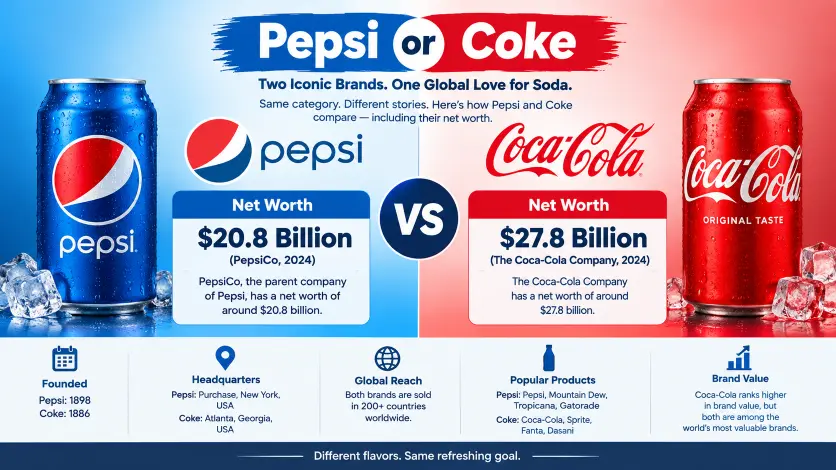
If you have ever stood in front of a refrigerator wondering whether to grab Pepsi or Coke, you are certainly not alone. These two globally recognized cola brands have been competing for consumer attention for generations, yet their differences are not always obvious at first glance. From flavor and sweetness to ingredients, caffeine content, branding, and product variety, Pepsi and Coke have several characteristics worth comparing. Understanding these differences can help readers make an informed choice based on their own preferences rather than relying only on brand familiarity or advertising.
A meaningful Pepsi or Coke comparison requires more than simply asking which drink tastes better. Taste is subjective, while measurable factors such as nutrition information, ingredient lists, caffeine content, serving size, and product formulations can be examined more objectively. It is also important to remember that formulas and product offerings can vary by country and may change over time. Looking at information provided by the manufacturers and reputable nutritional sources gives readers a clearer foundation for understanding what distinguishes the two beverages.
This guide takes an evidence based approach to comparing Pepsi and Coke across the factors people commonly search for, including taste, ingredients, caffeine, calories, sugar, history, branding, and food pairings. Instead of treating personal preference as a universal fact, the comparison separates measurable information from individual opinions. Whether you are a longtime cola drinker, researching the difference between the brands, or simply curious about why the two beverages taste different, this guide provides a straightforward starting point for understanding Pepsi or Coke.
Pepsi or Coke: What’s the Difference?
Pepsi is a cola soft drink produced by PepsiCo, while Coca Cola is the flagship cola produced by The Coca Cola Company. Therefore, both belong to the same broad beverage category, although they are distinct products with different formulations, branding strategies, packaging, and flavor characteristics.
From a language perspective, Pepsi and Coke are proper names used as nouns. Pepsi identifies the Pepsi brand, whereas Coke commonly refers to Coca Cola. However, the word Coke can have additional meanings in other contexts, so the surrounding sentence matters.
Moreover, the two products have developed different identities over decades. Pepsi has frequently emphasized a sweeter, more energetic image, while Coca Cola has traditionally emphasized classic refreshment, familiarity, and heritage. Nevertheless, individual taste perception varies considerably.
| Feature | Pepsi | Coke |
|---|---|---|
| Brand | Pepsi | Coca Cola |
| Product category | Cola soft drink | Cola soft drink |
| Common name | Pepsi | Coke |
| Flavor perception | Often described as sweeter | Often described as more classic or balanced |
| Caffeine | Contains caffeine in standard versions | Contains caffeine in standard versions |
| Main use | Refreshment, meals, gatherings | Refreshment, meals, gatherings |
| Brand identity | Modern, energetic, youthful campaigns | Heritage, familiarity, classic branding |
| Sugar free options | Available | Available |
Therefore, Pepsi and Coke aren’t simply two spellings for the same beverage.
Instead, they are competing cola brands with similar purposes but different recipes and brand identities.
Consequently, the choice usually comes down to flavor preference, dietary requirements, availability, and personal familiarity.
Is Pepsi or Coke a Grammar, Vocabulary, or Usage Issue?
The phrase Pepsi or Coke is primarily a vocabulary and usage question rather than a grammar problem.
First, Pepsi is a brand name. Second, Coke is a commonly used shortened name for Coca Cola. Consequently, both terms function naturally as nouns in everyday conversation.
For example, someone might ask, “Would you like Pepsi or Coke?” Here, the speaker is presenting two beverage choices.
However, capitalization matters in polished writing. Pepsi should normally appear with an uppercase P because it is a brand name. Likewise, Coke should appear with an uppercase C when referring to the Coca Cola brand.
Furthermore, formal writing may use Coca Cola when precise brand identification is important. Casual conversation, restaurant ordering, advertising copy, and everyday speech frequently use Coke.
In academic writing, the choice depends on the subject. For example, a paper discussing consumer preferences could use both brand names consistently. Meanwhile, casual conversation allows greater flexibility.
Thus, the distinction isn’t about one term being grammatically correct and the other being grammatically incorrect. Instead, context determines which name is more suitable.
Pepsi: Meaning, Usage, and Practical Examples
Pepsi is a proper noun identifying a specific cola brand. Therefore, it should be capitalized when used in standard written English.
In everyday speech, people commonly use Pepsi when discussing a beverage preference, ordering food, comparing cola brands, or describing a drink available at a particular location.
For example, a workplace conversation might sound like this:
“I’m ordering lunch for everyone. Would you prefer Pepsi?”
Here, Pepsi functions as the name of the requested beverage.
In an academic context, the word can appear in research concerning consumer behavior, advertising, food preferences, branding, or business competition. For instance:
“The survey examined whether participants preferred Pepsi or another cola brand.”
In technology related writing, Pepsi might appear in discussions involving digital advertising, online ordering systems, restaurant applications, or product databases. A menu application, for example, may display Pepsi as a beverage selection.
Additionally, Pepsi can appear in product descriptions, menus, surveys, promotional material, and conversational writing.
Pepsi usage recap
Use Pepsi when you specifically mean the Pepsi brand.
Capitalize Pepsi in ordinary formal writing.
Use it naturally when discussing preferences, purchases, menus, or brand comparisons.
Remember that Pepsi and Coca Cola are separate products.
Coke: Meaning, Usage, and Practical Examples
Coke is commonly used to refer to Coca Cola. Therefore, the term frequently appears in everyday conversations involving soft drinks.
However, context deserves attention because Coke can have meanings unrelated to the beverage brand in certain situations. Consequently, formal writing may benefit from using Coca Cola when ambiguity is possible.
In the workplace, someone might say:
“Could you bring me a Coke with lunch?”
Here, the intended meaning is normally a Coca Cola beverage.
In academic writing, however, Coca Cola may be preferable when discussing the company or brand formally. For example:
“The study compared consumer responses to Pepsi and Coca Cola.”
Meanwhile, technology platforms may use Coca Cola as a product name in databases, online menus, delivery applications, or inventory systems. Such systems generally favor precise product naming because users need to distinguish among product variants.
Furthermore, Coke is common in casual speech because it is shorter and familiar to many speakers.
Coke usage recap
Use Coke when the context clearly means Coca Cola.
Use Coca Cola when formal precision matters.
Capitalize Coke when referring to the brand.
Avoid assuming that Coke always means the beverage because the term has other meanings in English.
When You Should NOT Use Pepsi or Coke
Although both names are widely recognized, certain situations require greater precision. Therefore, consider the following common misuse scenarios.
1. When discussing the company
If you’re discussing corporate operations, ownership, financial performance, or business history, Coca Cola or The Coca Cola Company may be more precise than simply saying Coke.
2. When discussing an unspecified cola
If you mean any cola beverage rather than a particular brand, neither Pepsi nor Coke necessarily communicates the intended meaning.
3. When discussing a specific product variant
Diet, zero sugar, cherry, vanilla, and other variants shouldn’t automatically be identified by the basic brand name alone.
4. When writing formal research
Academic material benefits from consistent terminology. Therefore, identify the precise product or brand being examined.
5. When ambiguity could change the meaning
Because Coke can have non beverage meanings, use Coca Cola when context doesn’t make the intended reference obvious.
6. When describing personal taste as objective fact
Flavor perception differs among individuals. Therefore, saying that one product objectively tastes better isn’t a neutral linguistic description.
7. When comparing nutritional information
Different sizes and formulations can contain different quantities of sugar, caffeine, calories, or other ingredients. Consequently, compare equivalent products rather than relying solely on brand names.
8. When writing product specifications
A product database should use exact names, package sizes, and variants rather than informal shorthand.
Common Mistakes and Decision Rules
| Correct sentence | Incorrect sentence | Explanation |
|---|---|---|
| I prefer Pepsi with my meal. | I prefer pepsi with my meal. | Brand names require capitalization. |
| Would you like Coke? | would you like coke? | The brand name should be capitalized. |
| The study compared Pepsi and Coca Cola. | The study compared Pepsi and coke. | Formal writing benefits from consistent capitalization and naming. |
| I ordered a Coca Cola Zero Sugar beverage. | I ordered Coca Cola. | The first sentence identifies the specific variant. |
| Pepsi and Coke are competing cola brands. | Pepsi is another name for Coke. | They are separate brands. |
| Which cola do you prefer? | Which Pepsi do you prefer? | Use a general category term when no specific brand is intended. |
Decision Rule Box
If you mean the Pepsi brand, use Pepsi.
If you mean Coca Cola and the context is casual, Coke can work.
If you need maximum formal precision, use Coca Cola.
If you mean the general beverage category, use cola or cola drink.
Pepsi or Coke in Modern Technology and Digital Tools
Today, brand names frequently appear in digital menus, delivery platforms, online surveys, retail catalogs, product databases, and voice activated ordering systems.
Therefore, precise naming has become increasingly useful.
For example, a restaurant ordering interface may need to distinguish between Pepsi, Coca Cola, diet varieties, and zero sugar varieties. Likewise, a grocery database may need separate entries for different bottle sizes.
Furthermore, automated search systems depend heavily on wording and context. Consequently, users should provide the exact product name whenever precision matters.
This principle also applies to conversational queries. Asking for “Coke” usually communicates a recognizable brand preference, while asking for “cola” communicates a broader category.
Thus, everyday shorthand remains useful, but exact terminology becomes increasingly valuable when digital systems must interpret product information accurately.
Pepsi and Coke: A Short Etymology and Brand History
The name Pepsi is associated with Pepsi Cola, a beverage that originated in the United States in the late nineteenth century. Over time, the brand name became one of the world’s most recognizable beverage trademarks.
Coca Cola also originated in the United States during the nineteenth century. The name combines references associated with its original formulation and the kola nut, while Coca Cola eventually became one of the world’s most recognizable commercial names.
The shortened term Coke developed as a familiar form of Coca Cola. Eventually, it became deeply established in everyday English and commercial communication.
Therefore, the distinction between Pepsi and Coke isn’t merely modern advertising language. Both names have developed substantial historical and cultural recognition.
“When two familiar brand names represent separate products, clarity comes from naming the exact object rather than assuming that familiarity makes the terms interchangeable.”
Two Notable Case Studies: Pepsi and Coke
Case Study 1: The Pepsi Challenge
The Pepsi Challenge became a prominent marketing campaign built around blind taste comparisons. Participants were encouraged to taste Pepsi and Coca Cola without relying on visible branding.
The campaign became influential because it demonstrated an important distinction between brand perception and immediate taste response. A blind tasting removes some visual and identity based cues, allowing flavor preference to become a more central part of the experience.
Consequently, the campaign became a significant example in discussions about branding, consumer psychology, and competitive marketing.
However, tasting conditions can influence outcomes. Therefore, a single blind tasting shouldn’t be interpreted as proof that every individual will prefer one beverage.
Case Study 2: The New Coke Episode
In 1985, Coca Cola introduced a reformulated version commonly known as New Coke. The change generated substantial consumer reaction, and the original formula was subsequently returned under the Coca Cola Classic name.
This episode demonstrated that consumer attachment can extend beyond flavor. Brand familiarity, expectations, identity, and historical associations can influence how people respond to a product change.
Therefore, the Pepsi versus Coke discussion isn’t exclusively about ingredients. Consumer behavior also involves memory, expectations, packaging, advertising, and cultural familiarity.
Error Prevention Checklist
Always use Pepsi when
- You specifically mean the Pepsi brand.
- You’re identifying a Pepsi product in formal writing.
- You’re comparing Pepsi with another named brand.
- You’re discussing a Pepsi product variant and need clear brand identification.
Never use Coke when
- You actually mean Pepsi.
- You mean an unspecified cola category.
- The surrounding context could create ambiguity.
- You’re referring specifically to the Coca Cola company rather than its beverage.
- A formal document requires exact corporate terminology.
- You’re identifying a product variant that needs a complete name.
Related Grammar Confusions You Should Master
Learning the difference between Pepsi and Coke can also encourage greater attention to other commonly confused expressions.
- Coke vs Coca Cola
- Cola vs soft drink
- Brand name vs generic noun
- Product name vs company name
- Trademark vs common usage
- Capitalization of brand names
- Proper nouns vs common nouns
- Formal wording vs conversational wording
- Specific product vs general category
- Singular brand reference vs category reference
These distinctions are useful because English frequently moves between formal terminology and everyday shorthand. Consequently, understanding context can prevent many communication errors.
Pepsi or Coke: What Should You Say in Different Situations?
The appropriate wording depends largely on what you’re trying to communicate.
If you’re ordering casually at a restaurant, “Coke” may be perfectly natural when you want Coca Cola.
If you’re writing a university assignment, “Coca Cola” can provide greater precision.
If you’re conducting a consumer survey, specify the complete product names so participants understand exactly what they’re comparing.
If you’re discussing the beverage category, use “cola” instead of either brand.
If you’re building a product catalog, use the precise commercial name and variant.
Meanwhile, if you’re simply discussing personal preference, either brand name works naturally.
Therefore, there isn’t one universally correct expression. Instead, the best wording depends on specificity, context, audience, and purpose.
Advanced FAQs
What is the difference between Pepsi and Coke?
Pepsi and Coke are separate cola brands produced by different companies. They have distinct formulations, flavor profiles, branding histories, and product ranges.
Is Coke the same as Coca Cola?
Coke is a widely recognized shortened name for Coca Cola. However, Coca Cola is generally more precise in formal contexts.
Is Pepsi sweeter than Coke?
Many people perceive Pepsi as sweeter or more citrus influenced, while others perceive Coca Cola as having a different balance of sweetness and acidity. Individual taste perception varies.
Which has more caffeine, Pepsi or Coke?
Caffeine levels depend on the specific product, serving size, and market. Therefore, consumers should check the nutrition information for the exact beverage being compared.
Are Pepsi and Coke the same type of drink?
Yes, both are cola style carbonated soft drinks. Nevertheless, they are separate branded products with different formulations.
Should Coke be capitalized?
Yes, when Coke refers to the Coca Cola brand, it should normally be capitalized.
Can Coke mean something other than Coca Cola?
Yes. The word Coke can have meanings unrelated to the beverage. Therefore, Coca Cola may be clearer in formal or potentially ambiguous contexts.
Is Pepsi a proper noun?
Yes. Pepsi functions as a proper noun when it identifies the brand or its products.
Should I say cola, Coke, or Pepsi?
Use cola when referring to the general beverage category. Use Pepsi when referring specifically to Pepsi. Use Coke when referring to Coca Cola in a context where the meaning is clear.
Why do people compare Pepsi and Coke so often?
The two brands have a long history of commercial competition, strong cultural recognition, and overlapping product purposes. Consequently, they are frequently discussed together when people talk about cola preferences.
Final Takeaway: Pepsi or Coke
The phrase Pepsi or Coke describes a choice between two distinct cola brands rather than two interchangeable names. Pepsi identifies Pepsi, while Coke commonly refers to Coca Cola. Therefore, the correct term depends on the product you actually mean and the level of precision required.
For casual conversation, Coke is a familiar way to refer to Coca Cola. For formal writing, Coca Cola may provide greater clarity. Meanwhile, cola is the better choice when discussing the beverage category generally.
Ultimately, flavor preference is personal. However, language doesn’t need to be confusing. By distinguishing brand names, product categories, formal terminology, and casual shorthand, you can communicate your intended meaning clearly in menus, conversations, academic writing, workplace communication, and digital contexts.









