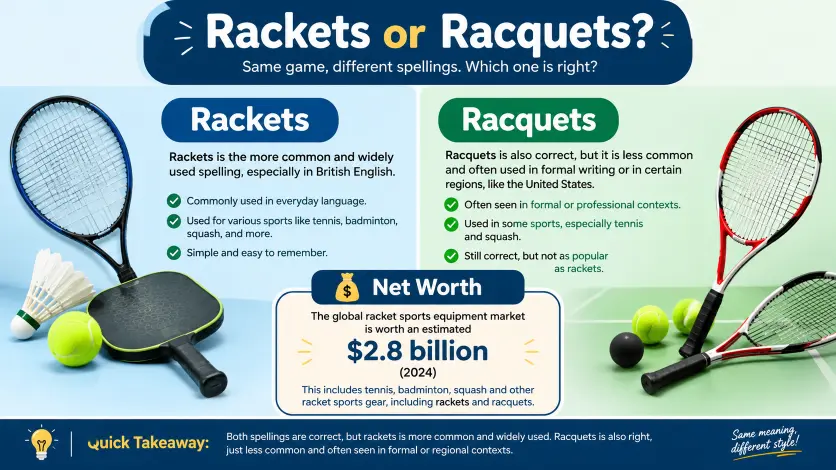
The spelling rackets or racquets can easily create confusion, especially when you see both forms used in sports articles, product descriptions, dictionaries, and everyday writing. Although the two words generally refer to the same type of sports equipment, their spelling and usage can vary depending on regional English and the context in which the word appears. Knowing the distinction can help you write more accurately and understand why different sources may use different forms.
The word racket is widely used in English and can refer to equipment used in sports such as tennis, badminton, and squash. Racquet is another established spelling that is particularly associated with sports terminology and is often seen in formal sporting contexts, organization names, product descriptions, and specialized writing. The choice between the two is not always about one being right and the other being wrong. Instead, language history, regional conventions, and style preferences can influence which form appears in a particular source.
In this guide, we will explore rackets or racquets in detail, including their meanings, spelling differences, regional usage, pronunciation, examples, and common mistakes. The goal is to provide a clear, evidence based explanation that helps readers confidently choose the appropriate form for their writing. Whether you are a student, content writer, sports enthusiast, or simply searching for the correct spelling, understanding how these terms are used can make your writing clearer and more precise.
Rackets vs Racquets: What’s the Difference?
First, rackets and racquets have the same basic meaning. Both are plural nouns referring to sporting implements with a frame, strings, and a handle. The singular forms are racket and racquet.
More importantly, neither spelling represents a different object in ordinary modern usage. Instead, the distinction mainly concerns spelling convention. Racket is the more common form in general English, while racquet remains especially familiar in sports related contexts and in particular varieties of English.
Consequently, a tennis player can talk about a new racket or a new racquet without changing the underlying meaning.
| Feature | Rackets | Racquets |
|---|---|---|
| Part of speech | Plural noun | Plural noun |
| Singular form | Racket | Racquet |
| Basic meaning | Sporting equipment used to strike a ball or shuttlecock | Sporting equipment used to strike a ball or shuttlecock |
| Meaning difference | Usually none | Usually none |
| Common setting | General English and everyday writing | Sports writing and specialized contexts |
| Accepted usage | Yes | Yes |
Therefore, both spellings can be correct when referring to sporting equipment.
However, rackets is generally the simpler choice for broad audiences.
Meanwhile, racquets can appear naturally in sports organizations, club names, product descriptions, and specialist writing.
Ultimately, context and consistency matter more than treating one spelling as universally correct.
Is Rackets vs Racquets a Grammar, Vocabulary, or Usage Issue?
Primarily, this is a vocabulary and usage issue rather than a grammar problem.
Grammar determines how a word functions within a sentence. For example, both rackets and racquets can function as plural nouns:
“Those rackets are expensive.”
“Those racquets are expensive.”
In both examples, the grammatical structure is identical.
Furthermore, the two spellings are generally interchangeable when the intended meaning is sporting equipment. Therefore, changing from one form to the other normally does not alter the sentence’s meaning.
However, usage preferences can vary. General publications may favor rackets, whereas sporting institutions or specialist communities may prefer racquets.
In casual communication, either spelling is usually understood immediately. Likewise, in academic writing, either form can work when it is used consistently and appropriately for the selected style guide.
For instance, a university paper discussing tennis equipment could use rackets throughout. Conversely, a sports management report could use racquets if that spelling matches its established terminology.
Thus, the important point is not to imagine a grammatical distinction that does not exist. Instead, consider audience, regional convention, publication style, and consistency.
Rackets: Meaning and Practical Usage
The spelling rackets is the plural form of racket when the subject is sporting equipment.
For example, a tennis coach might say, “The players placed their rackets beside the court.” Here, rackets clearly identifies several pieces of equipment.
Moreover, this spelling works naturally across everyday, professional, educational, and digital environments.
Workplace Example
Consider a sporting goods store preparing an inventory report:
“The warehouse received 250 tennis rackets this morning.”
Here, rackets functions as a plural noun describing physical products.
Consequently, this spelling is suitable for invoices, product descriptions, inventory records, staff communication, and customer service messages.
Academic Example
A research paper might state:
“The study examined how racket weight affected player performance.”
In this context, the singular form racket describes the equipment being investigated. Therefore, the plural form would be appropriate when discussing several pieces.
Technology Example
Suppose a sports application displays equipment information:
“Players can compare rackets by weight, grip size, and string tension.”
Here, rackets fits naturally within a digital interface.
Therefore, developers, editors, and product writers can safely use the form when their chosen terminology follows that convention.
Usage recap: Rackets is a widely recognized plural spelling. Consequently, it is a practical choice for general communication, especially when the intended audience is broad.
Racquets: Meaning and Practical Usage
Similarly, racquets is the plural form of racquet. It identifies the same general type of sporting equipment.
For example:
“The club replaced its old racquets before the tournament.”
Here, racquets refers to multiple sporting implements. The meaning does not fundamentally differ from rackets.
Furthermore, the spelling can feel particularly natural in specialist sporting contexts.
Workplace Example
A professional tennis club might write:
“The equipment manager inspected all racquets before the competition.”
This usage is completely understandable and grammatically sound.
Academic Example
A sports science article could state:
“Participants selected racquets according to their preferred grip size.”
Again, the spelling does not create a different grammatical function.
Technology Example
A digital equipment catalog could organize products under the heading:
“Performance Racquets.”
In such a setting, the spelling may reflect the terminology preferred by a particular brand, club, retailer, or sporting community.
Usage recap: Racquets is an established spelling with the same core meaning as rackets. Therefore, it should not automatically be treated as incorrect simply because another publication prefers rackets.
When You Should NOT Use Rackets or Racquets
Because these spellings have the same sporting meaning, the most important mistakes involve context and unintended meanings.
- Do not use either spelling when you mean noise.
The word racket can also mean a loud or unpleasant noise. Therefore, “The children made several rackets” could create ambiguity if the intended meaning is sporting equipment.
- Do not assume racquets describes a completely different object.
Although specialist terminology may create subtle preferences, racquets normally does not identify a separate category of sporting equipment.
- Do not switch spellings randomly within one document.
Consistency improves readability. Therefore, if a publication chooses rackets, continuing with that form usually creates a cleaner presentation.
- Do not treat racquets as a verb.
Both rackets and racquets function here as plural nouns. They do not represent two different actions.
- Do not choose a spelling merely because it looks more sophisticated.
A less familiar spelling is not automatically more authoritative.
- Do not change a quotation unnecessarily.
If a source uses racquets, preserving the original spelling may be appropriate when reproducing the wording.
- Do not assume regional preferences are universal.
Different readers may encounter one form more frequently than the other.
- Do not confuse spelling preference with meaning.
The central distinction is convention, not the identity of the sporting object.
Common Mistakes and Decision Rules
The following examples show how the two forms operate in ordinary sentences.
| Correct sentence | Incorrect sentence | Explanation |
|---|---|---|
| The players bought new rackets. | The players bought new racket. | The subject refers to several pieces of equipment, so a plural form is needed. |
| She selected two racquets. | She selected two racquet. | The number two requires the plural noun. |
| This racket is lightweight. | This rackets is lightweight. | A singular subject requires the singular form. |
| The club sells tennis racquets. | The club sells tennis racquet. | Several products are being described, so the plural is appropriate. |
| These rackets have stronger strings. | These racket have stronger strings. | The demonstrative and verb require a plural noun. |
Decision Rule Box
If you mean sporting equipment, either racket or racquet can normally be used. If you mean several pieces of that equipment, use rackets or racquets. Choose one spelling according to audience, regional convention, or house style, then remain consistent.
This rule is more accurate than the often repeated instruction to use one form for an action and another for a person or tool. In this case, both terms are nouns referring to equipment.
Rackets and Racquets in Modern Technology
Modern digital products frequently display terminology related to sporting equipment. For example, tennis applications may record racket weight, balance, grip size, string tension, and player preferences.
Likewise, online stores may categorize products using either rackets or racquets. Therefore, users can encounter both spellings while comparing equipment.
Furthermore, predictive writing systems and language tools may suggest one spelling more frequently than another. Such suggestions do not necessarily mean that the alternative is wrong.
Instead, these systems often reflect training patterns, regional usage, dictionary preferences, or the wording commonly found in their underlying language data.
Consequently, writers should verify the intended context rather than treating an automated suggestion as an absolute grammatical rule.
Etymology and the Story Behind the Spellings
The history of racket and racquet helps explain why two spellings remain in use.
The English word developed through European language history and has been associated with several earlier forms. Over time, English speakers adopted different spellings, while sporting terminology continued to develop across regions.
The spelling racquet is especially associated with French influenced usage and specialist sporting contexts. Meanwhile, racket became the more broadly familiar English spelling.
Therefore, the coexistence of the two forms is not a recent internet invention. Instead, it reflects the natural development of English spelling conventions.
An expert style principle can summarize the issue:
“When two established spellings share the same meaning, context and consistency matter more than unnecessary correction.”
This principle is particularly useful for editors because spelling variation does not automatically indicate a language error.
Two Practical Case Studies
Case Study 1: Tennis Club Communication
Imagine a tennis club preparing a membership handbook. The document repeatedly uses the phrase tennis rackets. A later section suddenly changes to tennis racquets.
The factual meaning remains unchanged. However, the inconsistent terminology can make the document appear less carefully edited.
Therefore, the practical result is clear: selecting one spelling throughout the handbook produces greater consistency without changing the information itself.
Case Study 2: Sporting Product Catalog
Now consider an online retailer selling tennis equipment. Its product database contains both rackets and racquets as category labels.
Although shoppers may understand both forms, inconsistent categorization can make product discovery less straightforward. Consequently, a controlled vocabulary can improve organization.
The concrete editorial result is that standardizing category terminology reduces unnecessary variation within the catalog while preserving the same underlying product meaning.
Error Prevention Checklist
Always use Rackets when
- Your publication normally follows the general spelling racket.
- Your audience is broad and you want familiar wording.
- Your surrounding content already uses racket consistently.
- Your editorial guide specifies the spelling.
- You are writing general educational material and have no reason to prefer the alternative.
Always use Racquets when
- Your established sporting terminology uses racquet.
- Your organization consistently uses that spelling.
- A quoted source specifically uses racquets and the wording should remain faithful.
- Your selected regional or specialist convention favors the form.
- A product or organization officially uses that spelling in its name or terminology.
Most importantly, neither list means the other spelling is inherently wrong.
Related Grammar Confusions You Should Master
Once you understand rackets or racquets, several other spelling and usage contrasts become easier to recognize.
- Practice or practise: noun and verb distinctions in varieties of English.
- Advice or advise: noun versus verb.
- License or licence: spelling variation between American and British usage.
- Color or colour: regional spelling preference.
- Center or centre: differences between American and British conventions.
- Traveler or traveller: variation involving consonant doubling.
- Canceled or cancelled: regional and editorial differences.
- Organize or organise: alternate spelling conventions.
- Program or programme: context and regional usage.
- Theater or theatre: regional spelling variation.
Consequently, the broader lesson is valuable: English spelling differences often reflect geography, history, editorial style, or established convention rather than differences in meaning.
Advanced FAQs
Are rackets and racquets the same thing?
Yes. In ordinary sporting usage, rackets and racquets are plural spellings referring to the same type of equipment. The principal difference is spelling preference rather than meaning.
Is racket or racquet the correct spelling?
Both spellings are accepted. However, racket is generally the more familiar spelling in broad English usage, while racquet remains common in sports related contexts.
Which is more common, rackets or racquets?
Rackets is generally more widespread in general English. Nevertheless, racquets continues to appear frequently in sporting terminology, product names, clubs, and specialist contexts.
Should I write tennis rackets or tennis racquets?
Either phrase can be correct. Therefore, choose according to your audience, regional convention, organizational style, or preferred dictionary standard.
Is racquet an incorrect spelling of racket?
No. Racquet is an established spelling. Consequently, treating it as a simple misspelling would be inaccurate.
What is the singular of racquets?
The singular form is racquet. Therefore, one item is a racquet, while several items are racquets.
What is the plural of racket?
The plural form is rackets. Therefore, one item is a racket, while multiple items are rackets.
Are rackets and racquets interchangeable?
In most sporting contexts, yes. Both forms normally communicate the same meaning. However, a particular organization or publication may prefer one spelling for consistency.
Which spelling should I use in formal writing?
Either can work in formal writing. Nevertheless, consistency is important. Therefore, follow the relevant style guide or the terminology already established by your organization.
Why are there two spellings for the same sporting equipment?
English has developed through contact with several languages and regional traditions. Consequently, alternative spellings can survive even when their meanings remain essentially identical.
Final Takeaway
Ultimately, rackets and racquets are established plural spellings for sporting equipment. Neither one represents a separate grammatical category, and neither should automatically be labeled wrong. Instead, the distinction is primarily one of spelling convention, audience expectation, regional preference, and editorial consistency.
For general communication, rackets is often the straightforward choice because it is widely familiar. However, racquets remains perfectly suitable when it matches a sporting organization, publication, product category, or established style.
Therefore, the most useful rule is simple: identify your audience, check the preferred convention, and maintain the same spelling throughout your content. Above all, don’t invent a difference in meaning where established English usage does not require one.









