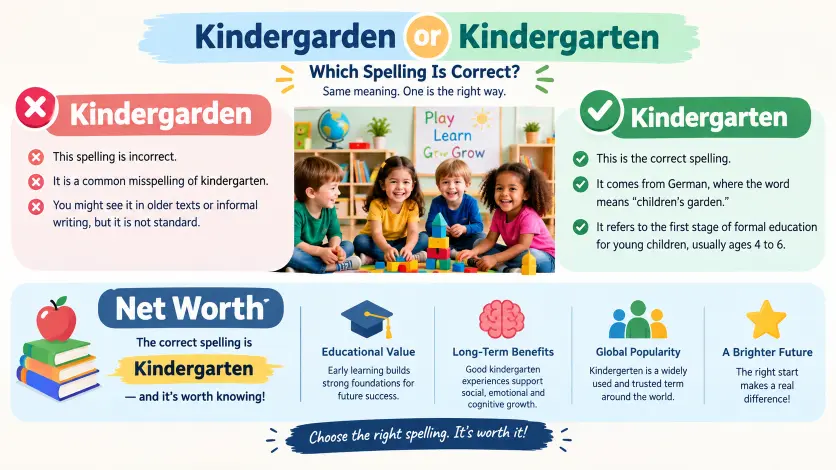
When writing about early education, even a small spelling mistake can create confusion. One of the most common examples is “kindergarden or kindergarten,” especially among students, parents, teachers, and people learning English. The two spellings look very similar, but they are not interchangeable in standard English. Knowing which form is correct can help you write school applications, educational content, emails, assignments, and everyday messages more accurately. This guide explains the difference in simple language and shows how the correct term is used in real English contexts.
The correct spelling is kindergarten, while kindergarden is a common misspelling. The word “kindergarten” originally comes from German and literally refers to a “children’s garden.” Over time, it became an established English term for an early stage of formal education for young children. Because “garden” is a familiar English word, some people naturally write “kindergarden” instead. However, standard dictionaries and established educational usage recognize kindergarten as the correct spelling.
Understanding this distinction is useful for anyone who wants to communicate clearly and professionally. Whether you are a parent filling out a school form, a teacher preparing educational material, a student completing an assignment, or a content writer researching early education terminology, using the standard spelling matters. In the sections ahead, we will examine kindergarden or kindergarten, explain why the mistake happens, clarify the meaning and pronunciation, and provide practical examples so you can confidently choose the correct word.
Kindergarden or Kindergarten: What’s the Difference?
The central difference is simple: kindergarten is the accepted English word, whereas kindergarden is a misspelling.
The confusion often happens because the ending “garden” looks familiar and seems logical. However, the word does not refer to a garden in the ordinary English sense. Instead, it comes from German and describes an early educational environment for young children.
| Term | Part of speech | Standard English? | Meaning | Recommended use |
|---|---|---|---|---|
| Kindergarten | Noun | Yes | An early childhood education class or school | Use this form |
| Kindergarden | Noun | No | Common misspelling of kindergarten | Avoid in formal writing |
Moreover, kindergarten can describe either a class level or an educational setting, depending on context.
For example, a parent might say, “My child starts kindergarten next year.” Similarly, a school might announce, “Kindergarten registration begins in August.”
Therefore, the practical distinction is straightforward.
Kindergarten is the correct spelling.
Kindergarden is a spelling error.
The two forms aren’t interchangeable in standard English.
For school, work, publishing, and academic contexts, choose kindergarten.
Is Kindergarden vs Kindergarten a Grammar, Vocabulary, or Usage Issue?
Primarily, this is a spelling and vocabulary usage issue, rather than a grammatical difference.
Both forms appear to function as nouns when people use them in sentences. However, only kindergarten belongs to standard English vocabulary.
Furthermore, changing the final part from “garten” to “garden” changes the appearance of the word without creating a legitimate alternative spelling.
In formal writing, this distinction matters because spelling communicates accuracy and familiarity with established vocabulary. Consequently, students may lose marks for using kindergarden, while professional writers may receive corrections from editors.
In casual communication, readers can usually understand kindergarden from context. Nevertheless, understanding doesn’t make the spelling correct.
Academic writing requires greater precision. Therefore, use kindergarten in essays, reports, applications, educational documents, lesson plans, and professional communication.
Similarly, digital writing benefits from the standard form because search systems, spell checkers, dictionaries, and educational platforms generally recognize kindergarten as the established word.
Why Do People Write Kindergarden Instead of Kindergarten?
The mistake has a surprisingly understandable cause.
First, the word contains a familiar English sequence that resembles garden. Because “garden” is a common English noun, writers may unconsciously replace the less familiar “garten” with the familiar spelling.
Furthermore, English contains many words whose spelling doesn’t closely match their pronunciation. As a result, people often rely on sound when writing unfamiliar vocabulary.
The pronunciation can also contribute to uncertainty. Someone who has heard the word frequently but hasn’t seen it written may naturally construct a spelling based on what they hear.
Additionally, children learning to write may encounter the word before they have developed strong spelling habits. Therefore, variants such as kindergarden can appear in informal school communication.
However, once the standard spelling is known, the distinction becomes easy to remember.
A useful memory aid is this: kindergarten keeps the original “garten” ending.
Kindergarden: Meaning, Usage, and Common Problems
Kindergarden is generally intended to mean the same educational level as kindergarten. However, it isn’t the standard spelling.
For example, someone might write:
“My daughter will enter kindergarden this fall.”
The intended meaning is clear. Nevertheless, the sentence should be corrected to:
“My daughter will enter kindergarten this fall.”
Workplace example
Consider an employee preparing a report about childcare support:
“The company provides assistance for employees with children entering kindergarten.”
Here, kindergarten is appropriate because the document is professional.
Using kindergarden could make the report appear less carefully edited.
Academic example
A student writing an education paper might state:
“Kindergarten provides an important transition into formal schooling.”
This wording is suitable for academic discussion.
By contrast, replacing kindergarten with kindergarden introduces an unnecessary spelling error into otherwise correct work.
Technology example
Educational software might contain a menu labeled:
“Kindergarten Activities”
The standard spelling makes the interface clearer and more consistent with educational terminology.
Usage recap: Kindergarden may be understood, but it isn’t the preferred spelling. Consequently, use kindergarten whenever accuracy matters.
Kindergarten: Meaning, Usage, and Correct Examples
Kindergarten is a noun referring to an early stage of formal education for young children.
The term is widely used in discussions involving schools, child development, classroom learning, and early education.
For instance:
“My niece enjoys kindergarten.”
Likewise:
“The school opened a new kindergarten classroom.”
Workplace example
A human resources document might explain:
“Employees can request flexible schedules when their children begin kindergarten.”
Here, the standard spelling supports clear professional communication.
Academic example
An education researcher might write:
“Early classroom experiences can influence children’s adjustment to kindergarten.”
Therefore, the word works naturally in scholarly discussion.
Technology example
A learning platform could categorize resources under:
“Kindergarten Reading Practice”
Likewise, educational applications frequently use the standard spelling when organizing age appropriate materials.
Usage recap: Kindergarten is the established noun. Consequently, it should be used in educational, professional, academic, and everyday contexts.
When You Should NOT Use Kindergarden or Kindergarten
Although kindergarten is the correct form, context still determines whether the word itself is appropriate.
1. When discussing a different educational level
If you’re referring to preschool, nursery education, or another early learning stage, don’t automatically substitute kindergarten.
2. When quoting an original spelling
If you’re reproducing an historical document or an exact quotation, preserve the original wording when appropriate. However, explain unusual spelling when readers might become confused.
3. When describing German language directly
The German word Kindergarten has its own linguistic history and usage. Therefore, don’t treat it as though it originated as an ordinary English compound.
4. When writing about a garden
A physical garden has a completely different meaning. Consequently, the presence of “garden” in kindergarden can create a misleading visual association.
5. When creating educational materials
Teachers and publishers should use the established spelling because children may learn vocabulary directly from these materials.
6. When completing official forms
School enrollment documents, applications, records, and correspondence should use the standard spelling.
7. When preparing academic assignments
Students should avoid kindergarden because spelling errors can reduce the perceived quality of otherwise strong work.
8. When writing professional content
Reports, workplace documents, presentations, and public materials should consistently use kindergarten.
Common Mistakes and Decision Rules
The following examples demonstrate how the spelling problem appears in ordinary sentences.
| Correct sentence | Incorrect sentence | Explanation |
|---|---|---|
| My child starts kindergarten in September. | My child starts kindergarden in September. | Kindergarten is the standard spelling. |
| She teaches kindergarten students. | She teaches kindergarden students. | The educational level is kindergarten. |
| The school renovated its kindergarten room. | The school renovated its kindergarden room. | The noun requires the established spelling. |
| Kindergarten children participated in the activity. | Kindergarden children participated in the activity. | Kindergarden is a misspelling. |
| He works in a kindergarten classroom. | He works in a kindergarden classroom. | The standard educational term is kindergarten. |
Decision Rule Box
If you mean the established early childhood educational setting, use kindergarten.
The requested action, person, or tool rule does not apply to this particular spelling pair because neither word represents an action, person, or tool. Instead, the decision depends on whether you’re referring to the recognized educational term.
Therefore, remember:
Kindergarten = correct standard spelling
Kindergarden = misspelling
Kindergarden or Kindergarten in Modern Technology and Digital Tools
Digital technology has made spelling consistency increasingly visible.
For example, online forms, educational platforms, classroom management systems, and writing software may automatically flag unusual spellings.
Furthermore, predictive text can reinforce the standard form when users begin typing kindergarten.
However, automatic correction shouldn’t be treated as the only authority. Some systems may contain incomplete dictionaries, custom terminology, or inconsistent language settings.
Consequently, writers should still understand the underlying spelling.
This matters particularly for educators and content creators because repeated spelling errors can spread quickly through worksheets, presentations, digital classrooms, and downloadable materials.
Additionally, consistent terminology helps students encounter the same vocabulary across different learning environments.
Where Did the Word Kindergarten Come From?
The history of kindergarten explains why the spelling can seem unusual to English speakers.
The word comes from German. It literally combines Kinder, meaning children, with Garten, meaning garden.
The educational concept is associated with Friedrich Fröbel, who developed the kindergarten approach in the nineteenth century.
The “garden” idea was metaphorical. Children were viewed as developing naturally with appropriate care and guidance.
Therefore, garten isn’t a random spelling choice. It reflects the word’s German origin.
When the term entered English, the original form remained recognizable. Over time, kindergarten became established in English vocabulary.
Consequently, changing “garten” to “garden” isn’t an accepted English spelling variation. Instead, it creates a familiar looking but incorrect form.
An expert style perspective
“When a borrowed word has become established in English, its standard spelling should be learned as vocabulary rather than reconstructed from familiar sounds.”
That principle is useful beyond this particular example.
Two Practical Case Studies
Case Study 1: A School Communication
Imagine a school preparing a welcome letter for families.
The draft repeatedly uses “kindergarden.” Although families can understand the intended meaning, the administration changes every occurrence to kindergarten before publication.
The concrete result is greater consistency across the letter, registration materials, classroom labels, and parent communications.
The important lesson is that one spelling decision can affect an entire collection of educational materials.
Case Study 2: A Student Assignment
Consider a student writing an assignment about early childhood education.
The student understands the subject well but repeatedly writes “kindergarden.” During proofreading, those instances are corrected to kindergarten.
The concrete result is a cleaner final submission with the established terminology used consistently.
Therefore, proofreading unfamiliar educational vocabulary can prevent small spelling problems from distracting readers from the underlying ideas.
Error Prevention Checklist
Before publishing or submitting a document, use this quick check.
Always use kindergarten when:
You mean an early childhood educational level.
You are writing a school document.
You are preparing an academic assignment.
You are communicating with parents or educators.
You are creating classroom materials.
You are writing a professional report.
You are labeling an educational resource.
You want the standard English spelling.
Never use kindergarden when:
You are writing formal English.
You are preparing educational content.
You are completing school documentation.
You are writing an academic paper.
You are creating professional communication.
You are editing published material.
You are preparing instructional resources.
You simply mean the standard educational term.
Related Grammar Confusions You Should Master
Learning spelling distinctions can make other commonly confused terms easier to recognize.
Consider studying these pairs as well:
- Principal vs principle
- Advice vs advise
- Affect vs effect
- Their vs there vs they’re
- Your vs you’re
- Its vs it’s
- Than vs then
- Lose vs loose
- Stationary vs stationery
- Accept vs except
Furthermore, these pairs demonstrate an important language principle: words that sound similar or look similar aren’t necessarily interchangeable.
Therefore, context, meaning, spelling, and grammatical function should all be considered before choosing a word.
Advanced FAQs
What is the correct spelling, kindergarden or kindergarten?
The correct standard spelling is kindergarten. Kindergarden is a common misspelling. Therefore, use kindergarten in formal, academic, educational, and professional writing.
Why is kindergarten spelled with garten?
Kindergarten comes from German. The German elements relate to children and garden, which explains the unusual “garten” ending. Consequently, the original spelling differs from the familiar English word garden.
Is kindergarden an accepted spelling?
No. Kindergarden isn’t the standard English spelling of the educational term. Although readers generally understand it, writers should use kindergarten instead.
Why do people spell kindergarten as kindergarden?
People often make this mistake because garden is a familiar English word. Furthermore, pronunciation can encourage writers to reconstruct an unfamiliar spelling according to what they hear.
Is kindergarten one word or two words?
Kindergarten is normally written as one word. It functions as a noun referring to an early educational level or setting.
Should I use kindergarten in academic writing?
Yes. Kindergarten is the established spelling and is appropriate for academic writing when discussing the relevant educational stage.
Is kindergarten a noun?
Yes. Kindergarten is primarily used as a noun. For example, “The child attends kindergarten” uses kindergarten as the name of an educational setting or level.
Can kindergarden ever be correct?
In ordinary modern English, kindergarden isn’t the standard spelling. It might appear when someone is intentionally reproducing an original misspelling, but normal writing should use kindergarten.
How can I remember the spelling of kindergarten?
Remember the German origin and focus on the ending garten rather than changing it to garden. Writing the word several times can also reinforce the correct spelling.
Is kindergarten the same everywhere?
Not necessarily. Educational systems differ between countries and regions. Therefore, although the spelling remains standard, the exact age range, curriculum, and structure associated with kindergarten can vary.
Final Verdict:
When choosing between kindergarden or kindergarten, use kindergarten.
The distinction isn’t about two competing English spellings with different meanings. Instead, it is a matter of standard spelling versus a common error. Kindergarten is the established noun for an early childhood educational setting or level. Meanwhile, kindergarden usually results from replacing the unfamiliar German derived “garten” with the familiar English word “garden.”
Therefore, whenever you write about classrooms, early education, school registration, teachers, young learners, educational programs, or related subjects, choose kindergarten. Most importantly, remember that familiarity can sometimes create spelling mistakes.
Because garden is such a recognizable English word, kindergarden may look natural at first glance. Nevertheless, the established form preserves the original garten ending. Once that distinction becomes familiar, the confusion is easy to eliminate.









