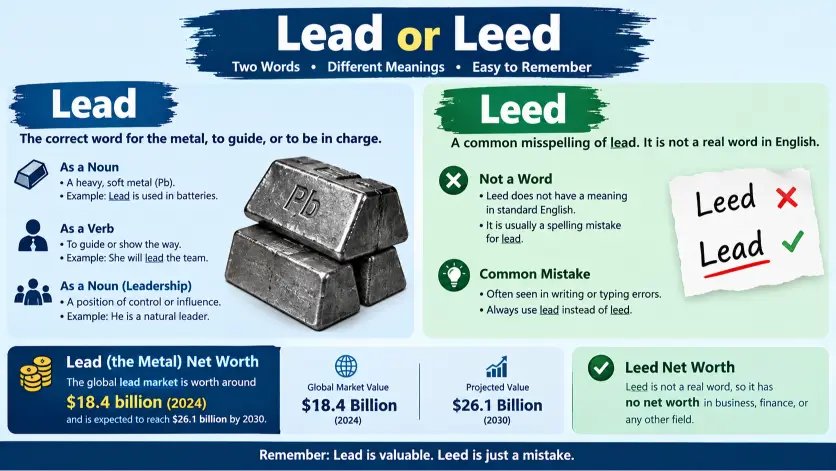
Have you ever written “lead” or “leed” and stopped to wonder whether you chose the right word? You are not alone. These terms can cause confusion because lead has more than one pronunciation and meaning, while leed is generally not the standard spelling for the meanings people intend. A small spelling mistake can completely change how clear and professional your writing appears, especially in emails, schoolwork, business communication, and online content. Understanding the difference becomes much easier once you know how each word is pronounced and where it is correctly used.
In this guide, we will explain lead or leed in simple English, including their meanings, pronunciations, correct spelling, and practical examples. You will also learn why people confuse these words and how to quickly decide which form belongs in your sentence. Whether you are improving your everyday English or checking a sentence before publishing it, this clear comparison will help you use the correct word with confidence.
Lead or Leed: What’s the Difference?
At first, lead and leed may appear to be two possible spellings of the same sound. However, standard English treats them differently. Lead is the established spelling, while leed is usually a phonetic attempt to spell the sound of the word.
Most importantly, lead has several meanings. As a verb, it means to guide, direct, control, or take someone somewhere. For example, She will lead the team means that she will guide or manage the team.
As a noun, lead can describe a position in front or an advantage. For example, Our team has the lead means that the team is ahead.
Interestingly, lead can also refer to a chemical element. In that meaning, it is pronounced like “led,” not “leed.” Therefore, pronunciation depends on meaning, while the written form remains lead.
| Word | Part of Speech | Meaning | Pronunciation | Example |
|---|---|---|---|---|
| Lead | Verb | To guide or direct | Like “leed” | She will lead the team. |
| Lead | Noun | A position ahead | Like “leed” | They have the lead. |
| Lead | Noun | A chemical element | Like “led” | The paint contains lead. |
| Leed | Not normally standard | Phonetic spelling of lead | Like “leed” | Generally avoid this spelling. |
Therefore, if you hear someone say “leed” and mean to guide, the written word you need is lead.
Likewise, if someone is talking about the chemical element, the spelling is still lead, even though the pronunciation changes.
Quick Recap
Lead is the standard spelling.
Leed is generally an incorrect spelling when replacing lead.
When lead means guide or direct, it sounds like “leed.”
When lead means the metal, it sounds like “led.”
Consequently, context helps determine pronunciation, but it does not normally change the spelling.
Is Lead or Leed a Grammar, Vocabulary, or Usage Issue?
The confusion is mainly a spelling and pronunciation issue, although vocabulary and usage also play an important role.
When people hear the verb lead, they often notice that it sounds like the letters “leed.” Consequently, they may assume that leed must be the written form. However, English spelling does not always follow pronunciation exactly.
For instance:
The captain will lead the team.
Here, lead means guide or direct. It sounds like “leed.”
Now consider:
The old pipe contains lead.
Here, lead means the chemical element. This time, it sounds like “led.”
Therefore, the two meanings create a pronunciation difference, but neither requires the spelling leed.
In formal writing, academic assignments, workplace documents, reports, and professional communication, lead should be used according to the intended meaning.
Furthermore, leed should not normally be treated as an informal alternative spelling. Although it may occasionally appear in usernames, names, phonetic writing, or creative contexts, it does not replace the standard spelling of lead.
How to Use Lead Correctly
The word lead is extremely common because it can describe guidance, direction, influence, progress, or a position ahead.
As a verb, it commonly appears before an object:
The manager will lead the meeting.
Here, the manager is responsible for guiding the meeting.
Similarly:
Good communication can lead to better results.
In this sentence, lead to describes a connection between one situation and its result.
As a noun, the word can describe an advantage:
The runner has a comfortable lead.
It can also describe responsibility:
She took the lead during the discussion.
Consequently, recognizing the role of the word in the sentence makes its meaning easier to understand.
Workplace Example
In professional communication, you might write:
Daniel will lead the new marketing project.
The sentence means that Daniel will guide or manage the project.
Another example is:
Our director took the lead during the negotiations.
Here, lead refers to the position of responsibility or control.
Academic Example
Academic writing also uses the word frequently:
These findings may lead to further research.
Here, lead to means that one result may cause or contribute to another development.
Similarly:
The evidence could lead researchers to reconsider the original theory.
Again, lead describes movement toward a conclusion or decision.
Technology Example
Technology related writing commonly includes the same construction:
A faster processor can lead to improved performance.
Likewise:
Poor configuration may lead to unexpected errors.
In both examples, lead describes a possible result.
Usage Recap
Use lead when you mean guide, direct, cause, result in, or remain ahead. Moreover, use the same spelling when referring to the chemical element, although its pronunciation changes.
How to Understand Leed
The spelling leed creates confusion because it represents the sound that many people hear when lead is used as a verb.
For example, imagine someone says:
I will lead the group.
The pronunciation sounds like:
I will “leed” the group.
However, English speakers do not normally write the sound as leed. The established spelling is lead.
Therefore, the mistake happens when someone tries to spell a familiar word entirely according to how it sounds.
This is especially common among English learners, children, fast typists, and people writing informal messages. Nevertheless, standard written English uses lead.
Incorrect Example
She will leed the discussion.
Correct Example
She will lead the discussion.
The pronunciation stays the same. Only the spelling is corrected.
Workplace Example
Incorrect:
The supervisor will leed the team.
Correct:
The supervisor will lead the team.
The second sentence follows standard English spelling.
Academic Example
Incorrect:
The results may leed to further investigation.
Correct:
The results may lead to further investigation.
Technology Example
Incorrect:
This update could leed to better performance.
Correct:
This update could lead to better performance.
Usage Recap
Leed should generally not replace lead in standard writing. If the word sounds like “leed” because it means guide or direct, that is still spelled lead.
When You Should NOT Use Lead or Leed
Understanding when not to use a particular form can prevent mistakes before they happen.
1. Do Not Write Leed for the Verb Lead
If you mean guiding or directing someone, write lead.
Correct:
She will lead the group.
Incorrect:
She will leed the group.
2. Do Not Write Leed for a Position of Advantage
If someone is ahead in a competition, the noun is lead.
Correct:
The team has a three point lead.
Incorrect:
The team has a three point leed.
3. Do Not Use Leed for Lead to
The expression lead to means that something causes or contributes to a result.
Correct:
Exercise can lead to better health.
Incorrect:
Exercise can leed to better health.
4. Do Not Replace Lead With Leed in Academic Work
University essays and research papers should use standard spelling.
Correct:
The evidence may lead to a different conclusion.
5. Do Not Use Leed in Professional Documents
Reports, emails, presentations, and workplace instructions should use lead.
6. Do Not Write Leed for the Chemical Element
Even though the metal is pronounced “led,” its spelling is still lead.
Correct:
The material contains lead.
7. Do Not Assume Every Sound Has One Matching Spelling
English contains many words whose spelling cannot be predicted simply by listening. Therefore, pronunciation alone isn’t a reliable spelling guide.
8. Do Not Confuse Lead With Leader
If you mean a person who guides others, leader is usually the appropriate noun.
Correct:
She is the team leader.
Not:
She is the team leed.
Common Mistakes With Lead or Leed
This is where many writers make errors. The easiest solution is to look at the meaning of the sentence before choosing the spelling.
Mistake 1: Writing Leed Instead of Lead
A person may hear:
He will lead the meeting.
Because lead sounds like “leed,” they may write:
He will leed the meeting.
This is incorrect in standard English.
Why? Because the established spelling of the verb is lead.
Remember: If someone guides or directs something, write lead.
Mistake 2: Writing Leed in “Lead To”
Another frequent mistake occurs in the phrase lead to.
Incorrect:
Lack of sleep can leed to poor concentration.
Correct:
Lack of sleep can lead to poor concentration.
Why? The phrase lead to means that one thing causes or contributes to another.
Remember: The expression is always spelled lead to.
Mistake 3: Writing Leed When Someone Is Ahead
Consider a sports report:
The home team has the lead.
Some writers may incorrectly write:
The home team has the leed.
That spelling is not standard.
Why? The noun describing an advantage or position ahead is spelled lead.
Mistake 4: Confusing Lead With Led
This mistake is different because led is a real English word.
Compare:
She will lead the team tomorrow.
and:
She led the team yesterday.
The first sentence uses the present form lead. The second uses the past tense led.
Therefore, don’t write leed when you mean led, either.
Mistake 5: Mispronouncing Lead as Led
The opposite problem can also happen.
Consider:
She will lead the department.
Here, lead is pronounced like “leed.”
However:
The old pipes contain lead.
Here, lead is pronounced like “led.”
Consequently, the meaning determines the pronunciation.
Mistake 6: Assuming Lead Always Has the Same Sound
Although the spelling remains lead, its pronunciation isn’t always identical.
When it means guide, pronounce it like “leed.”
When it means the metal, pronounce it like “led.”
Mistake 7: Creating Leed From Sound
Some writers believe that spelling a word according to its sound makes it easier to understand.
However, standard English uses established spellings rather than personal phonetic versions.
Therefore:
lead
is correct, while:
leed
is generally not.
Simple Rule to Remember
Ask yourself one question:
What does the word mean?
If it means guide or direct, use lead.
If it means being ahead, use lead.
If it means the chemical element, use lead.
If you are thinking about the sound “leed,” don’t change the spelling to leed.
Lead or Leed: Correct Sentence vs Incorrect Sentence
The following examples make the distinction easier to remember.
| Correct Sentence | Incorrect Sentence | Why? |
|---|---|---|
| She will lead the team. | She will leed the team. | The verb meaning guide is spelled lead. |
| He took the lead. | He took the leed. | The noun meaning advantage is lead. |
| This may lead to problems. | This may leed to problems. | The phrase is lead to. |
| They lead the discussion. | They leed the discussion. | The verb is lead. |
| The team has the lead. | The team has the leed. | The advantage is called a lead. |
| The paint contains lead. | The paint contains leed. | The metal is spelled lead. |
| She led the group yesterday. | She lead the group yesterday. | Led is the past tense of lead. |
| He leads the department. | He leeds the department. | Leads is the correct present form. |
Easy Decision Rule
If you mean guide or direct, write LEAD.
If you mean an advantage or position ahead, write LEAD.
If you mean the metal, write LEAD.
If you mean the past tense of guide, write LED.
Do not normally write LEED as the spelling of these meanings.
This rule handles most everyday situations.
Lead and Leed in Modern Technology and Digital Tools
Digital communication has made sound based spelling more noticeable. People often type quickly, dictate messages, or rely on speech recognition. Consequently, words that sound different from their written forms can sometimes cause confusion.
For example, a person might dictate:
This could lead to a problem.
A transcription system must interpret the surrounding context correctly. The intended meaning is important because English contains words whose pronunciation changes according to usage.
Furthermore, digital writing often happens quickly. As a result, people may type leed without checking whether it is the recognized spelling.
However, professional technology documentation should maintain conventional spelling.
For example:
Incorrect configuration can lead to system instability.
The word lead remains correct even though it sounds like “leed.”
Therefore, technology may influence how the mistake appears, but it does not change the underlying English rule.
The Etymology of Lead
The verb lead has a long history in English. It comes from Old English lǣdan, which carried meanings connected with guiding, bringing, conducting, or directing.
Over time, its spelling and pronunciation developed into the modern form used today.
The noun lead referring to the metal has a separate historical origin. Nevertheless, modern English uses the same written form for both meanings.
This historical development helps explain why learners cannot always predict pronunciation from spelling alone.
In other words, the spelling lead has been preserved across different meanings, while pronunciation distinguishes them in modern speech.
Therefore, learning the word through context is more useful than trying to create a separate spelling for every pronunciation.
An Expert Style Explanation
“When pronunciation creates uncertainty, identify the meaning first and then choose the established spelling.”
This principle applies particularly well to lead because one spelling represents different meanings and sounds.
Rather than asking, “How does this word sound?” ask, “What does this word mean in this sentence?”
That small change in thinking can prevent several common spelling mistakes.
Two Practical Case Studies
Case Study 1: Workplace Report
Suppose a company prepares a report about a new management strategy.
The writer wants to say:
Better communication may lead to stronger teamwork.
Because the writer hears the word as “leed,” they initially type leed.
During editing, the sentence becomes:
Better communication may lead to stronger teamwork.
The meaning hasn’t changed. The spelling has simply been corrected to the standard form.
The lesson is straightforward: sound does not determine the spelling.
Case Study 2: Material Safety Discussion
Now imagine a technical document discussing old building materials.
The writer states:
The paint may contain lead.
A reader might notice that the pronunciation is “led.” Nevertheless, the spelling remains lead.
This example demonstrates an important point. The same written word can have different pronunciations because it carries different meanings.
Therefore, context should always be considered before deciding how a word should sound.
Error Prevention Checklist
Always Use Lead When
You mean to guide someone.
You mean to direct a group.
You mean to manage an activity.
You mean to cause or contribute to a result.
You mean a position ahead of others.
You mean an advantage in a competition.
You mean the chemical element.
You are writing a formal document.
Never Use Leed When
You are simply trying to spell the sound of lead.
You mean to guide someone.
You mean a competitive advantage.
You are writing lead to.
You are preparing academic work.
You are writing professional communication.
You are creating technical documentation.
Instead, use the established spelling lead.
Related Grammar Confusions You Should Master
Once you understand lead or leed, several other confusing word pairs become easier to recognize.
Affect or Effect
These words can create uncertainty because their grammatical roles and meanings differ.
Advice or Advise
Advice is generally a noun, whereas advise is a verb.
Their, There, or They’re
These forms can sound similar while having completely different functions.
Your or You’re
Your shows possession, while you’re means you are.
Its or It’s
Its indicates possession, while it’s is a contraction.
Then or Than
Then commonly relates to time or sequence, while than is used for comparisons.
Principal or Principle
Principal can refer to a person or something primary, while principle generally refers to a rule or belief.
Stationary or Stationery
Stationary describes something that isn’t moving, while stationery refers to writing materials.
Complement or Compliment
A complement completes or enhances something, while a compliment is an expression of praise.
Lose or Loose
Lose means to misplace or no longer possess something, while loose means not firmly attached or tight.
Frequently Asked Questions
Is lead or leed the correct spelling?
Lead is the standard spelling. Leed is generally not the correct spelling when you mean to guide, direct, be ahead, or refer to the chemical element.
Is lead pronounced like leed?
Yes, when lead means to guide, direct, or be ahead, it is pronounced like “leed.” However, when it refers to the chemical element, it is pronounced like “led.”
Why is lead pronounced differently?
The word lead has different meanings, and English has retained different pronunciations for those meanings. The verb meaning guide sounds like “leed,” while the noun referring to the metal sounds like “led.”
Is leed a word in English?
Leed isn’t normally the standard spelling for the common meanings of lead. It may appear in particular names or specialized contexts, but writers should generally use lead for the meanings discussed in this article.
What is the past tense of lead?
The past tense of lead is led.
For example:
She leads the team today.
She led the team yesterday.
Therefore, led should not be confused with leed.
What is the difference between lead and led?
Lead is the present form of the verb meaning to guide. Led is the past form.
For example:
They lead the project now.
They led the project last year.
Is lead a noun or a verb?
It can be either. As a verb, lead means to guide or direct. As a noun, it can describe an advantage, a position ahead, or the chemical element.
How do I remember whether to use lead or leed?
Remember one simple rule: the standard spelling is lead. Even when it sounds like “leed,” don’t automatically change the spelling.
Is lead always pronounced the same way?
No. When lead means guide or direct, it sounds like “leed.” When it refers to the chemical element, it sounds like “led.”
Should I use leed in formal writing?
Generally, no. In academic, professional, business, and formal writing, use lead when that is the intended word.
Final Conclusion
The correct standard spelling is lead, not leed, in the common situations discussed here. Although the verb lead is pronounced like “leed” when it means to guide or direct, its spelling remains lead.
Furthermore, the same spelling refers to the chemical element, although that meaning is pronounced like “led.” Therefore, pronunciation can change according to meaning, but the written form does not normally become leed.
The simplest way to remember the distinction is to focus on meaning. If you mean guide, direct, cause, result in, or be ahead, use lead. If you mean the metal, use lead again, but pronounce it differently. If you’re talking about the past action of guiding, use led. Ultimately, leed is usually a spelling mistake caused by hearing the pronunciation of lead.









