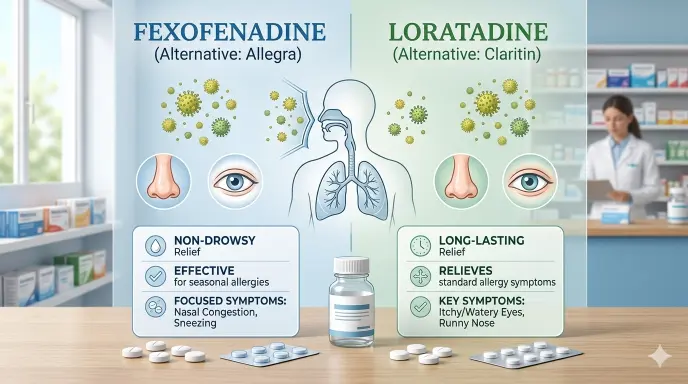
When allergies strike, choosing between Allegra or Claritin can feel surprisingly confusing. Both are popular antihistamines used to help relieve common allergy symptoms such as sneezing, runny nose, itchy eyes, and nasal irritation, but they contain different active ingredients and may affect people differently. So, what actually separates Allegra from Claritin, and which factors should you consider before using either one?
In this guide, we’ll break down Allegra and Claritin in simple, practical language, including their active ingredients, common uses, how they work, potential side effects, duration of action, and important safety considerations. Allegra contains fexofenadine, while Claritin contains loratadine, and both are generally classified as second-generation antihistamines.
However, individual response, other medications, age, and existing health conditions can matter when selecting an allergy medicine. This comparison is designed to provide reliable educational information, while a healthcare professional or pharmacist can help you determine which option is appropriate for your specific situation.
Allegra or Claritin: What’s the Difference?
Allegra is a proper noun used as a brand name for products containing fexofenadine. Claritin is also a proper noun used as a brand name, with loratadine as its active ingredient in standard allergy products.
Both medicines are antihistamines. Consequently, they work by reducing the effects of histamine, a substance involved in many allergy symptoms. Fexofenadine is used for symptoms such as sneezing, runny nose, itchy or watery eyes, and itching associated with hives. Loratadine is likewise used for sneezing, runny nose, nasal or throat itching, and red, itchy, or watery eyes.
| Feature | Allegra | Claritin |
|---|---|---|
| Active ingredient | Fexofenadine | Loratadine |
| Drug class | Antihistamine | Antihistamine |
| Common allergy use | Allergic rhinitis and hives | Allergic rhinitis and hives |
| Typical adult allergy schedule | Depends on product strength | Commonly once daily |
| Food instructions | Product directions matter; take with water | Generally with or without food |
| Fruit juice concern | Yes, certain juices can reduce absorption | No comparable instruction in standard guidance |
| Possible drowsiness | Can occur | Can occur |
| Available forms | Tablets, gelcaps, dissolving tablets, liquid | Tablets, liquid, chewable and dissolving forms |
The important point is that these aren’t simply two names for the same medicine. Instead, they contain different active ingredients.
Both can provide allergy relief, yet an individual may respond differently to each one. Furthermore, product strength and formulation can change instructions, so the package label should always be checked.
Is Allegra or Claritin a Grammar, Vocabulary, or Usage Issue?
This is not a grammar or vocabulary problem in the traditional language sense. Rather, it is a medicine identification and usage distinction.
The two names are not interchangeable when discussing ingredients. Saying that a product contains Allegra does not mean it contains loratadine. Instead, standard Allegra allergy products contain fexofenadine, while standard Claritin allergy products contain loratadine.
Similarly, neither medicine is inherently formal or informal. You may encounter both names in everyday conversations, workplace discussions, pharmacy settings, and educational material.
For academic or professional writing, however, the active ingredient is often clearer. Thus, instead of writing only “I took Allegra,” a medically precise sentence could identify fexofenadine when the ingredient matters.
In casual conversation, brand names are usually sufficient. Nevertheless, healthcare professionals need the exact product, strength, and ingredient when evaluating possible interactions or duplicate therapy.
Allegra: Practical Usage in Everyday Situations
Allegra contains fexofenadine, an antihistamine used to relieve several allergy symptoms and itching associated with hives. According to MedlinePlus, fexofenadine is available in multiple forms and should be taken exactly according to the directions for the particular product.
Workplace example
Suppose an employee develops sneezing, itchy eyes, and a runny nose during pollen season. The person may consider an antihistamine such as fexofenadine for symptom relief.
However, alertness still matters. Although newer antihistamines generally cause less sleepiness than older products, individual reactions vary. Therefore, someone taking a medicine for the first time should understand how it affects them before driving or operating machinery.
Academic example
A student experiencing seasonal allergy symptoms might encounter the same question while preparing for examinations. Since concentration is important, the student should read the product information and consider personal sensitivity to drowsiness.
Technology example
Someone using a medication reminder application might record the medicine by its active ingredient rather than its brand name. Consequently, “fexofenadine” can make the medication easier to distinguish from products containing different antihistamines.
Allegra usage recap
Overall, Allegra refers to a brand associated with fexofenadine. It can help control several allergy symptoms, but its administration instructions deserve particular attention. Most notably, fexofenadine should be taken with water rather than fruit juice such as apple, orange, or grapefruit juice.
Claritin: Practical Usage in Everyday Situations
Claritin contains loratadine in its standard allergy formulations. Like fexofenadine, loratadine belongs to the antihistamine family and works by blocking the effects of histamine.
Workplace example
Imagine someone working outdoors who experiences sneezing and itchy, watery eyes during a high pollen period. Loratadine may be one of the antihistamines considered for symptom control.
Nevertheless, the person should follow the package directions rather than assuming that every allergy product has identical instructions.
Academic example
A university student may use loratadine during seasonal allergy periods while attending lectures or studying. Since drowsiness can occur, the student’s own response remains relevant even though loratadine is generally regarded as a less sedating antihistamine.
Technology example
When entering medication information into a digital health record, identifying “loratadine” can prevent confusion with similarly named products. Likewise, pharmacists can use the active ingredient to check potential medication interactions more accurately.
Claritin usage recap
In short, Claritin is a brand name associated with loratadine. Standard loratadine instructions allow administration with or without food. Even so, users should follow the specific label because formulations and strengths can differ.
When You Should NOT Use Allegra or Claritin
Choosing an allergy medicine involves more than asking which brand sounds familiar. Therefore, several situations deserve extra caution.
1. Do not assume both medicines contain the same ingredient
They don’t. Allegra uses fexofenadine, whereas Claritin uses loratadine.
2. Do not combine antihistamines casually
Taking multiple allergy medicines together can increase the chance of unwanted effects. Instead, check with a pharmacist or healthcare professional before combining products.
3. Do not take fexofenadine with certain fruit juices
Apple, orange, and grapefruit juice can reduce fexofenadine absorption. Water is recommended for administration.
4. Do not ignore other medicines
Drug interactions can change how medicines work or increase unwanted effects. Therefore, provide your pharmacist or clinician with a complete medication list.
5. Do not assume “less drowsy” means “never sleepy”
Both loratadine and fexofenadine can be associated with drowsiness or tiredness. Individual responses differ.
6. Do not use either product as an emergency treatment for anaphylaxis
Severe allergic reactions require urgent medical treatment. Epinephrine is the emergency medicine used for anaphylaxis, not an ordinary antihistamine tablet.
7. Do not rely on adult instructions for children
Children require age appropriate products and directions. Always check the specific pediatric label or ask a healthcare professional.
8. Do not assume persistent symptoms should simply be treated indefinitely
If symptoms remain uncontrolled, recur frequently, or become unusual, professional evaluation may identify another cause or a treatment that better fits the symptoms.
Common Mistakes: Allegra or Claritin
| Correct sentence | Incorrect sentence | Explanation |
|---|---|---|
| Allegra contains fexofenadine. | Allegra contains loratadine. | The active ingredients are different. |
| Claritin contains loratadine. | Claritin and Allegra contain the same medicine. | Their standard active ingredients differ. |
| I take fexofenadine with water. | I take fexofenadine with orange juice. | Certain fruit juices can reduce absorption. |
| Loratadine is an antihistamine. | Loratadine is a decongestant. | Loratadine belongs to the antihistamine class. |
| I check the product label before dosing. | All allergy tablets have identical directions. | Formulations and strengths vary. |
| I ask a pharmacist before combining allergy medicines. | I can safely combine any two antihistamines. | Combination therapy requires appropriate professional guidance. |
Decision Rule Box
If you mean the active ingredient, identify fexofenadine for standard Allegra products and loratadine for standard Claritin products.
If you mean the brand, use Allegra for products marketed under that name and Claritin for products marketed under that name.
Unlike a grammar comparison, there is no universal rule saying one medicine should always replace the other. The appropriate choice depends on the specific product, symptoms, medical history, other medicines, and individual response.
Allegra or Claritin in Modern Technology
Modern health applications increasingly organize medicines according to active ingredients, strengths, and schedules. Consequently, understanding the difference between fexofenadine and loratadine can make digital medication records more accurate.
For example, a medication reminder may ask for the exact ingredient rather than merely the brand. Similarly, electronic pharmacy systems can use ingredient information when checking for potential interactions.
Nevertheless, technology should not replace professional medication advice. A digital tool may identify a possible interaction, but a pharmacist or clinician can interpret that information in the context of the person’s complete medication history.
Etymology and Medical Naming
The names fexofenadine and loratadine are generic pharmaceutical names rather than ordinary English words. Their endings reflect standardized drug naming conventions used to identify medicines within particular pharmacological families.
Meanwhile, Allegra and Claritin are commercial brand names. Therefore, they serve a different naming purpose.
This distinction is useful because pharmaceutical packaging often presents both the brand and active ingredient. Reading both names can reduce medication errors, particularly when several allergy products are available on the same shelf.
What Research Shows About Fexofenadine and Loratadine
A randomized study involving 688 people with seasonal allergic rhinitis compared fexofenadine, loratadine, and placebo over two weeks. Both medicines reduced overall symptoms compared with placebo. In that particular study, fexofenadine produced significantly greater improvement in certain eye symptoms and nasal congestion and also produced a clinically relevant improvement in quality of life compared with loratadine.
However, another randomized study reached a different result. Among participants who completed the initial treatment phase, loratadine produced a greater mean reduction in total symptom scores than fexofenadine. Among people who did not respond to their first medicine, switching treatment produced symptom relief in both groups, with different response rates.
These findings illustrate an important principle: clinical studies do not establish one universal winner for every person. Results can vary according to population, dosage, symptom pattern, study design, and individual response.
“Fexofenadine and loratadine administered once daily are effective and well tolerated in seasonal allergic rhinitis.”
That conclusion comes from the cited clinical trial and should be understood within its specific study conditions.
Two Practical Case Studies
Case Study One: Seasonal Nasal Symptoms
Consider an adult experiencing repeated sneezing, itchy eyes, and nasal congestion during pollen season. A clinical trial comparing fexofenadine 120 mg with loratadine 10 mg found that both reduced seasonal allergy symptoms compared with placebo. In that study, fexofenadine performed better on selected eye symptoms and nasal congestion.
The practical lesson is not that everyone should choose fexofenadine. Rather, the evidence shows why symptom pattern matters when discussing options with a healthcare professional.
Case Study Two: Different Response to Initial Treatment
Now consider someone whose seasonal allergy symptoms remain troublesome after trying one antihistamine. In a randomized crossover study, participants who did not respond sufficiently to their initial medicine switched to the other treatment. The results demonstrated that some nonresponders benefited after changing medicines.
Therefore, a lack of satisfactory relief from one antihistamine does not necessarily mean that every antihistamine will perform identically for that individual.
Error Prevention Checklist
Always use Allegra information when
You need to identify a product containing fexofenadine.
You are checking instructions involving fruit juice.
You are verifying the exact formulation and strength.
You are discussing symptoms commonly treated with fexofenadine.
Never use Claritin information when
You are actually taking a fexofenadine product.
You are assuming loratadine and fexofenadine are identical.
You are copying dosing instructions from one product onto another.
You are ignoring the active ingredient printed on the package.
Most importantly, read the Drug Facts label every time you start a new over the counter medicine. FDA guidance emphasizes following the product’s dosing instructions when selecting and using nonprescription allergy medicines.
Related Grammar Confusions You Should Master
Although this topic concerns medicines rather than grammar, several related naming distinctions are useful when reading medication information:
- Brand name vs active ingredient
- Generic name vs commercial name
- Antihistamine vs decongestant
- Allergy medicine vs emergency allergy treatment
- Symptom relief vs disease treatment
- Tablet vs liquid formulation
- Adult directions vs pediatric directions
- Prescription medicine vs over the counter medicine
- Drug interaction vs side effect
- Allergy symptom vs medication allergy
Understanding these distinctions makes pharmacy labels, medical articles, and medication instructions easier to interpret.
Frequently Asked Questions
Is Allegra the same as Claritin?
No. Standard Allegra allergy products contain fexofenadine, while standard Claritin allergy products contain loratadine. Both are antihistamines, but their active ingredients are different.
Which is better for allergies, Allegra or Claritin?
There is no universal answer that applies to every person. Clinical research has found effective symptom relief with both medicines, while individual studies have reported different comparative results. Personal response, symptom type, other medicines, and health circumstances all matter.
Does Allegra make you sleepy?
Fexofenadine can cause drowsiness or tiredness in some people, although newer antihistamines generally cause less sleepiness than older antihistamines. Individual responses vary.
Does Claritin cause drowsiness?
Loratadine can cause drowsiness or tiredness. Although it is generally considered a less sedating antihistamine, a person should pay attention to their own reaction.
Can you take Allegra with orange juice?
Fexofenadine should be taken with water rather than fruit juice. Orange, grapefruit, and apple juice can reduce its absorption.
Can you take Claritin with food?
Standard loratadine can generally be taken with or without food. However, users should follow the directions for their particular formulation.
Are Allegra and Claritin both antihistamines?
Yes. Fexofenadine and loratadine are both antihistamines that reduce the effects of histamine involved in allergy symptoms.
Can you take Allegra and Claritin together?
Do not assume that combining two antihistamines is appropriate. Taking multiple medicines without professional guidance can increase the risk of unwanted effects or unnecessary duplicate treatment. Ask a pharmacist or clinician before combining them.
What should I do if neither medicine controls my allergies?
Persistent symptoms may require a different treatment approach or evaluation of the underlying problem. Nasal corticosteroid sprays, for example, are considered among the most effective treatments for allergic rhinitis, while the appropriate option depends on the person’s symptoms and circumstances.
Final Answer
Allegra or Claritin are both established antihistamine options, but they aren’t identical medicines. Allegra is associated with fexofenadine, while Claritin is associated with loratadine. Both can relieve common allergy symptoms, yet administration instructions and individual responses differ.
Consequently, the most useful comparison is not simply the brand name. Instead, check the active ingredient, formulation, dosing directions, possible interactions, and your specific symptoms. Fexofenadine also has an important administration consideration because certain fruit juices can reduce absorption.
If symptoms are severe, unusual, persistent, or accompanied by breathing difficulty or swelling, seek appropriate medical attention rather than relying on an ordinary antihistamine.









