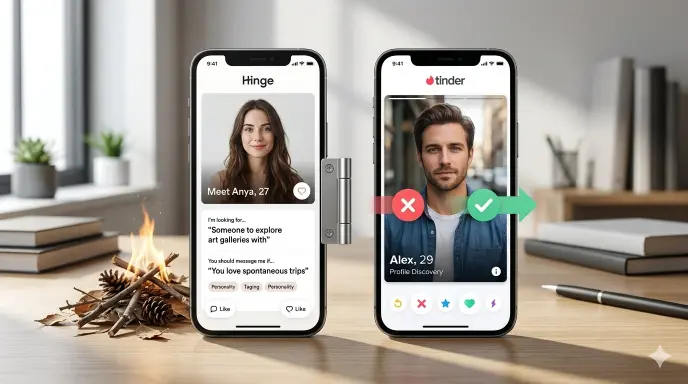
Choosing between Hinge or Tinder can feel confusing, especially when both dating apps offer profiles, matches, messaging, and plenty of potential connections. But they are not designed around exactly the same dating experience. One may appeal more to people looking for meaningful conversations, while the other is widely recognized for its fast and simple matching approach. So, which one actually fits your dating goals?
In this guide, we’ll break down Hinge vs Tinder in a clear and practical way, including profile features, matching systems, user experience, relationship goals, messaging, and important differences. Rather than relying on vague opinions, the comparison focuses on how the apps are designed and how their features can affect the way people use them.
Whether you are new to dating apps or thinking about switching platforms, understanding these differences can help you make a more informed choice. By the end, you’ll have a straightforward picture of what separates Hinge and Tinder and what each app offers.
Hinge vs Tinder: What’s the Difference?
First, Hinge is a proper noun when it identifies the dating application. However, lowercase hinge is an ordinary English noun or verb. As a noun, it describes a movable joint. As a verb, it can mean that something depends on another condition.
Meanwhile, Tinder is a proper noun when it identifies the dating application. Lowercase tinder is an ordinary noun referring to easily combustible material used to help start a fire.
Therefore, the difference becomes much easier to understand when context is considered.
| Feature | Hinge | Tinder |
|---|---|---|
| Word type as a dating brand | Proper noun | Proper noun |
| Ordinary English meaning | Movable joint or dependence | Easily ignited material |
| Dating context | Dating application | Dating application |
| Profile approach | Detailed prompts and profile responses | Profile discovery with swiping |
| Common interaction | Likes and comments on profile elements | Likes, passes, and matches |
| Correct brand capitalization | Hinge | Tinder |
| Can the names be substituted? | No | No |
Quick Recap
Hinge and Tinder are different dating applications.
Both names must be capitalized when they identify those applications.
Lowercase hinge and tinder have completely different dictionary meanings.
Therefore, context determines which meaning readers should understand.
Is Hinge vs Tinder a Grammar, Vocabulary, or Usage Issue?
The distinction is mainly a vocabulary and usage issue, although capitalization also plays an important grammatical role in written English.
Grammar explains how words function inside sentences. Vocabulary concerns the meanings of words. Usage determines how a word should appropriately appear within a particular situation.
For example:
I created a profile on Hinge.
I created a profile on Tinder.
Both sentences are grammatically correct. However, they refer to different applications.
Now consider:
The door hinge is loose.
Here, hinge is lowercase because it is an ordinary noun rather than a brand name.
Likewise:
The dry tinder caught fire quickly.
In this sentence, tinder has its ordinary dictionary meaning.
Consequently, the biggest mistake is not grammar itself. Instead, the problem occurs when writers confuse a brand name with an ordinary English word.
In formal writing, capitalization should remain consistent. In casual messages, people may use lowercase brand names, although standard writing normally preserves the correct capitalization.
How to Use Hinge Correctly
When Hinge refers to the dating application, capitalize the first letter.
For example:
She met someone interesting on Hinge.
The capitalization tells readers that Hinge is being used as the name of a particular platform.
In workplace communication, you might write:
Our research team is examining how users interact on Hinge.
Here, the name identifies a specific digital service.
In academic writing, a sentence could read:
The researchers examined how profile prompts influence conversations on Hinge.
Again, Hinge is capitalized because it identifies the application.
In technology related writing, you could say:
She updated her Hinge profile before using the application again.
The same rule applies whether you’re writing a report, article, school assignment, email, or casual message.
Hinge Usage Recap
Use Hinge when you mean the dating application.
Use lowercase hinge when you mean a physical joint or the verb meaning to depend upon something.
How to Use Tinder Correctly
When Tinder refers to the dating application, capitalize it.
For example:
He created a Tinder profile last month.
The capital letter immediately identifies Tinder as a proper name.
In workplace writing, you might say:
The company examined how users interact with profiles on Tinder.
For academic writing, consider this example:
The study investigated communication patterns among people who met through Tinder.
In a technology discussion, you could write:
Tinder allows users to browse profiles and interact with potential matches.
However, lowercase tinder has an entirely different meaning.
For example:
The campers gathered dry tinder before lighting the fire.
Here, tinder means material that catches fire easily.
Therefore, the surrounding words provide an important clue about meaning.
Tinder Usage Recap
Use Tinder when referring to the dating application.
Use lowercase tinder when referring to material used to help start a fire.
When You Should NOT Use Hinge or Tinder
Understanding when not to use these terms can prevent several common writing mistakes.
1. When You Mean a Door Joint
If you’re talking about the mechanism that connects a door to its frame, use hinge.
Correct:
The door hinge needs to be replaced.
Using Tinder would completely change the meaning.
2. When You Mean Fire Starting Material
If you’re discussing dry material that catches fire easily, use lowercase tinder.
Correct:
The dry tinder helped them start the campfire.
Using Hinge would be incorrect.
3. When You Mean the Dating Application
If you specifically mean the dating platform, don’t treat the name as an ordinary lowercase noun.
Correct:
She downloaded Hinge yesterday.
Correct:
He joined Tinder last week.
4. When You Mean Dependence
The verb hinge can describe dependence on something.
Correct:
The decision hinges on the available evidence.
Tinder cannot replace hinge in this sentence.
5. When Writing About Fire
Don’t capitalize tinder merely because it appears in the middle of a sentence.
Correct:
The fire needed dry tinder.
6. When Writing About a Physical Object
Don’t capitalize hinge when it has its ordinary mechanical meaning.
Correct:
The cabinet hinge is damaged.
7. When Naming a Specific Platform
Don’t use Tinder when you specifically mean Hinge, or Hinge when you specifically mean Tinder.
The names identify separate applications.
8. When Comparing Dating Platforms
Don’t describe the two names as alternative spellings. Instead, explain that they are separate brand names within the same broader category.
Common Mistakes and Decision Rules
The following examples show how small errors can create confusion.
| Correct sentence | Incorrect sentence | Explanation |
|---|---|---|
| The door hinge is broken. | The door Tinder is broken. | Hinge means a movable joint here. |
| She joined Hinge. | She joined hinge. | Hinge is a proper name in this context. |
| He created a Tinder profile. | He created a tinder profile. | Tinder is the name of the application. |
| The fire needs dry tinder. | The fire needs dry Tinder. | Lowercase tinder means combustible material. |
| The cabinet hinge is rusty. | The cabinet Hinge is rusty. | The ordinary noun should remain lowercase. |
| They met on Tinder. | They met on tinder. | Tinder is a proper name here. |
| The outcome hinges on timing. | The outcome tinders on timing. | Hinge is the correct verb. |
| She answered a prompt on Hinge. | She answered a prompt on hinge. | The application name requires capitalization. |
Decision Rule Box
If you mean the dating application, use Hinge or Tinder and capitalize the name.
If you mean a movable joint, use lowercase hinge.
If you mean dependence on something, use lowercase hinge as a verb.
If you mean easily ignited material, use lowercase tinder.
This rule covers the major meanings without requiring complicated memorization.
Hinge and Tinder in Modern Technology
Modern dating applications have changed how people discover potential connections. Profiles, preferences, messaging, location based discovery, verification features, and recommendation systems now form important parts of the experience.
However, Hinge and Tinder should still be treated as distinct product names.
Hinge uses profile prompts and other profile elements to give users opportunities to present more information about themselves. This format can make written responses an important part of a profile.
Tinder is strongly associated with a swipe based discovery experience. Users can review profiles, indicate interest, and form a match when interest is mutual.
Therefore, although both applications operate within online dating, their names shouldn’t be treated as synonyms.
This distinction is especially useful for writers discussing digital culture, relationships, mobile applications, communication patterns, or consumer technology.
Hinge or Tinder in Formal and Informal Writing
In casual conversation, people often shorten explanations because the surrounding context already makes the meaning obvious.
For example:
I met her on Hinge.
That’s perfectly natural.
Similarly:
They matched on Tinder.
The sentence is short but clear.
In formal writing, however, additional context may be useful.
For example:
Participants reported using Hinge to communicate with prospective romantic partners.
Or:
Participants described Tinder as one of the platforms they used to discover potential matches.
Consequently, the difference isn’t about one name being formal and the other being informal. Instead, both are proper names. The level of formality depends on the sentence, audience, and purpose.
Hinge or Tinder: Which Word Should You Use in a Sentence?
Choosing between these names becomes straightforward when you first identify your intended meaning.
If you’re talking about the dating application with profile prompts, write Hinge.
If you’re talking about the dating application associated with swiping and matching, write Tinder.
If you’re talking about a door, cabinet, or similar movable joint, write hinge.
If you’re talking about material used to start a fire, write tinder.
Consider these four examples:
I downloaded Hinge.
I downloaded Tinder.
The door hinge squeaks.
The dry tinder burned quickly.
Each sentence is correct because the word matches the intended meaning.
Etymology: Where Do Hinge and Tinder Come From?
The ordinary word hinge has a long history in English and refers to a joint or mechanism that allows connected parts to move relative to one another.
Over time, hinge also developed a figurative use.
For example:
The final decision hinges on cost.
Here, no physical object is involved. Instead, the verb indicates dependence.
The word tinder has an older connection with fire making. It describes dry material that can catch fire readily and help ignite other fuel.
The dating application names use words that already existed in English. Therefore, capitalization and context help distinguish brand usage from ordinary vocabulary.
This is why the same spelling can sometimes refer to a product and sometimes refer to an everyday object or material.
An Expert Style Explanation
A useful way to remember this distinction is to separate name from meaning.
When Hinge or Tinder identifies a specific application, capitalization signals that you’re referring to a named service.
When hinge or tinder describes an ordinary object, action, or material, lowercase spelling is appropriate.
Context tells the reader what a word means, while capitalization can help signal when an ordinary word is being used as a specific name.
This principle extends beyond these two words. Many modern product names originate from familiar dictionary words, so careful writers should always consider context before deciding how a term should appear.
Two Practical Case Studies
Case Study 1: Academic Writing
Imagine a student preparing a paper about online dating behavior.
The first draft says:
Many participants reported using hinge and tinder.
The intended meanings are clear, but the capitalization doesn’t identify the applications according to standard proper name conventions.
A clearer version is:
Many participants reported using Hinge and Tinder.
The revision makes the names recognizable and gives the sentence a more polished appearance.
Moreover, if the study compares specific platform features, maintaining consistent capitalization becomes even more important.
Case Study 2: Everyday Writing
Now imagine someone describing a camping trip.
They write:
We collected Tinder before starting the fire.
The capital letter may suggest that Tinder refers to the dating application.
If the intended meaning is combustible material, the sentence should be:
We collected tinder before starting the fire.
Therefore, capitalization can sometimes prevent an otherwise unnecessary moment of confusion.
The lesson is simple: identify the intended meaning before choosing capitalization.
Error Prevention Checklist
Always use Hinge when:
You mean the dating application.
You are discussing a Hinge profile.
You are referring to a Hinge prompt.
You are describing an interaction that occurred through Hinge.
You are writing about the platform as a specific product.
Always use Tinder when:
You mean the dating application.
You are discussing a Tinder profile.
You are referring to Tinder matching.
You are describing the Tinder platform.
You are comparing Tinder with another dating application.
Never use Hinge when:
You mean dry fire starting material.
You mean the Tinder application.
You are discussing a physical joint but intend ordinary lowercase usage.
Never use Tinder when:
You mean a door joint.
You mean a cabinet joint.
You mean the verb hinge.
You mean dependence on a particular condition.
Related Grammar Confusions You Should Master
Once you understand hinge or tinder, you can apply the same reasoning to other commonly confused terms.
Affect or Effect
Affect commonly functions as a verb, while effect commonly functions as a noun, although both have additional uses.
Fewer or Less
Fewer generally accompanies countable items, whereas less commonly accompanies uncountable amounts.
Advice or Advise
Advice is a noun, while advise is a verb.
Compliment or Complement
A compliment expresses praise, while a complement completes or enhances something.
Principal or Principle
Principal can refer to a person or something primary, while principle refers to a rule, belief, or guiding idea.
Its or It’s
Its indicates possession, while it’s is a contraction of it is or it has.
Your or You’re
Your indicates possession, while you’re is a contraction of you are.
Then or Than
Then commonly relates to time or sequence, whereas than introduces comparisons.
Lay or Lie
These verbs differ in their grammatical behavior and meanings, which makes them frequent sources of confusion.
Farther or Further
Farther is commonly associated with physical distance, while further often relates to additional degree, extent, or discussion.
Frequently Asked Questions
What is the difference between Hinge and Tinder?
Hinge and Tinder are separate dating applications. Hinge uses detailed profile elements and prompts, while Tinder is strongly associated with profile discovery, swiping, and matching. Therefore, their names should not be treated as interchangeable.
Is Hinge the same as Tinder?
No. Hinge and Tinder are different applications. Although both belong to the online dating category, they have separate brands, interfaces, features, and approaches to profile discovery.
Which is spelled correctly, Hinge or Tinder?
Both Hinge and Tinder are correctly spelled when referring to the respective dating applications. However, lowercase hinge and tinder also have ordinary English meanings unrelated to dating.
Should Hinge and Tinder be capitalized?
Yes. When the words refer to the dating applications, capitalize them as Hinge and Tinder because they function as specific names.
What does hinge mean in English?
Lowercase hinge can be a noun meaning a movable joint connecting two parts. It can also function as a verb meaning that something depends on another factor.
What does tinder mean in English?
Lowercase tinder is a noun referring to dry material that can easily catch fire. It is commonly associated with starting a fire.
Can I use Hinge and Tinder interchangeably?
No. When discussing the applications, each name identifies a different platform. You can mention both as examples of dating applications, but one name should not replace the other.
Why is Tinder capitalized?
Tinder is capitalized when it identifies the dating application. When tinder refers to material used for starting a fire, it normally appears in lowercase.
Why is Hinge capitalized?
Hinge is capitalized when it identifies the dating application. When hinge refers to a physical joint or functions as a verb, it is normally written in lowercase.
Is hinge a noun or a verb?
It can be both. As a noun, hinge describes a movable joint. As a verb, hinge can indicate dependence, as in the sentence, “The decision hinges on timing.”
Final Conclusion
The correct choice in hinge or tinder depends on what you are trying to say. When you mean the dating applications, use Hinge and Tinder as capitalized proper names. However, when you mean an ordinary English word, hinge refers to a movable joint or dependence, while tinder refers to easily ignited material.
Therefore, the key distinction is context. First identify the meaning, then select the appropriate word and capitalization. Once you remember that Hinge and Tinder are separate application names, while lowercase hinge and tinder have unrelated dictionary meanings, this commonly confusing pair becomes much easier to use correctly.









