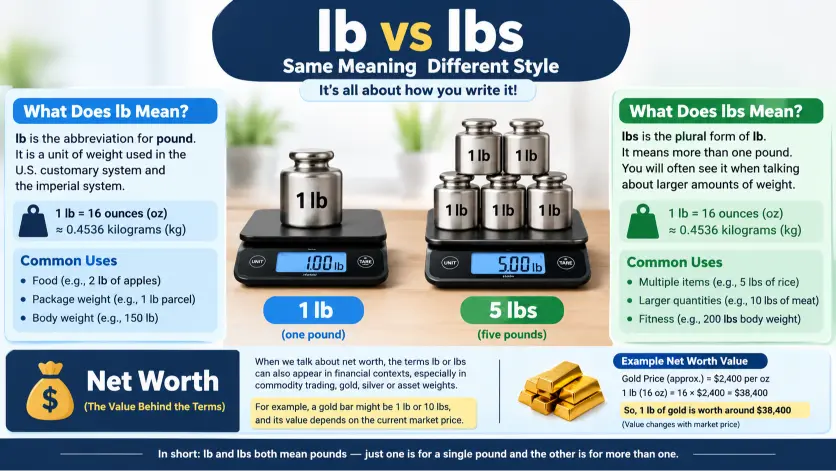
If you have ever wondered whether to write “5 lb” or “5 lbs,” you are not alone. The abbreviations for pounds can look almost identical, but their usage often causes confusion in everyday writing, shopping, fitness, recipes, shipping, and measurements. So, is lb or lbs correct, and does the number change which form you should use?
The abbreviation lb comes from the Latin word libra, while “lbs” is commonly seen as a plural abbreviation for pounds. However, modern style guides and technical writing often follow specific conventions for measurement abbreviations. Understanding these conventions can help you write measurements clearly and consistently.
In this guide, we will explain lb or lbs, where each form comes from, how they are used, common mistakes to avoid, and practical examples from everyday situations. Whether you are writing professionally or simply checking a weight measurement, this simple explanation will make the difference much easier to understand.
LB or LBS: The Basic Difference
Understanding lb and lbs is easier once you separate a formal measurement symbol from an everyday abbreviation. Lb represents the pound and is the standard form used in many formal measurement contexts. Meanwhile, lbs is a common informal plural form that readers frequently see in everyday writing.
The main reason for the confusion is that ordinary English abbreviations often change when they become plural. Therefore, people naturally add an “s” to “lb” when referring to several pounds. However, standardized unit symbols generally don’t follow the same pattern as regular abbreviations.
For example, formal measurement writing may use 1 lb for one pound and 15 lb for fifteen pounds. On the other hand, casual writing often uses 1 lb and 15 lbs. Both forms communicate the intended quantity, although their style and context differ.
The distinction becomes particularly useful in professional documents, product specifications, academic assignments, recipes, fitness records, and digital interfaces. Consequently, knowing when each form fits can help you avoid unnecessary inconsistencies.
| Feature | LB | LBS |
|---|---|---|
| Meaning | Pound | Pounds |
| Standard form | Yes | Common informal form |
| Singular quantity | 1 lb | Rarely used |
| Multiple pounds | 10 lb | 10 lbs |
| Formal writing | Generally preferred | Less preferred |
| Casual writing | Common | Very common |
| Technical notation | Suitable | Usually avoided |
Simple Recap
Lb is the conventional measurement symbol for pound.
Lbs is a familiar plural abbreviation used in everyday English.
Therefore, “20 lb” is suitable for standardized measurement writing.
Meanwhile, “20 lbs” is widely accepted in casual communication.
Ultimately, the best choice depends on the level of formality and the style requirements of your writing.
Is LB or LBS a Grammar, Vocabulary, or Usage Issue?
Primarily, this is a usage and style issue, rather than a basic vocabulary problem. Both forms are recognizable, but they belong to slightly different writing conventions.
In ordinary English, writers often treat “lbs” like a shortened version of “pounds.” Thus, phrases such as “20 lbs of flour” are easy to understand.
However, measurement standards commonly treat unit symbols differently from ordinary abbreviations. For that reason, “20 lb” can be preferable in technical, scientific, engineering, and academic contexts.
The distinction becomes especially important when consistency matters. For example, a product catalog containing “5 lb,” “10 lb,” and “25 lb” looks more systematic than a document switching between “5 lbs” and “10 lb.”
Furthermore, capitalization deserves attention. The conventional symbol is lb, not “LB,” although uppercase letters may appear because of a website’s design, packaging style, or formatting system.
In casual communication, however, readers rarely object to “lbs.” Therefore, the choice usually depends on whether precision or conversational familiarity is the priority.
When to Use LB
Use lb when you want a concise, standardized measurement symbol. Moreover, this form works particularly well when the number appears directly before the unit.
For example:
“Please order 25 lb of rice.”
Similarly:
“The package weighs 4 lb.”
Workplace Example
In a workplace inventory record, consistency is important. Therefore, a warehouse document might state:
“Quantity: 18 lb”
Likewise, a shipping specification could say:
“Maximum load: 50 lb”
Consequently, “lb” creates a clean and consistent appearance across technical records.
Academic Example
Academic writing frequently favors standardized measurement notation. Thus, a research report might state:
“The sample contained 12 lb of material.”
However, the exact style should always follow the institution or publication’s preferred guidelines.
Technology Example
Digital systems also commonly display unit symbols without plural endings. For instance, a fitness application may show:
“Current weight: 165 lb”
Similarly, an electronic shipping platform could display:
“Package weight: 7.5 lb”
Usage recap: Therefore, choose “lb” when writing formally, recording measurements, preparing specifications, or aiming for standardized presentation.
When to Use LBS
“Lbs” is common in conversational, commercial, and informal writing. Furthermore, many readers naturally interpret it as the plural form of “lb.”
For example:
“She lost 10 lbs.”
Likewise:
“The suitcase weighs 35 lbs.”
Although these sentences are widely understood, formal measurement style may instead write “10 lb” and “35 lb.”
Workplace Example
A casual workplace message might say:
“The shipment contains approximately 40 lbs of equipment.”
The meaning is immediately clear. Nevertheless, if that message becomes part of a formal technical record, “40 lb” may provide greater consistency.
Academic Example
In academic work, the preferred form depends on the required style guide. Therefore, students should check their institution’s instructions rather than automatically assuming that “lbs” is unacceptable.
Technology Example
Fitness websites, mobile applications, online stores, and calculators often display “lbs” because users commonly search for and recognize that format.
For example:
“Enter your weight in lbs.”
Consequently, “lbs” remains highly visible in consumer technology even though formal unit notation may favor “lb.”
Usage recap: Therefore, “lbs” works naturally in informal communication, consumer interfaces, and ordinary conversations, while “lb” is generally safer for formal measurement writing.
When You Should NOT Use LB or LBS
Several common situations can cause unnecessary inconsistency. Therefore, consider the following examples before choosing a form.
1. Don’t Add “s” Automatically
The plural form of a unit symbol does not always behave like an ordinary English abbreviation. Consequently, technical writing can use “20 lb” rather than “20 lbs.”
2. Don’t Mix Styles in One Document
For example, writing “5 lb,” “10 lbs,” and “15 lb” in the same specification creates inconsistency. Instead, choose one convention and follow it throughout.
3. Don’t Confuse Weight With Mass
Although pounds are commonly discussed as weight, scientific contexts can distinguish mass and force carefully. Therefore, technical discussions may require more precise terminology.
4. Don’t Assume Capitalization Is Required
The standard abbreviation is normally written as “lb.” Therefore, “LB” should not automatically replace the lowercase form.
5. Don’t Use an Informal Style in a Strict Technical Record
A casual “lbs” may be perfectly understandable. However, standardized documents often require consistent unit notation.
6. Don’t Change the Unit Because the Number Changes
Writing “1 lb” and then changing to “10 lbs” is common conversational practice. Nevertheless, technical style can retain “lb” in both cases.
7. Don’t Confuse Pounds With Other Units
A pound is not interchangeable with ounces, kilograms, or grams. Therefore, always check the actual quantity before converting or recording it.
8. Don’t Rely Only on What Looks Familiar
Because “lbs” appears everywhere online, it can seem automatically correct. However, widespread usage does not necessarily mean it is the preferred formal convention.
Common Mistakes With LB and LBS
Common Mistakes With LB and LBS
Many people use lb and lbs interchangeably because both forms are widely understood. However, the difference becomes important when you’re writing formal documents, product specifications, academic content, or technical information. Here are some common mistakes to avoid.
| Correct Sentence | Incorrect or Less Preferred Sentence | Explanation |
|---|---|---|
| The package weighs 10 lb. | The package weighs 10 lbs. | In standardized measurement writing, the unit symbol stays unchanged after a plural number. |
| We ordered 25 lb of flour. | We ordered 25 lbs of flour. | “Lb” is preferred when following formal unit notation. |
| The machine has a 50 lb capacity. | The machine has a 50 lbs capacity. | The unit symbol should remain consistent when used with a number. |
| She lifted 30 lb at the gym. | She lifted 30 lbs at the gym. | “Lbs” is common in casual writing, but “lb” is more suitable for standardized notation. |
| Enter your weight as 150 lb. | Enter your weight as 150 lbs. | Formal interfaces and measurement records often use the unchanged unit symbol. |
| The box contains 5 lb of material. | The box contains 5 lbs of material. | The first version follows the conventional treatment of unit symbols. |
Mistake 1: Adding “S” to Every Plural Measurement
A common assumption is that every abbreviation must receive an “s” when the quantity is plural. However, standardized unit symbols generally don’t work like ordinary English abbreviations. Therefore, 20 lb can be written without adding an “s.”
Mistake 2: Switching Between LB and LBS
Another frequent problem is inconsistency. For example, a document might use “10 lb” in one paragraph and “20 lbs” in another. Although readers will understand both, switching formats can make professional content look less polished. Therefore, select one convention that matches your intended style and use it consistently.
Mistake 3: Writing LB in All Capitals
People sometimes write LB because they assume abbreviations should be capitalized. However, the conventional symbol is lb. Consequently, lowercase letters are generally preferred unless a particular design or formatting system requires otherwise.
Mistake 4: Forgetting the Space
Another small formatting error occurs when the number and unit are joined together. For example, “25lb” is less appropriate than “25 lb” in standard prose. Therefore, keep a space between the numerical value and the measurement symbol.
Mistake 5: Using LBS in Strict Technical Content
“Lbs” is familiar and widely understood. Nevertheless, technical specifications, scientific material, and structured measurement records may favor lb because it follows standardized unit notation more closely.
Mistake 6: Assuming LBS Is Always Wrong
The opposite mistake is also common. Some writers believe “lbs” should never appear under any circumstances. However, it is a familiar plural abbreviation in everyday English. Therefore, context matters. Casual communication may naturally use “lbs,” while formal measurement notation generally favors “lb.”
Mistake 7: Confusing the Abbreviation With the Full Word
Remember that pound and pounds are ordinary English words, whereas lb functions as a measurement symbol. Therefore, the rules governing a unit symbol aren’t necessarily identical to the rules governing the full word.
Quick Rule to Remember
Use “lb” when following formal or standardized measurement notation.
Use “lbs” when informal everyday writing calls for the familiar plural abbreviation.
Most importantly, don’t switch between the two forms without a reason. Consistency, context, and the style requirements of your document should guide the final choice.
LB and LBS in Modern Technology
Modern digital platforms have made both forms highly visible. For example, fitness dashboards often let users enter weight using pounds, while shopping platforms display package measurements.
Furthermore, search interfaces frequently accommodate natural language. Users may type “lbs,” “lb,” or even “pounds,” and modern systems can generally understand the intended measurement.
However, recognition does not eliminate the importance of writing style. A consumer interface can comfortably display “180 lbs,” while a technical specification may prefer “180 lb.”
Consequently, technology has increased exposure to both conventions without making them equally appropriate for every situation.
When creating forms, applications, product descriptions, or databases, consistency matters more than switching randomly between the two forms.
Where Did LB Come From?
The abbreviation lb has an interesting historical background. It comes from the Latin word libra, which was associated with weight and balance.
Over time, English adopted “pound” as the ordinary word while retaining “lb” as the abbreviation. Thus, the modern spelling looks quite different from the spoken term.
Meanwhile, “lbs” developed through ordinary English abbreviation practices, where writers added an “s” to indicate a plural quantity.
Therefore, the difference between the two forms is partly historical and partly related to modern measurement conventions.
This history also explains why the abbreviation can seem unusual to learners. The letters do not directly resemble the English word “pound.”
An Expert Style Principle for Choosing the Form
A useful editorial principle is:
“When a measurement symbol follows a number, consistency and context matter more than adding a plural ending.”
In practical terms, that means writers should distinguish between ordinary language and standardized notation.
Therefore, “lbs” is not mysterious or incomprehensible. Rather, it represents a familiar informal convention that differs from the stricter treatment of unit symbols.
Two Practical Case Studies
Case Study 1: Product Specification
Consider a fictional online retailer preparing descriptions for kitchen equipment. Its original catalog uses “5 lbs,” “10 lb,” and “20 lbs.”
After standardizing all measurements to “lb,” the catalog becomes visually consistent:
“5 lb capacity”
“10 lb capacity”
“20 lb capacity”
The concrete improvement is not a change in the actual measurements. Instead, the document gains a uniform presentation that makes specifications easier to scan.
Case Study 2: Fitness Interface
Imagine a fictional fitness application that displays a user’s body weight. Its interface originally switches between “150 lbs” on one screen and “150 lb” on another.
After adopting one house style, every measurement uses the same format. As a result, users see a consistent measurement label throughout the application.
These examples demonstrate an important principle: consistency often matters more than choosing between two widely understood forms without considering context.
Error Prevention Checklist
Before publishing or submitting text, use this quick review.
Always Use LB When
The document is technical.
The writing follows a formal measurement standard.
You are preparing specifications.
The same unit appears repeatedly in a structured document.
You want the most conservative formal style.
Never Use LBS When
A style guide specifically requires standardized unit symbols.
Your document mixes several measurement formats.
You are preparing a scientific or technical specification that requires symbols.
You are trying to maintain strict notation throughout a data table.
Therefore, when formal accuracy matters, “lb” provides a straightforward default.
Related Grammar Confusions You Should Master
Once you understand lb or lbs, several other language and measurement questions become easier to handle.
- Ft or feet: abbreviation versus full word
- In or inches: unit notation and ordinary English
- Oz or ozs: singular and plural measurement conventions
- Kg or kgs: standardized symbol usage
- Mi or miles: formal measurement notation
- M or meters: capitalization and unit symbols
- L or liters: abbreviation and international conventions
- Pound or pounds: full word usage
- Weight or mass: everyday versus scientific meaning
- Ounce or pound: selecting the appropriate measurement
Furthermore, learning the underlying principle is more useful than memorizing individual abbreviations.
Frequently Asked Questions
Is lb or lbs correct?
Both forms are commonly understood. However, “lb” is the more standardized choice for a pound measurement, especially in formal, technical, scientific, and structured writing.
Is lb singular or plural?
“Lb” is the conventional unit symbol for pound and can remain unchanged after both singular and plural quantities in standardized notation. Therefore, “1 lb” and “20 lb” can both be correct.
Should I write 5 lb or 5 lbs?
For formal or technical writing, “5 lb” is generally the safer choice. Meanwhile, “5 lbs” is common in everyday communication and remains immediately understandable to most readers.
Why is pound abbreviated lb?
The abbreviation comes from the Latin term libra. Consequently, “lb” does not directly correspond to the spelling of the modern English word “pound.”
Is lbs grammatically wrong?
Not necessarily. “Lbs” is a widespread English abbreviation for pounds. However, it does not follow the stricter convention used for standardized unit symbols, where the symbol generally remains unchanged.
Should LB be capitalized?
Normally, the abbreviation is written as lowercase “lb.” Therefore, “LB” should not be used as the standard form unless a specific design, branding system, or formatting requirement calls for uppercase letters.
Do you put a space between the number and lb?
Yes. In standard writing, a space normally appears between the numerical value and the unit, such as “15 lb.”
Is lbs accepted in formal writing?
It can be understood in formal writing, but “lb” is usually the more consistent choice when following standardized measurement notation. Therefore, check the applicable style guide when a publication has specific requirements.
Which is better for a website: lb or lbs?
That depends on the website’s audience and style. However, a website should choose one consistent convention. For product specifications and structured data, “lb” is a clear formal option.
Final Answer:
Ultimately, the choice between lb or lbs depends on the writing situation. “Lb” is the standardized and more formal unit symbol for pound, and it can remain unchanged when describing multiple pounds. “Lbs” is a familiar informal abbreviation that readers commonly encounter in everyday communication.
Therefore, if you’re writing a technical document, academic material, product specification, measurement table, or professional record, use “lb” consistently. Meanwhile, “lbs” can work naturally in casual writing where conventional everyday usage is the priority.
The simplest rule is this: when in doubt, choose “lb” for formal measurement writing and keep your usage consistent throughout the document.









