When you see the words horizontal or vertical, the difference may seem obvious, but choosing the wrong term can create confusion in writing, design, photography, mathematics, construction, and everyday communication. Horizontal generally describes something that extends from left to right, while vertical describes something that moves up and down. But how do these terms work in real situations, and when should you use each one? Understanding the distinction can help you describe direction, position, layout, and orientation more accurately.
This guide explains horizontal or vertical in simple language, with practical examples that make the difference easy to remember. Whether you are comparing an image orientation, arranging information on a page, describing a line, or talking about physical objects, knowing these terms improves clarity. You will also learn common mistakes, everyday examples, and useful ways to identify whether something is horizontal or vertical. By the end, you should be able to recognize and use both terms confidently and correctly.
Horizontal or Vertical: What’s the Difference?
To begin with, horizontal and vertical are adjectives that describe direction, orientation, arrangement, or position. Although both terms identify how something is placed, they point in different directions.
Horizontal describes something that moves from left to right or right to left. In ordinary situations, a horizontal object appears parallel to the ground. For example, a table surface, a horizon line, or a person lying down can be described as horizontal.
Vertical, by contrast, describes something that extends upward or downward. Generally, a vertical object stands at a right angle to a level surface. A standing person, a wall, or a straight pole provides an easy example.
| Feature | Horizontal | Vertical |
|---|---|---|
| Basic direction | Side to side | Up and down |
| Common position | Parallel to the ground | Perpendicular to the ground |
| Visual movement | Left to right | Top to bottom |
| Common example | Floor line | Standing wall |
| Screen orientation | Wide layout | Tall layout |
| Graph direction | Across the page | Up the page |
| Common association | Width | Height |
Quick Recap
Therefore, horizontal refers mainly to side to side direction.
Meanwhile, vertical refers mainly to upward and downward direction.
In addition, both expressions can describe physical objects, writing layouts, business structures, graphs, screens, and digital designs.
Consequently, identifying the direction first makes the correct choice much easier.
Is Horizontal vs Vertical a Grammar, Vocabulary, or Usage Issue?
Primarily, this is a vocabulary and usage distinction, rather than a difficult grammar rule. Both words function mainly as adjectives, although their related noun forms can also appear in specialized contexts.
For example, you can say, “The line is horizontal,” or “The screen has a vertical orientation.” In these examples, the words describe position rather than changing the grammatical structure of the sentence.
Moreover, the two expressions aren’t normally interchangeable. Replacing one with the other can change the intended meaning completely.
In formal writing, technical documentation, education, engineering, architecture, and design, accurate directional terminology is especially important. Meanwhile, casual conversations may rely on simpler descriptions such as “across” or “up and down.”
Nevertheless, precision remains valuable. For instance, telling a colleague to move something “vertically” provides a more specific instruction than simply saying “move it up.”
Therefore, the distinction concerns meaning and context more than sentence formation.
How to Use Horizontal Correctly
The word horizontal is appropriate whenever something extends across a level plane or follows a side to side direction.
For example, a designer might say, “Place the navigation bar in a horizontal position.” Here, the instruction tells the reader that the elements should extend across the page.
Workplace Example
In an office, a manager might explain:
“Please arrange the department names in a horizontal row.”
The instruction indicates that the names should appear beside one another rather than stacked vertically.
Academic Example
In mathematics, a student may encounter this statement:
“The horizontal axis represents time.”
Here, the term identifies the axis running across the graph.
Technology Example
Similarly, a website designer may explain:
“Use a horizontal menu for the desktop version.”
Consequently, the menu items are expected to appear across the available space.
Usage Recap
Overall, use horizontal when the main direction moves across rather than upward or downward. Furthermore, the word works naturally in mathematics, architecture, design, photography, writing, construction, and everyday descriptions.
How to Use Vertical Correctly
The word vertical applies when something extends upward or downward.
For instance, a building is normally described as vertical because its main structure rises from the ground. Likewise, a straight line drawn from the bottom of a page toward the top is vertical.
Workplace Example
A workplace instruction might say:
“Install the vertical support beside the entrance.”
Therefore, the worker understands that the support should rise upward rather than extend across the surface.
Academic Example
In mathematics, the vertical axis usually represents the values being measured. For example, a graph may place temperature on the vertical axis while time appears across the horizontal axis.
Technology Example
A smartphone display is commonly associated with vertical orientation when held upright. Consequently, an application interface may be designed specifically for this arrangement.
Usage Recap
In short, choose vertical when something follows an upward or downward direction. Additionally, the term appears frequently in graphs, architecture, engineering, photography, mobile design, and everyday speech.
When You Should NOT Use Horizontal or Vertical
Although the distinction appears simple, several situations cause unnecessary confusion. Therefore, consider these common misuse patterns before choosing either term.
1. Describing Height as Horizontal
If you are talking about something rising from the ground, horizontal is inappropriate. Instead, vertical normally communicates that upward direction.
2. Describing Width as Vertical
Likewise, if an object extends primarily from one side to another, vertical doesn’t accurately describe its direction.
3. Confusing Screen Orientation
A wide screen arrangement is generally horizontal, whereas a tall arrangement is generally vertical. However, the physical device itself may remain the same.
4. Mixing Up Graph Axes
A graph typically has a horizontal axis and a vertical axis. Consequently, switching their names can make mathematical instructions unclear.
5. Using Direction Without Checking Perspective
An object can appear horizontal from one viewpoint and differently oriented from another. Therefore, consider the intended reference plane.
6. Applying the Terms to People Incorrectly
Someone lying down may be described as horizontal in a particular context, whereas someone standing upright may be described as vertical. Nevertheless, the exact situation should guide the wording.
7. Confusing Layout With Movement
A horizontal layout doesn’t necessarily mean that something physically moves sideways. Instead, it may simply describe how elements are arranged.
8. Ignoring Context
Technical fields sometimes use these expressions with specialized meanings. Therefore, context should always be considered before selecting a term.
Common Mistakes: Horizontal or Vertical
The following examples demonstrate how a small directional mistake can change an instruction.
| Correct sentence | Incorrect sentence | Explanation |
|---|---|---|
| Draw a horizontal line across the page. | Draw a vertical line across the page. | Across the page indicates side to side movement. |
| The pole is vertical. | The pole is horizontal. | A standing pole normally rises upward. |
| Put the labels in a horizontal row. | Put the labels in a vertical row. | A row running across is horizontal. |
| The graph has a vertical axis. | The graph has a horizontal axis. | The upward axis is vertical. |
| Hold the phone vertically. | Hold the phone horizontally. | Upright orientation differs from sideways orientation. |
| The shelf is horizontal. | The shelf is vertical. | A conventional shelf extends across a wall. |
Decision Rule
If you mean side to side, use horizontal. If you mean upward or downward, use vertical.
However, remember that the reference frame matters. A camera, object, screen, or diagram can be rotated, so describe the actual orientation being discussed.
Horizontal and Vertical in Modern Technology and Digital Tools
Technology has made these two terms especially important because users constantly work with screens, images, interfaces, charts, and layouts.
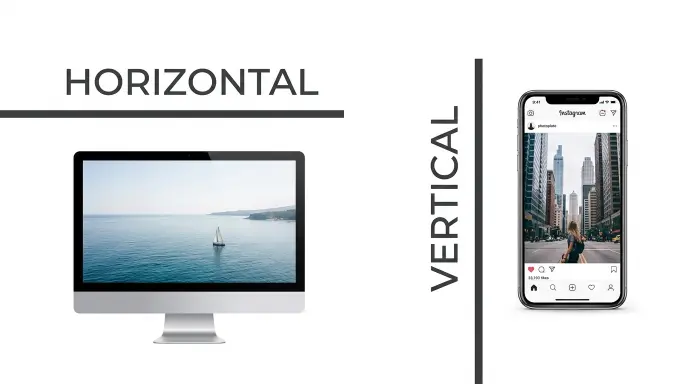
For instance, photographs can be displayed in landscape orientation or portrait orientation. A landscape image generally provides a wider horizontal composition, whereas a portrait image is taller and more vertical.
Similarly, websites may use horizontal navigation menus because wide computer screens provide substantial side to side space. Conversely, mobile applications often prioritize vertically arranged content because users typically scroll upward and downward.
Furthermore, data visualization depends heavily on directional clarity. A chart may place categories along the horizontal axis while numerical values rise along the vertical axis.
Therefore, accurate directional language helps designers, developers, analysts, teachers, and users communicate without ambiguity.
Horizontal and Vertical: A Short Etymology
The two terms have different historical roots, although both eventually became important English words for describing direction.
Horizontal comes through Latin and French linguistic history and relates to the horizon. Because the horizon appears level across the field of vision, the word developed its directional association with a level plane.
Vertical, meanwhile, comes from Latin vertex, associated with the highest point or top. Over time, the word became connected with an upright direction extending toward or away from the ground.
Thus, their histories offer a useful memory aid. Horizontal connects naturally with the horizon, while vertical connects with an upright position.
An Expert Perspective on Horizontal and Vertical
As a practical language principle, directional vocabulary should make the reader’s mental picture easier rather than harder.
“Clear directional language works best when the reference point is obvious and the intended orientation cannot be misunderstood.”
This principle is particularly useful in education, technical writing, workplace communication, design instructions, and documentation.
Therefore, don’t choose a directional word simply because it sounds familiar. Instead, identify the actual direction first and then select the matching term.
Two Practical Case Studies
Case Study 1: Classroom Graphs
Consider a mathematics classroom where students must plot monthly sales figures. The teacher explains that months belong on the horizontal axis while sales values belong on the vertical axis.
Initially, several students reverse the labels. Consequently, their charts become difficult to interpret.
After the teacher introduces the simple memory rule “horizontal goes across and vertical goes upward,” students correctly label the axes in a subsequent exercise.
The concrete improvement comes from replacing memorization with a visual reference.
Case Study 2: Mobile Interface Design
Imagine a product team creating an application for smartphones. The designers initially arrange important controls horizontally, creating a crowded interface on narrow screens.
After testing, the team changes several controls into a vertical arrangement. Users can then move through the options by scrolling rather than searching across a restricted width.
The result is a clearer interface and a more natural reading path.
These examples demonstrate why directional vocabulary matters beyond grammar exercises. Clear terminology can improve instructions, visual organization, and communication.
Error Prevention Checklist
Use the following checklist whenever you aren’t sure which word belongs in a sentence.
Always use horizontal when:
The direction moves from side to side.
A line runs across a page.
A layout spreads across available width.
An axis runs from left to right.
An object rests parallel to a level surface.
Never use vertical when:
You specifically mean a side to side arrangement.
You are describing the horizontal axis of a conventional graph.
You are identifying a wide screen orientation.
You are describing an object that extends across a level plane.
Instead, reserve vertical for upward, downward, or upright direction.
Horizontal or Vertical in Everyday Communication
In ordinary conversation, people often understand these concepts without consciously thinking about grammar. Nevertheless, confusion can arise when directions become part of instructions.
For example, “turn the image horizontal” generally suggests a wider orientation. On the other hand, “turn the image vertical” suggests a taller orientation.
Similarly, someone may ask whether a picture should be horizontal or vertical before posting it online. The answer depends on the intended display space.
Therefore, the terms aren’t limited to classrooms or technical environments. They are useful whenever orientation matters.
Horizontal or Vertical in Business and Organization
The distinction also appears in business terminology.
A horizontal structure can describe relationships or processes organized across similar levels. Conversely, a vertical structure may describe a hierarchy involving different levels of authority.
However, this use is metaphorical rather than purely physical.
For example, a company may discuss horizontal collaboration between departments. Meanwhile, vertical communication can describe information moving between different levels of an organizational hierarchy.
Consequently, the basic directional meanings remain relevant, even when the terms are used figuratively.
Related Grammar Confusions You Should Master
Once you understand horizontal and vertical, several related distinctions become easier to recognize.
- Parallel vs perpendicular: these describe geometric relationships between lines or surfaces.
- Width vs height: width generally measures side to side distance, while height measures upward distance.
- Portrait vs landscape: these describe common image orientations.
- Across vs along: these words can describe movement or position from different perspectives.
- Above vs over: both indicate higher position, although usage can vary by context.
- Below vs underneath: these expressions overlap but can carry different spatial implications.
- Upward vs upright: upward describes direction, while upright commonly describes position.
- Length vs width: these measurements depend on the object and chosen reference orientation.
- Inside vs outside: these terms describe position relative to boundaries.
- Parallel vs intersecting: these geometric concepts explain whether lines maintain the same direction or meet.
Learning these distinctions together creates a stronger foundation for precise spatial vocabulary.
Frequently Asked Questions
What is the difference between horizontal and vertical?
Horizontal describes a direction that extends from side to side, while vertical describes a direction that extends upward or downward. Therefore, a horizontal line normally runs across a page, whereas a vertical line runs from top to bottom.
Is horizontal up or down?
Neither. Horizontal generally describes a level side to side direction. Therefore, it isn’t primarily associated with upward or downward movement.
Is vertical left or right?
Not normally. Vertical describes an upward or downward direction. Meanwhile, left and right usually refer to side to side movement.
Is a standing person horizontal or vertical?
A standing person is generally described as vertical because the body extends upward from the ground. Conversely, a person lying flat can be described as horizontal in an appropriate context.
Is landscape horizontal or vertical?
Landscape orientation is generally wider than it is tall, so it is associated with horizontal orientation. Portrait orientation is generally taller than it is wide and is therefore associated with vertical orientation.
Which axis is horizontal?
In a conventional Cartesian graph, the x axis is horizontal. Meanwhile, the y axis is vertical.
Which direction is horizontal on a phone?
When a phone is held sideways, its display is generally described as horizontal or landscape. When held upright, the display is generally vertical or portrait.
Can horizontal and vertical be used figuratively?
Yes. For example, business communication can use horizontal to describe relationships across similar organizational levels and vertical to describe relationships between different levels.
How can I remember horizontal and vertical?
A simple memory aid is to connect horizontal with the horizon. The horizon appears level and stretches across the view. Vertical can be remembered as an upright direction extending toward the top.
Final Answer
The simplest distinction is this: horizontal means side to side, while vertical means up and down. Therefore, choose horizontal when something extends across a level plane, and choose vertical when it rises or falls along an upright direction.
Moreover, this distinction applies far beyond basic vocabulary. Graphs, photography, mobile screens, architecture, workplace instructions, mathematics, design, and business terminology all rely on these concepts.
Consequently, when you’re uncertain, identify the direction first. If the movement or arrangement goes across, choose horizontal. If it goes upward or downward, choose vertical. With that simple reference point, most common mistakes become much easier to avoid.









