Have you ever written dependant or dependent and then stopped to wonder whether you chose the right spelling? You are not alone. These two words look almost identical, and both are used in English, but their meanings and grammatical roles can differ depending on the context and variety of English. A small spelling change can make a sentence sound unnatural or even change what you are trying to say.
In this guide, we will explain dependant or dependent in simple, practical English. You will learn the difference between the noun and adjective forms, how British and American English handle these words, and when each spelling is appropriate. Clear examples will help you recognize the correct choice in everyday writing, academic work, workplace communication, and formal documents. Whether you are a student, professional, or simply improving your English, understanding this distinction can help you write with greater accuracy and confidence.
Why Do People Confuse Dependant or Dependent?
The question dependant or dependent creates confusion because the two spellings are closely related and have almost identical pronunciation. Moreover, both forms describe something connected with reliance on another person or thing. However, their preferred use differs according to English variety and grammatical function.
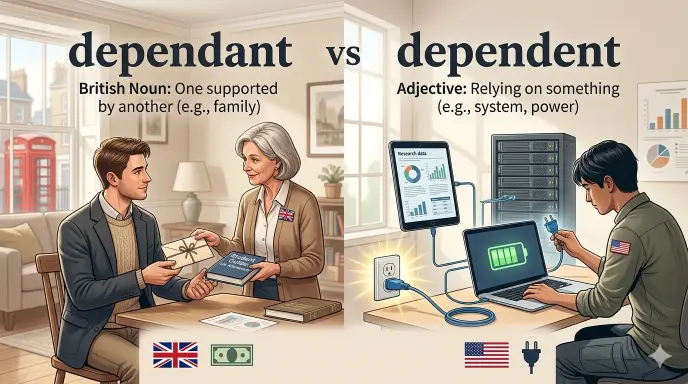
In American English, dependent is generally the standard spelling whether you’re describing someone who relies on another person or referring to that person as a noun. Meanwhile, British English traditionally distinguishes the forms more clearly: dependent functions as an adjective, whereas dependant functions as a noun.
Consequently, choosing the wrong spelling can cause practical problems. For instance, a learner writing a résumé, completing a tax form, preparing an academic paper, or communicating with an international employer may encounter different conventions. Therefore, understanding the distinction helps you write naturally and accurately.
Although the difference looks tiny, it reflects an important vocabulary and usage distinction. So, let’s examine when each spelling belongs in a sentence, why regional English matters, and how you can remember the correct choice without second guessing yourself.
Dependant vs Dependent: What’s the Difference?
The most useful distinction involves part of speech and regional English.
Dependent is an adjective meaning reliant on someone or something else. For example, in “The child is dependent on her parents,” the word describes the child’s state of reliance.
Additionally, dependent can function as a noun, especially in American English. In that usage, it refers to someone who relies financially or otherwise on another person.
Dependant, by contrast, is traditionally a noun in British English. It commonly refers to someone who depends on another person, particularly for financial support. Therefore, “She claimed her husband as a dependant” follows a British spelling convention.
| Feature | Dependent | Dependant |
|---|---|---|
| Main role | Adjective and noun | Noun |
| Meaning | Relying on someone or something | A person who relies on another |
| American English | Standard adjective and noun | Uncommon |
| British English | Standard adjective | Traditional noun |
| Example | “The patient is dependent on medication.” | “His dependant receives support.” |
| Formal writing | Widely accepted | Mainly British noun usage |
Mini Recap
Therefore, dependent is the safer general spelling across international contexts.
However, dependant remains legitimate when following traditional British noun usage.
Meanwhile, dependent should be used when the word describes reliance.
Ultimately, the surrounding sentence and your preferred English variety determine the appropriate form.
Is Dependant vs Dependent a Grammar, Vocabulary, or Usage Issue?
Primarily, this is a vocabulary and usage issue, although grammar also matters because the spelling can correspond to different parts of speech.
For example, British English distinguishes “a dependent child” from “a dependant.” In the first expression, dependent describes the child. In the second, dependant identifies the person receiving support.
However, American English generally removes this spelling distinction. Thus, an American writer may use dependent in both situations.
Importantly, neither spelling is simply a universal replacement for the other. Instead, regional convention determines which form sounds natural. Therefore, writers should consider their intended audience before making a choice.
In academic writing, consistency matters more than forcing one regional convention into every document. Likewise, professional communication should normally follow the spelling standards expected by the organization, publication, institution, or country.
In casual conversation, the distinction rarely causes communication problems because pronunciation is essentially the same. Nevertheless, written communication exposes the spelling difference immediately.
Formal vs Casual Usage
In formal British writing, dependant can appear as a noun. In contrast, American formal writing normally uses dependent.
For example:
“The employee added his daughter as a dependant.”
This sentence follows a British convention.
Meanwhile:
“The employee added his daughter as a dependent.”
This version follows the common American convention.
Consequently, neither sentence is automatically wrong without knowing the intended variety of English.
How to Use Dependent Correctly
Dependent has several common applications because it can operate as both an adjective and a noun.
First, as an adjective, it describes someone or something that relies on another source.
For example, a child may be dependent on parents for financial assistance. Similarly, a device can be dependent on an internet connection to perform certain functions.
Second, the word frequently appears with the preposition on. Thus, “dependent on” is an especially useful phrase for learners.
Workplace Example
A manager might write:
“The employee has two dependent children.”
Here, dependent describes the children.
Additionally:
“The project is dependent on timely approval.”
In this example, the word describes a situation rather than a person.
Academic Example
A research paper could state:
“The outcome is dependent on several environmental factors.”
Here, dependent explains a relationship between the outcome and those factors.
Likewise:
“Children may remain financially dependent on their families during higher education.”
Again, the adjective describes reliance.
Technology Example
A technology article might explain:
“The application is dependent on a stable network connection.”
Here, dependent describes the application’s reliance on another system.
Similarly:
“The device becomes dependent on external power.”
Therefore, the spelling remains unchanged even when the subject moves from a person to software, equipment, or a process.
Usage Recap
Use dependent when describing reliance.
Also, use dependent as the noun in standard American English.
Furthermore, phrases such as “dependent on” are widely accepted across English varieties.
How to Use Dependant Correctly
Dependant is chiefly associated with British English when it functions as a noun.
For example:
“The worker listed his wife as a dependant.”
Here, the word identifies the person receiving support.
However, British usage generally does not use dependant as the adjective. Therefore, you would normally write:
“She has a dependent child.”
Not:
“She has a dependant child.”
Workplace Example
A British employer might refer to:
“Employees with dependants may qualify for additional benefits.”
Here, dependants means people supported by employees.
Academic Example
A British academic text might say:
“The study examined financial support provided to adult dependants.”
Because the word identifies people, dependants works as a noun.
Technology Example
The noun is less common in technical contexts. Nevertheless, documentation could mention:
“The service supports accounts belonging to dependants.”
In that sentence, the term refers to people rather than describing a technical dependency.
Usage Recap
Therefore, choose dependant mainly when writing British English and referring to a person as a noun.
However, don’t use it as the standard adjective.
For international audiences, dependent may provide a more broadly recognizable option, particularly when American English is expected.
When You Should NOT Use Dependant or Dependent
Certain situations create predictable mistakes. Therefore, keep these distinctions in mind.
- Don’t use dependant as an adjective in standard British usage.
Instead, write “dependent child” or “dependent relative.” - Don’t automatically replace dependent with dependant in American English.
American usage generally prefers dependent for both grammatical roles. - Don’t choose dependant merely because you’re referring to a person.
Regional convention still matters. - Don’t write dependant when describing reliance.
For example, “The system is dependant on electricity” is not the preferred standard form. - Don’t switch spellings within one document without a reason.
Consistency makes professional writing clearer. - Don’t assume British and American conventions are identical.
Dictionaries and institutional style guides may follow different standards. - Don’t confuse dependent with dependency.
Dependency is a noun describing a state or relationship of reliance. - Don’t confuse either spelling with dependence.
Dependence refers to the condition of relying on someone or something.
Common Mistakes and Decision Rules
The following examples show how errors commonly appear in everyday writing.
| Correct sentence | Incorrect sentence | Explanation |
|---|---|---|
| “She has a dependent child.” | “She has a dependant child.” | The adjective is normally dependent. |
| “The result is dependent on timing.” | “The result is dependant on timing.” | The adjective describes reliance. |
| “He listed his daughter as a dependant.” | “He listed his daughter as a dependent.” | Dependant is traditional British noun usage. |
| “He listed his daughter as a dependent.” | “He listed his daughter as a dependant.” | Dependent is standard American noun usage. |
| “The system is dependent on electricity.” | “The system is dependant on electricity.” | The adjective requires dependent. |
| “The employee supports three dependants.” | “The employee supports three dependents.” | The first follows British noun convention. |
Decision Rule Box
If you mean reliance or describe someone or something that relies on another source, use “dependent.”
If you mean a person who receives support and you’re following traditional British English, use “dependant.”
If you’re writing American English, use “dependent” for both the adjective and noun.
This simple rule handles most real world situations.
Dependant and Dependent in Modern Technology and AI Tools
Modern digital writing has made spelling consistency even more important because documents are frequently read across different countries.
For example, online forms may ask whether a user has any dependents. American platforms commonly use this spelling because it serves as both a noun and adjective.
Meanwhile, British organizations may use dependants when referring specifically to people receiving support.
Technical writing introduces another related word: dependency. In software documentation, a dependency is a component, library, service, or resource that another program requires.
For instance:
“The application has several external dependencies.”
That sentence doesn’t call for either dependant or dependent.
Therefore, context is essential. A person receiving financial support is a dependent or dependant depending on regional convention, whereas a required software component is a dependency.
Etymology: Where Do Dependant and Dependent Come From?
Both forms ultimately connect to the Latin verb dependere, meaning “to hang from” or “to rely upon.”
Over time, the concept developed into the broader meaning of relying on another person, condition, or source.
English later developed related forms such as depend, dependence, dependent, and dependency.
The spelling distinction between dependent and dependant became particularly associated with British usage, where the noun and adjective developed different conventional endings.
Meanwhile, American English largely standardized dependent for both roles.
Expert Style Explanation
“The practical distinction is less about meaning than grammatical function and regional convention.”
This principle explains why two writers can choose different spellings while communicating essentially the same underlying idea.
Two Practical Case Studies
Case Study 1: International Employment Form
Imagine a professional in London completing an employment benefits form. The document asks for the names of family members receiving financial support.
Because the document follows British conventions, dependants may be the expected noun.
However, if the same worker writes “dependent children,” the adjective remains dependent.
Thus, one document can legitimately contain both forms because their grammatical functions differ.
Case Study 2: American Tax Documentation
Now consider an American taxpayer entering information about a child who qualifies for financial support.
The form may use dependent as a noun. For example:
“Number of qualifying dependents.”
Although a British reader may expect dependants, the American form follows its own established convention.
Consequently, changing the spelling simply because the person is being discussed would create an unnecessary error.
Error Prevention Checklist
Always Use Dependent When
☑ You are writing American English.
☑ You need an adjective describing reliance.
☑ You write phrases such as “dependent on.”
☑ You describe a dependent child, relative, condition, or system.
☑ You are using the noun in standard American English.
Never Use Dependant When
☑ You need the adjective in standard British English.
☑ You are describing something that relies on another source.
☑ You are writing American English and referring to a supported person.
☑ You are using “dependent on.”
Instead, reserve dependant mainly for the British noun referring to a person who relies on another.
Related Grammar Confusions You Should Master
Once you understand dependant or dependent, several other commonly confused pairs become easier to recognize.
- Affect or effect
These differ according to meaning and grammatical role. - Advice or advise
One is generally a noun, while the other is a verb. - Practice or practise
British English traditionally distinguishes noun and verb forms. - Licence or license
Regional conventions affect spelling and grammatical usage. - Fewer or less
The distinction involves countable and uncountable nouns. - Lay or lie
Their differences involve grammatical function and tense. - Further or farther
Modern usage often overlaps, although traditional distinctions remain. - Affecting or effecting
Meaning determines which form is appropriate. - Compliment or complement
Similar pronunciation hides substantially different meanings. - Principal or principle
One can describe a person or primary item, while the other refers to a rule or belief.
Learning these distinctions builds stronger editing habits because many spelling problems are really questions of context.
Frequently Asked Questions
Is dependant or dependent correct?
Both spellings can be correct. However, dependent is standard for the adjective in English and is also the usual noun in American English. Meanwhile, dependant is traditionally used as a noun in British English.
Is dependant British or American?
Dependant is primarily associated with British English when used as a noun. American English generally uses dependent for both the noun and adjective.
Is dependent an adjective or a noun?
Dependent can function as both an adjective and a noun. As an adjective, it describes reliance. As a noun, particularly in American English, it can identify someone who receives support from another person.
Should I write dependent child or dependant child?
Write dependent child. The word describes the child, so it functions as an adjective. The adjective form is dependent in both British and American English.
Should I write dependent on or dependant on?
Write dependent on. The word is functioning as an adjective describing reliance, so dependent is the standard form.
What is the British spelling of dependent?
British English uses dependent as the adjective. However, when referring to a person as a noun, traditional British usage commonly uses dependant.
What is the American spelling of dependant?
American English generally uses dependent instead. Therefore, “dependent” can function as either a noun or adjective in American usage.
Are dependent and dependant pronounced differently?
Generally, they are pronounced the same or extremely similarly. Therefore, pronunciation usually doesn’t help you decide which spelling to use. Context and regional convention are more reliable guides.
What is the difference between dependent and dependency?
Dependent usually describes a person or thing that relies on another source, or identifies such a person in American English. Dependency refers to the condition, relationship, or required component associated with that reliance.
Which spelling should international writers choose?
For international writing, dependent is generally easier to recognize because it is standard in American English and remains the adjective form in British English. However, writers should follow the style expected by their audience or institution.
Final Answer
The answer to dependant or dependent depends on both grammar and regional English. Use dependent when the word functions as an adjective, such as “dependent child” or “dependent on income.” In American English, use dependent as the noun as well. However, in traditional British English, dependant is commonly used as a noun for someone who relies on another person.
Therefore, the easiest rule is simple: dependent is the broadly applicable spelling, while dependant is mainly the British noun form. Once you identify the word’s grammatical role and your intended variety of English, the correct choice becomes much easier.









