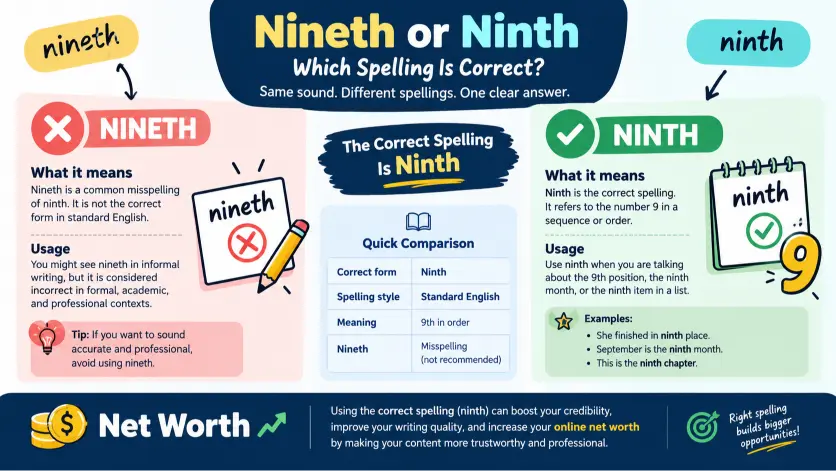
When writing ordinal numbers in English, small spelling differences can easily cause confusion. Nineth or ninth is a common example because “nineth” may look like the natural form of the number nine, but standard English uses ninth. Understanding this spelling is useful for students, teachers, writers, editors, and anyone who wants to communicate accurately in English. The confusion usually comes from expecting the word to follow the same pattern as “nine” plus “th.”
The correct form is ninth, which means coming after eighth and before tenth in a sequence. Although “nineth” is sometimes written by mistake, it is not the standard spelling in modern English. Knowing why the spelling changes can make the word easier to remember and help prevent similar errors. This distinction is especially important in formal writing, academic work, dates, rankings, addresses, and other situations where accurate spelling matters.
From a language perspective, the spelling ninth reflects a historical change in the word rather than a simple addition of “th” to “nine.” Reliable dictionaries and established English usage recognize “ninth” as the standard form. In this guide, we will explain nineth or ninth, show the correct usage with clear examples, discuss why “nineth” is incorrect, and provide simple memory tips so you can confidently use the right spelling every time.
Nineth or Ninth: What Is the Correct Spelling?
The correct spelling is ninth.
Although nineth may look logical at first glance, it isn’t accepted as the standard English spelling of the ordinal number that follows eighth. English spelling can be unpredictable, and this is a good example of why pronunciation alone isn’t always enough to determine written form.
The word ninth represents the ordinal form of nine. It identifies position, sequence, rank, order, or occurrence. For example, someone can finish ninth in a competition, attend a ninth class, celebrate a ninth anniversary, or read the ninth chapter of a book.
By contrast, nineth is generally treated as a misspelling. It may appear in informal messages, learner writing, search queries, handwritten notes, or user generated material, but that appearance doesn’t make it an accepted standard form.
Consequently, when accuracy matters, choose ninth.
This distinction becomes especially important for students, teachers, editors, workplace writers, website publishers, and anyone completing forms or official documents. A small spelling error can make otherwise polished writing appear careless.
The pronunciation can also contribute to uncertainty. When people say the word quickly, the spelling may not seem obvious. Furthermore, learners often apply a familiar pattern from words such as tenth, seventh, and eighth. However, ninth follows its own established spelling pattern.
Nineth vs Ninth: What’s the Difference?
The two forms do not represent two different meanings. Instead, they have different grammatical status.
Ninth is the correct standard spelling. It is an ordinal number and functions primarily as a determiner, adjective, or noun depending on sentence structure.
Nineth is a nonstandard spelling and is normally considered an error when the writer intends to use the ordinal form of nine.
| Feature | Ninth | Nineth |
|---|---|---|
| Standard English spelling | Yes | No |
| Meaning | Position after eighth | Intended to mean ninth |
| Word type | Ordinal number | Misspelled ordinal number |
| Formal writing | Appropriate | Avoid |
| Academic writing | Appropriate | Incorrect |
| Workplace communication | Appropriate | Avoid |
| Dictionary standard | Established | Not the standard form |
| Example | The ninth chapter | The nineth chapter |
In short, ninth is the form readers expect.
Meanwhile, nineth usually signals a spelling mistake.
Therefore, the practical choice is straightforward.
When referring to the position after eighth, write ninth.
Mini Recap
Ninth is the correct spelling.
Nineth is a common misspelling.
Both forms are usually intended to express the same idea, but only one is standard.
For formal, academic, professional, and published communication, use ninth.
Is Nineth vs Ninth a Grammar, Vocabulary, or Usage Issue?
Primarily, this is a spelling and usage issue, rather than a difference in meaning or vocabulary.
Both forms may be intended to represent the same ordinal concept. However, standard English recognizes ninth as the appropriate written form. Therefore, substituting nineth for ninth creates an orthographic error.
In grammatical terms, ninth is an ordinal number. Ordinal numbers describe position in an ordered sequence. For example, first, second, third, fourth, and ninth all identify places within an arrangement.
The distinction is not comparable to pairs such as advice and advise, where two separate words perform different grammatical functions. Instead, nineth is generally an incorrect spelling of the intended word.
In casual communication, a reader will often understand what the writer means. Nevertheless, understanding doesn’t make the spelling correct. Context can rescue an error, but it doesn’t remove the error.
In academic environments, the difference becomes more significant. Teachers, examiners, editors, and professional readers generally expect conventional spelling. Similarly, workplace correspondence benefits from standard forms because accuracy supports clarity and credibility.
Thus, the best approach is simple: recognize ninth as the standard ordinal form and treat nineth as an error to correct.
How to Use Ninth Correctly
The word ninth can appear in many everyday situations. It commonly describes a position, stage, date, chapter, floor, anniversary, ranking, or occurrence.
Workplace Example
Consider a company that is holding its ninth annual conference:
The company will host its ninth annual conference in October.
Here, ninth identifies which annual conference is being discussed. The word doesn’t describe the quantity of conferences in general. Instead, it identifies the position of this particular event within a sequence.
Another example is:
She joined the company on the ninth floor.
In this context, ninth identifies location.
Academic Example
Academic writing frequently uses ordinal numbers to organize information.
Students should review the ninth chapter before the examination.
The word ninth identifies the chapter’s position within the book.
Similarly:
The ninth question requires a detailed explanation.
Again, the ordinal describes sequence.
Technology Example
Ordinal numbers also appear naturally in technology related contexts.
The ninth update introduced several interface improvements.
Here, ninth indicates the position of an update in an ordered series.
Therefore, whenever you need to describe something that comes after the eighth item, ninth is the appropriate spelling.
Usage Recap
Use ninth for sequence and position.
Use it in professional, educational, technical, and everyday contexts.
Avoid replacing it with nineth, even when the intended meaning remains obvious.
How to Use Nineth Correctly
There is an important point here: in standard English, there isn’t a normal context in which nineth should replace ninth.
For example, these forms are correct:
The ninth student entered the room.
Today is the ninth day of the course.
She finished ninth in the competition.
Changing ninth to nineth produces a spelling mistake.
This is why learners should not treat the two forms as interchangeable alternatives. They may appear interchangeable during casual communication because readers can infer the intended meaning, but standard written English requires ninth.
The safest strategy is therefore to memorize the correct form rather than attempting to derive it mechanically from the spelling of nine.
Usage Recap
Nineth should not be used as the standard spelling.
It is generally a misspelled version of ninth.
For polished communication, replace it with ninth.
When You Should NOT Use Nineth or Ninth
The distinction becomes easier when you understand where an ordinal number is appropriate.
1. Do not write nineth in formal documents
If you’re preparing a report, application, letter, examination response, or business document, use ninth.
2. Do not treat nineth as an accepted alternative
English sometimes has regional spelling variations, but nineth is not a standard British or American alternative to ninth.
3. Do not use ninth when you mean nine
The words nine and ninth perform different roles.
For example:
Nine students attended the meeting.
Here, nine gives the quantity.
However:
The ninth student arrived late.
Here, ninth gives the position.
4. Do not confuse cardinal and ordinal numbers
Cardinal numbers tell us how many. Ordinal numbers tell us where something appears in a sequence.
Therefore, nine and ninth shouldn’t be treated as interchangeable.
5. Do not preserve nineth during editing
If you encounter nineth in a draft, correct it unless you’re deliberately discussing the spelling error itself.
6. Do not assume pronunciation determines spelling
English pronunciation doesn’t always provide a reliable spelling formula. Consequently, familiar patterns can sometimes lead writers toward incorrect forms.
7. Do not invent a second meaning for nineth
There is no standard semantic distinction between nineth and ninth.
8. Do not rely entirely on spell checking
Automated correction can help, but writers should also understand why the correction is necessary. That knowledge prevents the same mistake from returning later.
Common Mistakes and Decision Rules
| Correct sentence | Incorrect sentence | Explanation |
|---|---|---|
| She finished ninth. | She finished nineth. | Ninth is the standard ordinal spelling. |
| Read the ninth chapter. | Read the nineth chapter. | The ordinal form of nine is ninth. |
| This is our ninth meeting. | This is our nineth meeting. | Ninth identifies the position in the sequence. |
| He lives on the ninth floor. | He lives on the nineth floor. | Ninth is required for standard written English. |
| The ninth question is difficult. | The nineth question is difficult. | Nineth is a misspelling. |
| Today is the ninth day. | Today is the nineth day. | The correct ordinal form is ninth. |
Decision Rule Box
If you mean the number that comes after eight in a sequence, use ninth.
If you mean the quantity nine, use nine.
Do not use nineth as an alternative spelling of ninth.
This rule is more accurate than assigning separate meanings to the two forms. There is no standard meaning difference between them.
Nineth and Ninth in Modern Technology and Intelligent Tools
Digital writing environments make this spelling question especially interesting because modern tools can recognize frequent language patterns and flag unusual forms.
When a writer types nineth, many proofreading systems may identify it as an error and suggest ninth. However, users should still understand the underlying rule instead of accepting every automated suggestion without thought.
For example, a document editor may encounter:
The nineth version was released yesterday.
A correction system can suggest:
The ninth version was released yesterday.
The correction works because the surrounding context clearly indicates an ordinal number.
Technology is useful for catching such mistakes, yet language knowledge remains valuable. A writer who understands the distinction can recognize an error immediately, even without a correction tool.
Furthermore, search behavior can reveal why nineth continues to appear. People often type words according to pronunciation or familiar spelling patterns. As a result, incorrect forms can become visible in queries, comments, drafts, and informal communication.
Nevertheless, visibility doesn’t establish grammatical or spelling validity.
Why Is Ninth Spelled Without the Extra E?
The spelling of ninth becomes easier to remember when you consider the relationship between the cardinal number nine and its ordinal form.
The word comes from an older Germanic linguistic history, with related forms appearing across Germanic languages. Over time, English spelling and pronunciation changed, and the modern form became established as ninth.
The crucial point for modern writers is that the final e in nine disappears before the ordinal ending.
Compare:
nine → ninth
Not:
nine → nineth
This pattern can feel unusual because learners encounter other ordinal forms that appear more predictable. Yet English contains many historical spellings that cannot always be produced by applying one universal rule.
Consequently, memorizing ninth as a complete word is often more effective than trying to construct it from nine each time.
An Expert Style Explanation of Ninth
A useful linguistic principle is this:
“Standard spelling depends on established word forms, not simply on adding letters according to pronunciation.”
Applied here, the established ordinal form of nine is ninth. The written language preserves that form even though learners may initially expect nineth.
This principle applies far beyond this single example. English contains numerous words whose conventional spellings reflect historical development rather than a perfectly predictable modern formula.
Therefore, learning common irregular or unexpected forms is an important part of developing reliable spelling skills.
Two Practical Case Studies
Case Study One: Academic Writing
Imagine a student writing a report about a textbook:
The nineth chapter examines economic development.
The meaning is immediately understandable. Nevertheless, the spelling is incorrect. During proofreading, the student changes nineth to ninth:
The ninth chapter examines economic development.
The sentence now follows standard written English.
The practical result is improved accuracy and a more polished presentation. The underlying idea hasn’t changed, but the written form has been corrected.
Case Study Two: Workplace Communication
Consider a company announcement:
Our nineth annual meeting will take place on Friday.
Again, readers can understand the intended message. However, the organization changes the sentence to:
Our ninth annual meeting will take place on Friday.
The revised version removes the spelling error before publication.
The concrete result is straightforward: the communication uses the recognized ordinal form and avoids an unnecessary correction by readers or editors.
Error Prevention Checklist
Always use ninth when:
☑ You mean the position after eighth.
☑ You are describing sequence or ranking.
☑ You are referring to an ordinal date or occurrence.
☑ You are writing an academic assignment.
☑ You are preparing professional communication.
☑ You are publishing educational material.
Never use nineth when:
☑ You mean the standard ordinal form of nine.
☑ You’re writing for a formal audience.
☑ You’re submitting school or university work.
☑ You’re preparing edited or published material.
☑ You’re creating professional documentation.
☑ You’re trying to follow standard English spelling.
The easiest memory technique is simple: nine loses its final e when it becomes ninth.
Related Grammar Confusions You Should Master
Learning ninth becomes even easier when you understand similar spelling and usage questions.
Here are several related areas worth mastering:
- nine vs ninth, quantity compared with position
- eight vs eighth, cardinal and ordinal formation
- five vs fifth, spelling changes in ordinal forms
- twelve vs twelfth, irregular ordinal formation
- twenty vs twentieth, changes in larger ordinal numbers
- forty vs fourty, a frequent spelling error
- separate vs seperate, another common orthographic confusion
- definitely vs definately, a frequent spelling mistake
- receive vs recieve, a common letter order problem
- principal vs principle, words that sound similar but differ in meaning
These examples demonstrate an important lesson: English spelling frequently requires familiarity with established forms rather than simple letter by letter construction.
FAQs
What is the correct spelling, nineth or ninth?
The correct spelling is ninth. It is the standard ordinal form of the number nine and identifies the position that comes after eighth. Nineth is generally considered a spelling error.
Why is ninth spelled without an e?
The final e in nine is removed when the word becomes the ordinal ninth. Therefore, the correct transformation is nine to ninth, not nine to nineth.
Is nineth a real English word?
Nineth may appear in informal writing or learner text, but it isn’t the standard spelling of the ordinal number nine. In edited English, ninth should be used.
Is ninth an ordinal number?
Yes. Ninth is an ordinal number because it identifies position within a sequence. For example, the ninth item comes after the eighth item and before the tenth item.
Is ninth used in British and American English?
Yes. Ninth is the standard spelling in both major varieties of English. There isn’t a standard British spelling called nineth.
How do you pronounce ninth?
The word ninth is commonly pronounced with the initial n sound followed by a sequence ending in the th sound. Exact pronunciation can vary slightly by accent and speaking speed.
What is the difference between nine and ninth?
Nine is a cardinal number used for quantity. Ninth is an ordinal number used for position or sequence. For example, nine books means a quantity of books, while the ninth book identifies one particular position.
Why do people spell ninth as nineth?
People may spell it nineth because the pronunciation and the spelling of nine encourage a natural but incorrect assumption that adding th should create the ordinal form. Familiar patterns from other number words can reinforce that assumption.
How can I remember the spelling of ninth?
Remember this simple pattern: nine loses the final e before becoming ninth. Think of the transformation as nine to ninth.
Final Takeaway: Nineth or Ninth
The answer is clear: ninth is the correct standard spelling.
The form nineth is a common misspelling caused by an understandable spelling assumption. Because many English ordinal numbers appear to be formed by adding a familiar ending, writers may expect nine to become nineth. However, standard English uses ninth.
Therefore, whenever you’re referring to the position following eighth, write ninth. Use nine when you’re describing quantity, and don’t treat nineth as a separate valid alternative.
Ultimately, this small distinction is a useful reminder that accurate English depends on established spelling conventions as well as meaning and pronunciation. Once you remember that the final e disappears, the correct form becomes much easier to recognize and use.









