Have you ever seen the word “gnarly” and wondered whether “narly” might also be correct? This spelling confusion is easy to understand because the silent letter can make the word look unusual, especially for people encountering it in casual conversations, social media, or popular culture. If you are unsure which form belongs in your writing, knowing the standard spelling can help you communicate clearly and confidently.
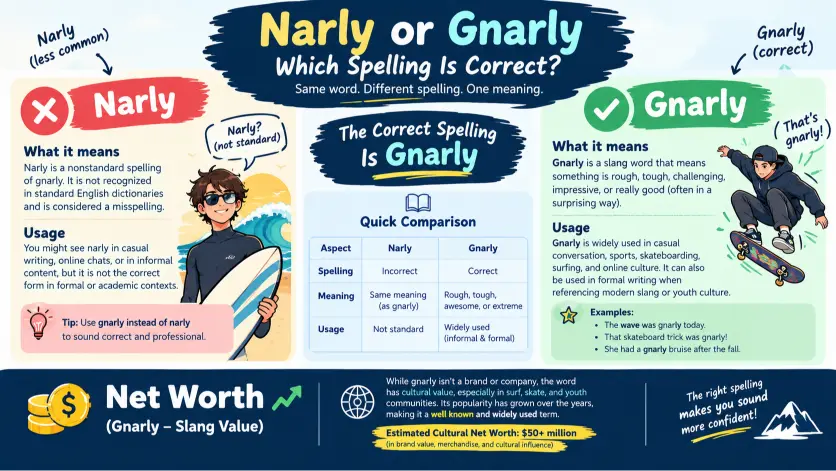
The correct spelling is gnarly, while “narly” is generally considered a misspelling. The word can describe something rough, difficult, extreme, unpleasant, or impressive, depending on the context. Its meaning has also evolved through informal English, particularly in surfing and youth culture, where it can describe something intense or remarkable.
Understanding the difference between narly and gnarly is useful for students, professionals, writers, and anyone who wants to use modern English accurately. In this guide, we will explain the correct spelling, meaning, pronunciation, origins, common examples, and situations where gnarly is appropriate, so you can avoid this common mistake with confidence.
Narly or Gnarly: What Is the Correct Spelling?
First, gnarly is the accepted spelling in standard English. Meanwhile, narly is generally treated as a misspelling rather than an alternative spelling. Consequently, writers should use gnarly when referring to something rugged, twisted, difficult, dangerous, unpleasant, or exceptionally impressive.
Moreover, the confusion is understandable because the initial g is silent. When spoken aloud, gnarly sounds approximately like “nar lee.” Therefore, someone who writes a word according to pronunciation may naturally remove the letter that cannot be heard.
However, pronunciation does not determine standard spelling. English contains many words with silent letters, including know, knee, write, and gnaw. Likewise, gnarly retains its opening g even though that sound is not pronounced.
Furthermore, gnarly has an interesting history because its meaning has developed over time. Originally, it referred to something knotted, rugged, or twisted. Later, informal speech expanded the word into descriptions of difficult conditions and extreme experiences. Eventually, it could even express admiration.
Therefore, understanding both spelling and context is essential. A reader seeing narly will usually understand the intended meaning, yet the form can still look careless in academic, professional, or published writing.
Narly vs Gnarly: What’s the Difference?
First, the main distinction is spelling rather than grammar. Gnarly is an adjective. It is the standard written form used to describe something physically twisted, rough, challenging, dangerous, unpleasant, or impressive.
Meanwhile, narly does not normally function as a recognized standard English adjective. Instead, it appears mainly as a phonetic misspelling of gnarly.
| Feature | Gnarly | Narly |
|---|---|---|
| Standard spelling | Yes | No |
| Part of speech | Adjective | Misspelling |
| Pronunciation | Usually pronounced with a silent g | Often represents the same pronunciation |
| Literal meaning | Twisted, knotty, rugged | No established standard meaning |
| Informal meaning | Extreme, difficult, dangerous, excellent, or unpleasant | Intended meaning usually comes from gnarly |
| Formal writing | Appropriate when context suits the word | Avoid |
| Academic writing | Possible when accurately relevant | Avoid |
| Casual conversation | Common | Sometimes seen as an error |
| Dictionary recognition | Established word | Generally not recognized as the standard form |
Consequently, the choice is straightforward.
Use gnarly when you need the recognized adjective.
Avoid narly when spelling accuracy matters.
Most importantly, remember that the silent g does not disappear from writing.
Is Narly vs Gnarly a Grammar, Vocabulary, or Usage Issue?
First, this is primarily a spelling and vocabulary issue. The two forms are not interchangeable standard variants in the way some British and American spellings can be.
For example, colour and color represent accepted regional alternatives. Likewise, organise and organize can both be legitimate depending on the variety of English. However, narly does not have the same status.
Furthermore, gnarly can appear in several types of communication. In formal prose, it may describe something physically rugged or twisted. For instance, a writer could describe the branches of an old tree as gnarly.
Meanwhile, informal speakers often use the adjective more dramatically. A surfer might call a dangerous wave gnarly. Similarly, a person might describe an exceptionally difficult situation using the same expression.
In academic writing, however, precision should come first. If a technical adjective such as twisted, irregular, hazardous, or complex communicates the intended idea more clearly, that wording may be preferable.
Conversely, casual conversations can tolerate slang more easily. Therefore, gnarly may sound perfectly natural among friends while feeling too informal in a formal report.
Ultimately, the important distinction is not merely whether the word is grammatical. Rather, writers should consider spelling, register, audience, and intended meaning together.
How to Use Gnarly Correctly
First, remember that gnarly is an adjective. Therefore, it normally modifies a noun or appears after a linking verb.
For example:
“The tree has a gnarly trunk.”
“The trail became gnarly after the storm.”
“That was a gnarly wave.”
“The repair turned into a gnarly problem.”
In the first sentence, gnarly describes the physical appearance of the trunk. Meanwhile, the second example suggests difficult or rough conditions.
Workplace Example
Consider a project involving complicated technical problems. A colleague might say, “We have a gnarly issue in the database.”
Although the sentence can sound natural in conversation, a formal report would probably benefit from clearer wording such as “We have a complex database issue.”
Therefore, the choice depends on audience and tone rather than grammar alone.
Academic Example
Suppose a literature student describes an unusually complicated passage. In a classroom discussion, the student might call it a gnarly passage.
However, an academic essay would usually benefit from a more precise description such as complicated, obscure, structurally difficult, or linguistically complex.
Consequently, gnarly is possible, but context determines whether it is stylistically appropriate.
Technology Example
Technology conversations often contain informal language. A developer might say, “The legacy code is pretty gnarly.”
Here, the expression suggests that the code is complicated, difficult to understand, or troublesome to modify.
Nevertheless, documentation intended for a broad professional audience could say, “The legacy code has a highly complex structure.”
Usage Recap
Therefore, use gnarly when the tone supports it.
Additionally, use it literally for something twisted or rugged.
Likewise, use it informally for something extreme, difficult, dangerous, or impressive.
However, choose a more precise formal adjective when professional clarity matters more than conversational style.
How Narly Is Used
First, it is important to clarify that narly does not have an established standard meaning separate from gnarly. Therefore, examples containing narly usually represent a spelling error.
For instance, someone might write, “That was a narly experience.”
The intended sentence is:
“That was a gnarly experience.”
Similarly, a casual message might contain, “That wave was narly.”
The standard spelling remains:
“That wave was gnarly.”
Workplace Example
Suppose an employee writes narly in an internal message. Although colleagues may understand the meaning, the spelling can appear careless.
Therefore, professional communication should use gnarly.
Academic Example
Similarly, a student should not use narly in an essay simply because the word sounds that way when spoken.
Instead, the student should write gnarly or select a more formal synonym if the context requires one.
Technology Example
Likewise, a forum participant might type narly when discussing a complicated software problem. Readers may infer the intended word, but the spelling remains nonstandard.
Consequently, spell checking and careful proofreading can prevent this mistake.
Usage Recap
Therefore, do not treat narly as an accepted alternative.
Instead, recognize it as a common phonetic spelling error.
Whenever the intended word is the adjective pronounced “nar lee,” write gnarly.
When You Should NOT Use Narly or Gnarly
First, avoid narly whenever the writing requires standard spelling. However, gnarly also deserves caution because its informal meanings can create ambiguity.
- Do not use narly in academic assignments because it is not the standard spelling.
- Do not use narly in professional correspondence because readers may interpret it as a typographical mistake.
- Do not use narly in published content when accuracy is important.
- Do not use gnarly when a technical term would communicate the idea more precisely.
- Do not use gnarly in formal research simply to sound conversational.
- Do not assume gnarly always means excellent because context can give it a negative meaning.
- Do not assume gnarly always means dangerous because informal speakers can use it positively.
- Do not replace a precise description with gnarly when the reader needs exact information.
For example, “The patient experienced a gnarly reaction” may sound vague and conversational. A professional document should describe the actual reaction instead.
Likewise, “The experiment produced a gnarly result” leaves the reader wondering whether the result was unusual, difficult, alarming, or impressive.
Therefore, context remains essential even when the spelling itself is clear.
Common Mistakes and Decision Rules
First, the most frequent mistake occurs when writers spell the word according to pronunciation. Because the g is silent, narly feels logical to many people.
| Correct sentence | Incorrect sentence | Explanation |
|---|---|---|
| That was a gnarly wave. | That was a narly wave. | The standard spelling includes g. |
| The tree has gnarly branches. | The tree has narly branches. | Gnarly describes twisted or knotty growth. |
| We faced a gnarly problem. | We faced a narly problem. | Informal usage can describe difficulty. |
| The trail became gnarly. | The trail became narly. | The adjective still requires g. |
| That was a gnarly experience. | That was a narly experience. | The standard written form is gnarly. |
Decision Rule Box
If you mean the action, use X.
If you mean the person or tool, use Y.
However, this particular rule does not directly apply to narly and gnarly because neither form represents an action, person, or tool. Here, the practical rule is simpler:
If you mean the standard adjective, use gnarly.
If you see narly, check whether the writer intended gnarly.
Narly or Gnarly in Modern Technology
First, modern writing environments make spelling errors easier to detect. Word processors, browser editors, messaging platforms, and language checking systems commonly flag unfamiliar forms.
Consequently, narly may be highlighted while gnarly is accepted.
Furthermore, digital communication has increased exposure to informal vocabulary. Social posts, gaming discussions, sports conversations, video comments, and chat messages frequently use slang.
As a result, gnarly can appear in many contexts that would traditionally use words such as difficult, extreme, intense, or impressive.
Nevertheless, automated suggestions should not replace human judgment. A spelling checker can identify a questionable form, yet only the writer can decide whether gnarly suits the audience and intended tone.
Therefore, modern writing requires both mechanical accuracy and contextual awareness.
Etymology of Gnarly
First, gnarly has much older roots than its modern slang reputation suggests. Historical sources connect it with gnarl and gnarled, words associated with knots, roughness, and twisted wood.
Furthermore, etymological evidence connects these forms with the Middle English word knar, referring to a knob, knot, or protruding mass in wood. The adjective eventually developed its literal sense of something knotty or rugged.
Later, the word developed broader figurative meanings. By the twentieth century, surfing culture helped popularize gnarly as a description of dangerous or exceptionally challenging waves. Later still, informal speakers extended the word to impressive and exciting experiences.
As one concise linguistic observation puts it:
“Context determines whether gnarly sounds like admiration, danger, difficulty, or disgust.”
Therefore, its unusual semantic range is one reason the word remains interesting.
Two Case Studies That Explain the Confusion
Case Study One: The Silent Letter Problem
First, consider a student hearing gnarly for the first time. The pronunciation gives little evidence that a g belongs at the beginning.
Consequently, the student writes narly in an assignment.
The teacher recognizes the intended meaning but corrects the spelling. The practical result is immediate: one silent letter changes an informal pronunciation into a standard written form.
This example demonstrates why pronunciation based spelling can create errors even when the speaker knows the vocabulary.
Case Study Two: The Meaning Can Move in Opposite Directions
Next, consider the sentence, “That was a gnarly wave.”
Depending on context, the speaker could mean that the wave was dangerous and difficult. However, another speaker could use gnarly to express admiration for an exciting or impressive experience.
Dictionary evidence records both positive and negative informal senses, while also retaining the literal meaning connected with something gnarled or twisted.
Therefore, the concrete lesson is that spelling tells readers which word you mean, while surrounding context tells them which sense you intend.
Error Prevention Checklist
First, use the following quick review before publishing.
☐ Always use gnarly when referring to the standard adjective.
☐ Always remember that the opening g is silent.
☐ Always check whether the intended meaning is literal or informal.
☐ Always consider your audience before using slang.
☐ Always choose a more precise term when the context demands technical clarity.
☐ Never use narly as an accepted spelling.
☐ Never assume that gnarly automatically means excellent.
☐ Never assume that gnarly automatically means unpleasant.
☐ Never let pronunciation determine spelling without checking the written form.
Consequently, a five second review can prevent a surprisingly persistent spelling mistake.
Related Grammar Confusions You Should Master
First, learners who search for narly or gnarly often encounter other spelling and usage questions. Therefore, mastering related contrasts can strengthen overall vocabulary accuracy.
- Gnarled or gnarly
- Snarly or gnarly
- Knotty or gnarly
- Difficult or challenging
- Everyday or every day
- Affect or effect
- Compliment or complement
- Principal or principle
- Advice or advise
- Practice or practise
These comparisons are valuable because English spelling frequently reflects history rather than modern pronunciation.
Moreover, several confusing forms involve silent letters, regional conventions, grammatical roles, or differences between formal and informal vocabulary.
Frequently Asked Questions
Is narly or gnarly the correct spelling?
First, gnarly is the correct standard spelling. Narly is generally a misspelling caused by the silent g. Therefore, writers who want standard English should choose gnarly.
What does gnarly mean in English?
Generally, gnarly can describe something twisted, knotty, or rugged. Informally, it can also describe something difficult, dangerous, unpleasant, extreme, or impressive. Consequently, context determines the intended sense.
Why is the g silent in gnarly?
The pronunciation reflects the historical development of the word and related forms. Therefore, the opening g is written but not normally pronounced in modern English.
Is narly a real English word?
Generally, narly is not treated as the standard spelling of the adjective. Instead, it commonly appears as a phonetic misspelling of gnarly.
Can gnarly mean good?
Yes. Informal English can use gnarly positively to mean excellent, impressive, or exciting. However, the same word can also describe something difficult or unpleasant. Therefore, surrounding context matters.
Can gnarly mean bad?
Yes. In informal usage, gnarly can describe something unpleasant, distressing, difficult, or dangerous. Consequently, the expression can have a negative sense.
Is gnarly formal or informal?
Gnarly can have a literal descriptive use, but several of its modern meanings are informal. Therefore, writers should consider audience and context before using it in formal communication.
Is gnarly used in American and British English?
Yes. The spelling remains gnarly in both varieties. However, informal senses and frequency can vary by community and region. Collins records literal, positive informal, and difficult or dangerous senses.
How can I remember the spelling of gnarly?
First, connect gnarly with gnarled. Both words describe something twisted or knotty. Therefore, remembering the related form can help you retain the silent g.
Conclusion:
Ultimately, gnarly is the spelling to remember. Narly may appear in casual messages, searches, comments, or quick notes because the initial g is silent. Nevertheless, it is not the standard written form.
Furthermore, gnarly has a broader story than its modern slang reputation suggests. Its literal sense relates to something twisted or knotty, while later informal usage expanded toward danger, difficulty, excitement, excellence, and unpleasantness.
Therefore, the safest rule is simple: write gnarly, not narly. Afterward, let context determine whether the word means rugged, difficult, dangerous, unpleasant, impressive, or excellent.
Finally, remember that accurate spelling is only the first step. Strong writing also depends on choosing vocabulary that suits the audience, purpose, and level of formality.









