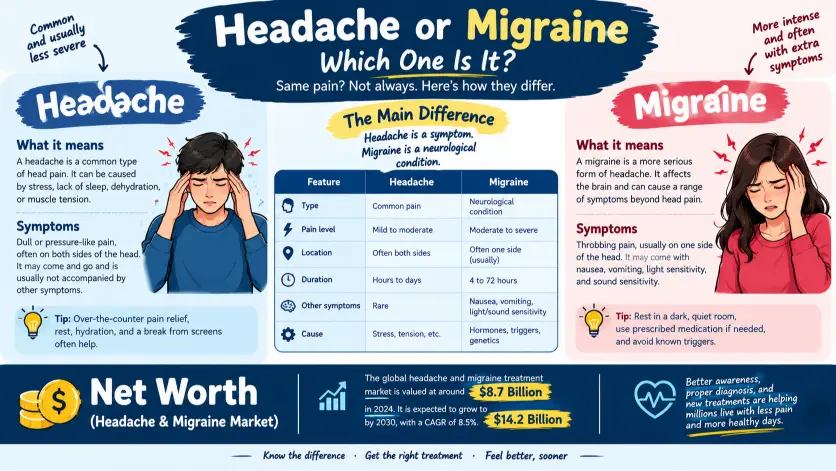
Head pain can be confusing, especially when the symptoms of a headache or migraine seem similar. A mild ache after a stressful day may feel very different from the intense, throbbing pain that can accompany nausea or sensitivity to light. Knowing these differences can help you understand your symptoms and decide when professional medical advice may be appropriate.
Although people often use the words headache and migraine interchangeably, migraine is a neurological condition with its own characteristic symptoms and patterns. Medical professionals consider factors such as pain intensity, duration, location, associated symptoms, triggers, and how frequently episodes occur when evaluating these conditions. However, symptoms can vary considerably from person to person.
This guide explains the important differences between a headache or migraine, including common symptoms, potential triggers, warning signs, and treatment approaches. It is based on established medical understanding rather than assumptions or internet myths. If headaches are sudden, unusually severe, frequent, or accompanied by concerning neurological symptoms, seeking advice from a qualified healthcare professional is important.
Headache or Migraine: What’s the Difference?
First, headache is a noun that describes pain or discomfort occurring in the head, scalp, face, or upper neck region. It is a broad symptom rather than one single disease. Consequently, headaches can occur for many different reasons and can have very different patterns.
By contrast, migraine is a neurological disease and a specific headache disorder. A migraine attack can produce head pain, but it may also involve nausea, vomiting, sensitivity to light or sound, dizziness, visual disturbances, and other neurological symptoms.
| Feature | Headache | Migraine |
|---|---|---|
| Part of speech | Noun | Noun |
| Meaning | General head pain or discomfort | A neurological disorder involving recurring attacks |
| Pain pattern | Varies considerably | Often throbbing or pulsating |
| Location | May occur in different areas | Often affects one side, although both sides can hurt |
| Nausea | Possible | Common |
| Light sensitivity | Possible | Common |
| Sound sensitivity | Possible | Common |
| Aura | Not a defining feature | Can occur in some attacks |
| Duration | Depends on the cause | Often 4 to 72 hours when untreated |
| Diagnosis | Depends on the underlying cause | Primarily based on symptoms and medical history |
Therefore, every migraine headache can involve head pain, but not every headache is a migraine. Furthermore, migraine can sometimes occur without head pain, which demonstrates why the terms shouldn’t be treated as exact synonyms.
In simple terms, headache is the broader category, while migraine identifies a particular neurological condition.
Is Headache or Migraine a Grammar, Vocabulary, or Usage Issue?
First, this distinction is mainly a vocabulary and usage issue, rather than a grammar problem. Both words are grammatically correct nouns, yet they communicate different meanings.
For example, “I have a headache” communicates that the speaker has head pain. However, “I have a migraine” communicates a more specific medical condition or attack pattern.
Furthermore, neither expression is simply more formal than the other. Both can appear in professional, academic, clinical, and casual conversations. The difference comes from precision rather than formality.
In casual conversation, someone may say, “This headache is killing me,” without identifying its cause. Nevertheless, a healthcare professional may need more information before deciding whether that pain represents migraine, tension type headache, cluster headache, medication overuse headache, or another condition.
Similarly, academic writing should avoid assuming that every severe headache is migraine. Instead, the writer should use the more specific term only when the available evidence supports it.
Consequently, the safest rule is straightforward. Use headache when discussing head pain generally. Use migraine when referring to a diagnosed condition or a symptom pattern that fits migraine and has been evaluated appropriately.
How to Use Headache Correctly
First, headache works naturally when the cause or exact type of head pain isn’t known. For example, someone might say, “I developed a headache after working for several hours.”
In a workplace setting, an employee might explain, “I have a headache and need a short break.” Here, the speaker isn’t claiming a particular neurological diagnosis.
In an academic context, a researcher might write, “Participants reported headache after prolonged exposure to the experimental condition.” Therefore, the general term is appropriate when the research concerns head pain rather than a confirmed migraine disorder.
In technology, a symptom tracking application might display “headache” as a general category. Users can then record intensity, duration, location, and accompanying symptoms. This approach is useful because symptom tracking can provide healthcare professionals with more detailed information.
However, headache doesn’t tell you why the pain exists. Consequently, it shouldn’t automatically be interpreted as evidence of dehydration, stress, eye strain, sinus disease, migraine, or another particular cause.
Usage recap
Use headache when you mean general head pain.
Use it when the exact cause isn’t established.
Use a more specific diagnosis only when appropriate clinical information supports it.
How to Use Migraine Correctly
First, migraine should be used when referring to the neurological condition rather than simply using it as another word for severe pain.
For instance, a person who has recurring attacks accompanied by pulsating pain, nausea, and sensitivity to light may discuss possible migraine symptoms with a healthcare professional. However, symptoms alone don’t replace professional diagnosis.
In the workplace, saying “I experience migraine attacks” communicates more information than simply saying “I get headaches.” It can explain why ordinary activities, bright lights, noise, or prolonged concentration may become difficult during an attack.
In an academic setting, a medical paper may distinguish migraine from tension type headache because the disorders have different diagnostic features and management considerations.
In technology, a headache diary may allow a person to record migraine attacks, possible triggers, duration, medication use, and associated symptoms. Such records can make discussions with clinicians more informative.
Furthermore, migraine doesn’t always mean unbearable pain. Some migraine attacks can involve aura or other symptoms without prominent head pain. Therefore, using “migraine” solely to mean “very painful headache” is an oversimplification.
Usage recap
Use migraine for the specific neurological disorder.
Don’t use it simply because a headache feels severe.
Remember that migraine can involve symptoms beyond head pain.
When You Should NOT Use Headache or Migraine
First, don’t automatically use migraine whenever head pain is intense. Severity alone doesn’t establish migraine.
Second, don’t assume that every pressure sensation is a tension type headache. Different conditions can produce overlapping symptoms.
Third, don’t call a sudden, extremely severe headache a routine migraine simply because someone has experienced migraine before. A sudden severe headache can require urgent evaluation.
Fourth, don’t describe new neurological symptoms as an ordinary headache without considering medical evaluation. Weakness, numbness, trouble speaking, confusion, seizures, or significant vision changes can require urgent attention.
Fifth, don’t assume that recurring head pain is automatically migraine. A healthcare professional may need to review the pattern, associated symptoms, medical history, and possible triggers.
Sixth, don’t use migraine as a casual synonym for any unpleasant experience. Saying “That meeting was a migraine” may be understandable conversationally, but it weakens the medical meaning of the term.
Seventh, don’t dismiss frequent headaches simply because previous episodes were harmless. A significant change in frequency, severity, or character deserves medical discussion.
Eighth, don’t rely on terminology alone when symptoms are new or unusual. Accurate description matters more than choosing a dramatic word.
Common Mistakes and Decision Rules
The most frequent mistake is treating the two terms as interchangeable. Because migraine often causes head pain, people naturally assume that “headache” and “migraine” describe the same thing. However, the broader term doesn’t communicate the complete clinical picture.
| Correct sentence | Incorrect sentence | Explanation |
|---|---|---|
| I have a headache. | Every headache is a migraine. | Headache is a broad symptom. |
| My doctor diagnosed migraine. | Any severe headache proves migraine. | Severity alone isn’t enough. |
| Bright light makes my migraine symptoms worse. | Bright light proves I have migraine. | One symptom doesn’t establish a diagnosis. |
| I recorded my headache symptoms. | I diagnosed my own migraine from one episode. | Symptom tracking isn’t the same as diagnosis. |
| I have recurring migraine attacks. | I call every headache migraine. | Specific terminology should match the condition. |
Decision Rule
If you mean general pain in the head, use headache.
If you mean the specific neurological disorder, use migraine.
This distinction is more medically useful than trying to decide which word sounds stronger.
Headache or Migraine in Modern Technology and Digital Health Tools
First, symptom tracking tools increasingly allow people to record pain intensity, duration, location, associated symptoms, medication use, and possible triggers. Consequently, a person can build a more detailed record instead of relying on memory.
For migraine, tracking may be particularly helpful because attacks can involve several phases. These can include prodrome, aura, headache, and postdrome. The early phase may begin hours or even days before head pain, while aura commonly involves temporary visual or sensory changes.
However, digital symptom tracking should support communication with a healthcare professional rather than replace clinical assessment.
Moreover, modern diagnostic practice generally relies on symptoms, medical history, and examination. There isn’t a single blood test or scan that confirms migraine in every patient. Imaging may sometimes be used when clinicians need to investigate another possible cause.
Where the Terms Come From
The word headache is a straightforward compound formed from “head” and “ache.” Consequently, its meaning is relatively transparent. It essentially describes an ache or pain involving the head.
The history of migraine is more complex. The term ultimately traces back through older European forms associated with a condition involving one side of the head. Over time, the word developed into the modern medical term used for a neurological disorder.
Therefore, the two words developed along different semantic paths. Headache describes a symptom broadly, while migraine became associated with a particular disorder and its characteristic collection of symptoms.
An Expert Perspective
The American Migraine Foundation emphasizes that migraine is “not just a headache” and explains that migraine is a neurological disease that can include multiple symptoms beyond head pain.
That distinction is important because reducing migraine to pain intensity can overlook nausea, sensory sensitivity, aura, dizziness, cognitive difficulties, and other features.
Two Practical Case Studies
Case Study One: Repeated Head Pain
Consider a hypothetical office worker who develops mild head pressure after long periods of concentration. The discomfort improves after rest and doesn’t regularly involve nausea, light sensitivity, or recurring attacks.
Initially, the most accurate description is simply headache. Therefore, labeling every episode migraine would introduce information that hasn’t been established.
After keeping a symptom record, the person notices that the episodes have different patterns depending on sleep, hydration, and workload. That record provides useful information for a later clinical discussion.
The concrete result is improved symptom description. Instead of reporting only “I get migraines,” the person can explain frequency, duration, intensity, triggers, and associated symptoms.
Case Study Two: Recurring Migraine Pattern
Now consider another hypothetical person who experiences recurring attacks lasting several hours. The episodes involve pulsating head pain, nausea, and marked sensitivity to light.
Because the pattern contains several features associated with migraine, the person schedules a clinical assessment rather than assuming the diagnosis independently.
The concrete result is a more structured evaluation. The individual can provide a symptom diary showing when attacks occur, how long they last, what symptoms accompany them, and what measures were attempted.
These examples demonstrate why precise language matters. A useful description isn’t simply “headache” or “migraine.” Instead, it explains what actually happens during an episode.
Error Prevention Checklist
Always use headache when
First, you’re referring to head pain generally.
Next, the exact cause hasn’t been established.
Also, you’re discussing headache as a broad symptom category.
Finally, you’re describing a symptom without claiming a specific diagnosis.
Never use migraine when
First, you’re using severity alone as proof.
Next, you’re labeling an unexplained new headache without appropriate assessment.
Also, you’re treating migraine as a universal synonym for head pain.
Finally, you’re ignoring unusual neurological symptoms that could indicate another medical problem.
Remember, a sudden severe headache, particularly one accompanied by confusion, weakness, numbness, seizures, trouble speaking, vision problems, fever, or a stiff neck, can require urgent medical attention.
Related Grammar Confusions You Should Master
First, understanding related distinctions can make everyday writing more precise.
- Affect or effect: Understand the difference between influence and result.
- Advice or advise: Separate the noun from the verb.
- Then or than: Use the appropriate word for sequence or comparison.
- Fewer or less: Match the expression to the type of quantity being discussed.
- Its or it’s: Distinguish possession from the contraction.
- Your or you’re: Separate possession from the shortened form of “you are.”
- Compliment or complement: Identify praise versus something that completes another thing.
- Further or farther: Recognize their traditional differences in usage.
- Lay or lie: Pay attention to whether the sentence describes placing something or reclining.
- Symptom or diagnosis: Don’t confuse a reported experience with a medically established condition.
The final distinction is particularly important in health writing. A symptom describes what someone experiences, whereas a diagnosis identifies a condition based on appropriate clinical evaluation.
Frequently Asked Questions
What is the difference between a headache and a migraine?
First, headache is a broad term for head pain, while migraine refers to a neurological disorder that can include head pain plus symptoms such as nausea, light sensitivity, sound sensitivity, and sometimes aura. Therefore, migraine is one type of headache disorder rather than a synonym for every headache.
How do I know if my headache is a migraine?
A migraine may involve moderate or severe pain, often with pulsating or throbbing qualities, along with nausea or sensitivity to light and sound. However, symptoms overlap among different headache disorders, so recurring or concerning symptoms should be evaluated by a healthcare professional.
Can a migraine happen without a headache?
Yes. Some people experience migraine symptoms such as aura without the subsequent headache phase. Consequently, the absence of head pain doesn’t always exclude migraine.
How long does a migraine usually last?
An untreated migraine attack commonly lasts between four and 72 hours. Nevertheless, individual experiences vary, and different phases can occur before and after the main headache period.
Is every severe headache a migraine?
No. Severity alone doesn’t establish migraine. Headache disorders include several different conditions, and some secondary headaches can result from an underlying medical problem. Therefore, a new or unusual severe headache deserves appropriate attention.
Can migraine cause nausea and light sensitivity?
Yes. Nausea and increased sensitivity to light and sound are common migraine symptoms. Moreover, some people experience sensitivity to smells, dizziness, fatigue, visual changes, or other neurological symptoms.
When should I seek emergency help for a headache?
Seek emergency medical care for a sudden, extremely severe headache or head pain accompanied by symptoms such as confusion, seizures, weakness, numbness, difficulty speaking, significant vision problems, fever, or a stiff neck. Headache following a head injury can also require urgent assessment.
Can keeping a headache diary help?
Yes. Recording timing, duration, intensity, symptoms, possible triggers, and medication use can give a healthcare professional useful information. Therefore, a consistent record can make clinical conversations more productive.
Is migraine a type of headache?
Migraine is a specific headache disorder, but the word headache itself is broader. In addition, migraine can occasionally occur without head pain. Therefore, describing migraine simply as “a bad headache” doesn’t capture the full condition.
Conclusion: Headache or Migraine
Ultimately, headache or migraine isn’t simply a choice between two interchangeable words. Instead, the distinction reflects different levels of meaning. A headache is a broad description of head pain. Meanwhile, migraine is a neurological disorder that can involve recurring attacks, head pain, nausea, sensory sensitivity, aura, and other symptoms.
Therefore, use headache when discussing head pain generally. Use migraine when referring to the specific neurological condition or an appropriately established diagnosis. Most importantly, don’t judge a headache solely by how painful it feels. A sudden or unusual pattern, particularly when accompanied by neurological symptoms, can require prompt medical evaluation.
Clear terminology won’t diagnose a condition by itself. However, accurate descriptions can make it easier to communicate symptoms, recognize concerning changes, and seek appropriate professional care.









