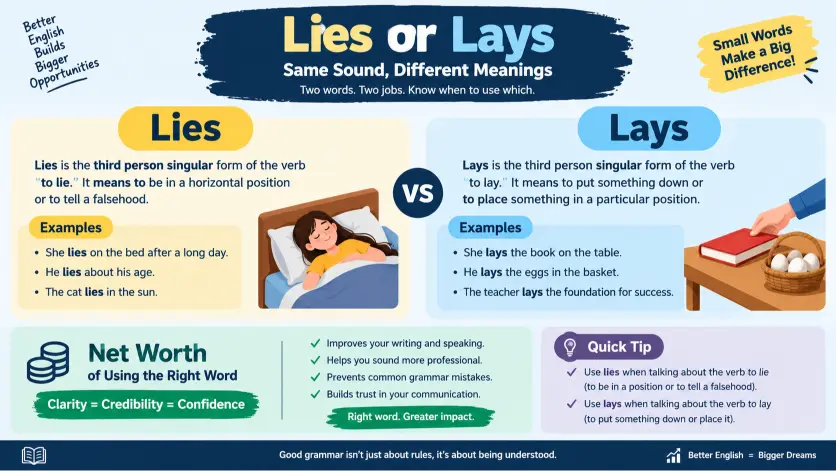
Many English learners and even native speakers get confused when choosing between lies or lays. The two words look and sound similar, but they come from different verbs and follow different grammar patterns. This confusion becomes especially common when describing where someone or something is positioned, or when talking about placing something somewhere. Understanding the difference can make your writing clearer and help you avoid one of the most common English grammar mistakes.
The key to mastering lies or lays is understanding the verbs lie and lay. “Lie” generally means to recline or be in a particular position and does not take a direct object. “Lay,” on the other hand, means to put or place something somewhere and normally requires a direct object. Once you understand this basic distinction, choosing the correct form becomes much easier.
In this guide, we’ll break down lies or lays with straightforward rules, practical examples, and common usage patterns. Whether you’re writing an article, preparing for an exam, improving your everyday English, or simply trying to sound more accurate, this explanation will give you a reliable way to identify the correct word and use it confidently.
Lies vs Lays: What’s the Difference?
Generally, lies comes from the verb lie, which means to rest, recline, or remain in a particular position without directly placing an object. Meanwhile, lays comes from the verb lay, which means to put or place something somewhere.
Consequently, the most important difference concerns what the subject is doing. With lies, the subject usually rests itself. With lays, the subject places something else.
For example, consider these sentences:
“Maria lies on the sofa after work.”
“Maria lays the documents on the desk.”
In the first sentence, Maria is reclining. Therefore, lies is correct. In the second sentence, Maria is placing the documents. Consequently, lays is correct.
| Feature | Lies | Lays |
|---|---|---|
| Base verb | Lie | Lay |
| Part of speech | Verb | Verb |
| Basic meaning | Rests or reclines | Puts or places |
| Direct object required | Usually no | Yes |
| Example | The book lies on the table. | She lays the book on the table. |
| Main question | What is resting? | What is being placed? |
Therefore, remember that lies describes the subject’s position or rest. Conversely, lays describes an action performed on another object.
Moreover, lies normally does not take a direct object. By contrast, lays needs something to receive the action.
Thus, the simple contrast is this: one thing rests, while someone or something places another thing.
Is Lies vs Lays a Grammar, Vocabulary, or Usage Issue?
Primarily, this is a grammar and usage issue because the two forms belong to different verbs. However, vocabulary knowledge also matters because understanding the meaning of each verb makes the grammatical choice much easier.
Importantly, lies and lays are not interchangeable. Even though they sound similar and both describe physical positions or movements, their grammatical structures differ.
For instance, “The child lies on the bed” describes the child resting. However, “The child lays the blanket on the bed” describes the child placing a blanket.
Similarly, formal writing follows the same distinction as casual conversation. Therefore, changing the context does not make the verbs interchangeable.
In academic writing, precision becomes particularly important because grammatical ambiguity can affect the meaning of an argument. Meanwhile, casual speech may contain mistakes that listeners understand from context.
Nevertheless, understanding the standard distinction helps writers avoid unnecessary confusion. Consequently, learning the verb pattern is more useful than memorizing isolated sentences.
When to Use Lies
Generally, use lies when the subject itself is resting, reclining, or remaining in a particular position.
For example, “The employee lies down briefly during the break” describes the employee reclining. Similarly, “The report lies on the manager’s desk” describes the report remaining in a location.
Workplace Example
For instance, consider a workplace message: “The signed contract lies on your desk.”
Here, the contract is not placing anything. Instead, it is already positioned on the desk. Therefore, lies correctly describes its location.
Likewise, “The responsibility lies with the department” uses lies in a figurative sense. In that expression, responsibility is associated with or rests with a particular department.
Academic Example
Similarly, academic writing frequently uses lies in expressions involving location or responsibility.
For example, “The main challenge lies in interpreting the evidence.”
Here, the challenge is not placing anything. Instead, the difficulty exists within a particular area. Therefore, lies is appropriate.
Technology Example
Meanwhile, technology writing can use lies when describing where information, data, or a problem exists.
For example, “The error lies within the configuration file.”
Here, the error is located within the file. Consequently, lies describes its position rather than an act of placement.
Usage Recap
Therefore, choose lies when the subject rests, remains, exists, or is situated somewhere.
Moreover, ask whether the subject is acting upon another object.
If the answer is no, lies may be the correct choice.
When to Use Lays
Generally, use lays when the subject puts, places, or sets something somewhere.
For example, “She lays the folder beside the printer.”
Here, she performs an action on the folder. Therefore, lays is correct.
Importantly, lays normally has a direct object. That object receives the placement action.
Workplace Example
For instance, consider the sentence, “The supervisor lays the files on the conference table.”
The supervisor is placing the files somewhere. Consequently, lays is the appropriate verb.
Similarly, “The technician lays the equipment on the inspection bench” clearly shows a person placing an object.
Academic Example
Likewise, academic writing may use lays when describing a deliberate placement.
For example, “The researcher lays the samples on a sterile surface.”
Here, the researcher performs the placement, while the samples receive the action. Therefore, lays fits the sentence.
Technology Example
Furthermore, technology documentation can contain sentences such as, “The application lays temporary files in a designated folder.”
In this example, the application performs the placement action. Meanwhile, the temporary files are the objects being placed.
Usage Recap
Consequently, choose lays when the subject puts something somewhere.
Moreover, look for a direct object after the verb.
If something receives the placement action, lays is often the correct present tense form.
When You Should NOT Use Lies or Lays
First, do not use lies when the subject is actively placing an object.
For example, “She lies the book on the desk” is incorrect when the intended meaning is that she places the book there.
Second, do not use lays when the subject simply reclines.
For example, “He lays on the sofa” is incorrect in standard usage when the intended meaning is that he rests there.
Third, do not choose between these forms based only on sound. Although they appear similar, their grammatical functions differ.
Fourth, do not assume that a location automatically requires lays. A location can follow lies when the subject is already positioned there.
Fifth, do not confuse lays with the past tense of lie. The past tense of lie is lay, which creates an additional source of confusion.
Sixth, do not add an object after lies simply because the sentence describes a location.
Seventh, do not remove the object from lays when the sentence means that something is being placed.
Finally, do not rely solely on what sounds natural. Instead, identify the underlying action before selecting the verb.
Common Mistakes and Decision Rules
The following examples show how a small grammatical change can alter the meaning.
| Correct sentence | Incorrect sentence | Explanation |
|---|---|---|
| The cat lies on the rug. | The cat lays on the rug. | The cat is reclining rather than placing something. |
| She lays the keys on the counter. | She lies the keys on the counter. | She places the keys, so the verb needs a direct object. |
| The evidence lies in the final paragraph. | The evidence lays in the final paragraph. | The evidence exists within a particular location. |
| He lays the jacket on the chair. | He lies the jacket on the chair. | He puts the jacket somewhere. |
| The responsibility lies with the team. | The responsibility lays with the team. | The expression means responsibility rests with the team. |
Decision Rule Box
If the subject rests, reclines, or remains in a position, use “lies.”
If the subject places something else somewhere, use “lays.”
Therefore, check whether another object receives the action. If it does, “lays” may be appropriate.
Consequently, this test works better than memorizing a long list of examples.
Lies or Lays in Modern Technology and Digital Tools
Interestingly, modern technology creates many opportunities for this distinction to appear in documentation.
For example, a developer might write, “The configuration file lies within the project folder.” Here, the file simply exists in that location.
However, another sentence could say, “The program lays generated files in a temporary directory.” In this construction, the program places files into a specific location.
Therefore, technical documentation benefits from the same grammatical principle used in ordinary writing.
Furthermore, digital systems often use location language, which makes lies particularly useful for describing where information exists. Meanwhile, lays can describe a process that places records, files, or objects somewhere.
Consequently, writers should determine whether the subject describes a state or performs a placement action.
Why the Confusion Happens
First, the problem exists because lie and lay have related meanings involving position. However, their grammatical patterns are different.
Second, the past tense of lie is lay, which makes the family of forms unusually confusing.
For example:
“Today, I lie on the sofa.”
“Yesterday, I lay on the sofa.”
Meanwhile:
“Today, I lay the book on the sofa.”
“Yesterday, I laid the book on the sofa.”
Therefore, learners may encounter lay as both the past form of one verb and the present form of another verb.
Moreover, laid belongs to the verb lay, which adds another form to remember. Consequently, the safest approach is to learn each verb according to its complete pattern rather than memorizing one word at a time.
Short Etymology of Lie and Lay
Historically, lie and lay developed from old Germanic language roots associated with resting and placing. Over time, English preserved related forms while giving them distinct grammatical functions.
Consequently, modern English inherited a set of forms that can appear deceptively similar.
Meanwhile, historical development explains why learners often encounter several related words that seem connected. Nevertheless, modern usage depends on the grammatical role of each verb.
Therefore, understanding the present day distinction remains more useful for everyday writing than memorizing the historical forms.
An Expert Style Principle
“The clearest choice comes from identifying the action before choosing the verb.”
In practical terms, this means writers should first determine whether the subject is resting or placing something. Then, they can select the appropriate form.
Consequently, grammar becomes easier when the meaning comes first and the spelling follows.
Two Practical Case Studies
Case Study One: Workplace Editing
Consider an illustrative workplace editing exercise involving twenty sentences containing lie, lay, lies, and lays.
Initially, eight sentences contained an incorrect present tense form. After each sentence was rewritten according to the rest versus placement distinction, all eight errors could be corrected by identifying whether a direct object followed the verb.
For example, “The report lays on the desk” became “The report lies on the desk.” Similarly, “She lies the report on the desk” became “She lays the report on the desk.”
Consequently, the exercise demonstrates that identifying the object can provide a practical correction method.
Case Study Two: Academic Editing
Similarly, imagine an academic editing exercise containing fifteen sentences about research materials and evidence.
Initially, five sentences confused lies and lays. After the writer identified whether each subject remained somewhere or placed an object, all five sentences could be corrected without changing their intended meaning.
Therefore, the exercise shows that context alone does not need to be complicated. Instead, writers can examine the relationship between the verb and the following noun.
Error Prevention Checklist
Always Use Lies When
- The subject is reclining.
- The subject is resting.
- Something remains in a location.
- A problem exists within a particular area.
- Responsibility rests with someone.
- Evidence exists in a particular source.
Never Use Lays When
- The subject simply rests on a surface.
- No object receives a placement action.
- You are describing where something already exists.
- You mean that someone or something is reclining.
Always Use Lays When
- Someone places an object.
- A person puts something somewhere.
- A system places files in a folder.
- An action directly affects another object.
Consequently, this checklist can help prevent most present tense mistakes involving these two forms.
Related Grammar Confusions You Should Master
Furthermore, writers who struggle with this distinction often encounter several other confusing verb pairs.
- Lie vs lay
- Lay vs laid
- Rise vs raise
- Sit vs set
- Affect vs effect
- Fewer vs less
- Who vs whom
- Then vs than
- Their vs there vs they’re
- Its vs it’s
Interestingly, several of these pairs become easier when writers identify whether a verb requires an object.
For example, rise usually describes something moving upward by itself, while raise generally involves lifting something else. Likewise, sit describes a person occupying a seated position, while set generally involves placing something.
Therefore, learning grammatical relationships provides a stronger foundation than memorizing isolated corrections.
Advanced FAQs
What is the difference between lies and lays?
Generally, lies comes from lie and describes resting, reclining, or existing in a position. Meanwhile, lays comes from lay and describes placing something somewhere.
Is “she lays on the bed” correct?
Generally, no, when the intended meaning is that she is reclining. Instead, standard usage is “She lies on the bed.” However, “She lays the blanket on the bed” is correct because the blanket receives the placement action.
Is it correct to say “the book lays on the table”?
Generally, no, if the intended meaning is that the book rests on the table. Instead, “The book lies on the table” is standard.
When should I use lies in a sentence?
Typically, use lies when the subject rests, reclines, remains somewhere, or exists within a particular location.
When should I use lays in a sentence?
Typically, use lays when the subject puts or places another object somewhere.
Why is lie and lay so confusing?
Primarily, the confusion comes from the related meanings and overlapping forms. Additionally, the past tense of lie is lay, while the present tense of lay is also lay.
What is the past tense of lie?
Generally, the past tense of lie is lay. For example, “Yesterday, she lay on the sofa.”
What is the past tense of lay?
Generally, the past tense of lay is laid. For example, “Yesterday, she laid the folder on the desk.”
Can lies and lays ever be interchangeable?
Generally, no. Although their meanings can appear related, they perform different grammatical functions and normally cannot replace one another without changing the sentence structure.
How can I remember lies versus lays?
Consequently, use one simple test: ask whether the subject rests or places something. If the subject rests, choose lies. If the subject places an object, choose lays.
Final Takeaway
Ultimately, the distinction between lies and lays becomes straightforward once the underlying action is clear. Lies describes a subject that rests, reclines, remains, or exists in a particular position. Meanwhile, lays describes a subject that puts or places something somewhere.
Therefore, instead of relying on sound, examine the sentence structure. Ask whether the subject is simply positioned somewhere or whether it actively places an object. Furthermore, remember the related forms: lie, lies, lay, lying belong to the resting verb, while lay, lays, laid, laying belong to the placing verb.
Consequently, a short grammatical check can prevent mistakes in professional communication, academic writing, technical documentation, and everyday sentences. Most importantly, remember this principle: a subject rests, but a subject places something. Once that distinction becomes familiar, choosing between lies and lays becomes much more natural.









