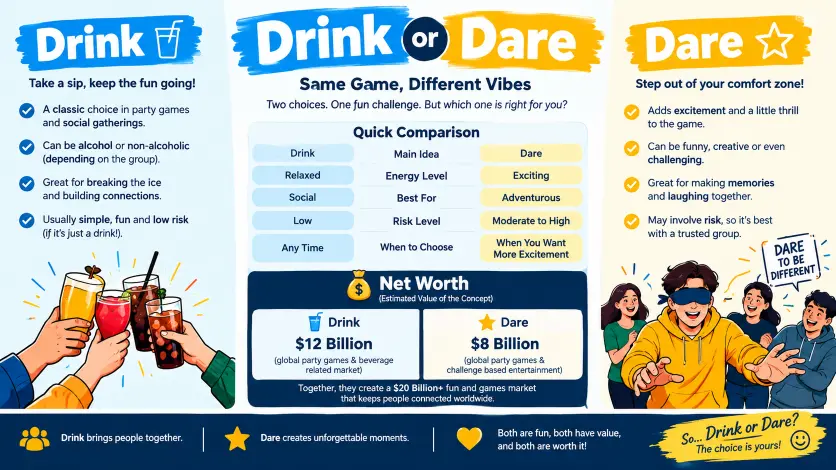
Drink or dare is a simple party game that combines questions, challenges, and playful choices to create an entertaining group activity. Players typically take turns choosing between answering a question or completing a dare, with the exact rules varying from group to group. Because the format is flexible, it can be adapted for casual gatherings, game nights, and celebrations.
The popularity of drink or dare comes from its easy-to-understand format and social nature. Unlike complicated party games that require special equipment, this game can usually be started with just a group of willing players and a set of questions or challenges. Participants can create their own rules, choose funny or competitive prompts, and adjust the difficulty according to the people playing.
This guide explains how drink or dare works, including common rules, question ideas, dare suggestions, and practical tips for keeping the game enjoyable. For a better experience, players should respect personal boundaries and make sure everyone is comfortable with the challenges. The goal is to create fun memories and friendly interaction rather than pressure anyone into doing something they do not want to do.
Drink or Dare: What Does Each Term Mean?
The word drink usually describes the act of consuming a liquid, although it can also identify a beverage itself. For example, someone might say, “Please drink some water,” or “I ordered a cold drink.” Therefore, its exact grammatical role depends on how it appears within a sentence.
Meanwhile, dare generally describes a challenge that asks another person to do something unusual, difficult, embarrassing, or adventurous. It can function as a verb, as in “I dare you to sing,” or as a noun, as in “That was a difficult dare.”
Consequently, the expressions can sound related when they appear in a party game, yet they represent separate choices. One concerns consumption, whereas the other involves accepting or performing a challenge.
For that reason, understanding drink or dare becomes especially useful when writing game instructions, invitations, captions, classroom examples, or casual messages. A small wording difference can change the intended activity completely.
Drink vs Dare: What’s the Difference?
Although drink and dare can occur together in recreational activities, they do not have interchangeable meanings. Instead, each word describes a distinct action or concept.
| Feature | Drink | Dare |
|---|---|---|
| Main meaning | Consume a liquid or refer to a beverage | Challenge someone to perform an action |
| Common part of speech | Verb and noun | Verb and noun |
| Typical context | Beverages, hydration, meals, games | Challenges, games, social activities |
| Example verb | “Drink the water.” | “I dare you to dance.” |
| Example noun | “I need a drink.” | “That was a strange dare.” |
| Basic idea | Consumption | Challenge |
Therefore, the simplest distinction is based on the action being described. If someone is consuming a beverage, drink is appropriate. If someone is being challenged to complete an activity, dare is the natural choice.
In addition, drink can identify either an action or an object. Dare can similarly identify either the act of challenging someone or the challenge itself.
Mini Recap
Drink relates primarily to consuming or referring to a beverage.
Dare relates to challenging someone or describing a challenge.
Both can function as nouns or verbs.
However, their meanings are not interchangeable.
Is Drink vs Dare a Grammar, Vocabulary, or Usage Issue?
The difference between drink and dare is mainly a vocabulary and usage issue, although grammar also matters because both words can perform more than one grammatical function.
First, drink can operate as a verb. For instance, “They drink water after exercise” describes an action. However, it can also act as a noun, as in “She ordered a drink.”
Similarly, dare can function as a verb. “I dare you to enter the room” presents a challenge. Yet it can also serve as a noun: “The dare was difficult.”
Consequently, neither word is simply a formal alternative to the other. They express different concepts.
In formal writing, drink is suitable when discussing beverages or consumption. Dare is appropriate when describing a challenge, especially within an account of games, social behavior, or personal experiences.
In casual communication, both words are common. However, context remains essential because using the wrong term can make an instruction confusing.
Academic writing usually requires greater precision. Therefore, a writer discussing hydration should use drink or a more precise term such as consume, whereas a writer discussing behavioral challenges should use dare or challenge.
How to Use Drink Correctly
The word drink has a remarkably broad range of everyday applications. Most importantly, it can describe the physical act of consuming a liquid.
For example, a workplace instruction might say, “Employees should drink enough water throughout the day.” Here, drink functions as a verb because it describes an action.
In an academic setting, the term can appear in research discussions involving beverages, nutrition, culture, or human behavior. A sentence such as “Participants reported how frequently they drink coffee” uses the word to describe consumption.
Technology provides another context. A fitness application might display a reminder encouraging users to drink water. Likewise, a smart bottle can record drinking habits and provide hydration reminders.
Therefore, drink is not limited to social games. It is an ordinary English word with applications ranging from daily conversation to professional communication.
Usage Recap for Drink
Use drink when referring to consuming liquid.
Use drink when identifying a beverage in suitable noun constructions.
Use the term naturally in casual, workplace, academic, and technological contexts.
How to Use Dare Correctly
Dare has a different semantic function because it introduces the idea of challenge or provocation.
In the workplace, someone might say, “I dare you to present that idea to the entire team.” However, this wording is usually playful rather than formal. A professional document would more naturally say, “I challenge you to present that idea.”
In academic writing, dare may appear when researchers discuss language, social behavior, literature, games, or interpersonal communication. For instance, a study of childhood language might examine how children use phrases such as “I dare you.”
Technology can also incorporate the concept. A social game might ask a participant to accept a dare and complete an assigned activity. Consequently, the word remains relevant even when the challenge is presented through a digital platform.
Furthermore, dare often carries an emotional element. It may communicate courage, teasing, competition, curiosity, or social pressure depending on the surrounding sentence.
Usage Recap for Dare
Use dare when describing a challenge.
Use dare as a verb when challenging someone.
Use dare as a noun when identifying the challenge itself.
Choose challenge instead when a formal or professional tone is required.
When You Should NOT Use Drink or Dare
Understanding when not to use a term can be more useful than memorizing a basic definition. Therefore, consider these common misuse situations.
1. Do not use drink for a challenge
The sentence “I drink you to jump” is incorrect because the intended meaning involves challenging someone. Use “I dare you to jump” instead.
2. Do not use dare for ordinary consumption
Saying “I dare water every morning” does not communicate the intended action. Instead, say “I drink water every morning.”
3. Do not treat them as synonyms
Although both words may appear in the same party activity, they represent separate actions.
4. Do not confuse a beverage with a challenge
A “drink” can refer to something consumed. A “dare” refers to an activity or challenge. Therefore, substituting one for the other changes the meaning.
5. Avoid dare in formal instructions when challenge is clearer
For professional communication, “challenge” often sounds more neutral and precise than “dare.”
6. Do not assume every drink is alcoholic
Drink is a broad word. Water, juice, tea, coffee, milk, and many other beverages can be described as drinks.
7. Do not assume every dare is dangerous
A dare can involve something harmless, humorous, creative, or challenging. Its meaning does not automatically imply risk.
8. Do not rely only on surrounding game terminology
If a game is called drink or dare, the title does not make the two words interchangeable. Their individual meanings remain unchanged.
Common Mistakes and Decision Rules
The following examples show how small wording changes affect meaning.
| Correct sentence | Incorrect sentence | Explanation |
|---|---|---|
| I drink water every morning. | I dare water every morning. | Water is being consumed, so drink is correct. |
| I dare you to sing. | I drink you to sing. | The speaker is issuing a challenge. |
| She ordered a drink. | She ordered a dare. | The object ordered is a beverage. |
| He accepted the dare. | He accepted the drink. | The person accepted a challenge. |
| Please drink your juice. | Please dare your juice. | The instruction concerns consumption. |
| They created a fun dare. | They created a fun drink. | The intended object is a challenge. |
Decision Rule
If you mean consuming a liquid or referring to a beverage, use drink.
If you mean challenging someone or referring to a challenge, use dare.
If the context is formal and the meaning is challenge rather than playful provocation, challenge may be more suitable.
Drink and Dare in Modern Technology and Digital Games
Modern digital platforms have changed how people encounter everyday vocabulary. Consequently, words such as drink and dare can now appear in mobile games, social applications, digital party activities, and interactive entertainment.
A digital game may present two buttons labeled “Drink” and “Dare.” In that situation, the labels function as concise instructions. The first option signals beverage consumption, while the second introduces a challenge.
Furthermore, technology can make the distinction visually obvious. A drink option may use an image of a glass or bottle, whereas a dare option may display an action symbol or challenge card.
However, digital presentation does not change the underlying meanings. The vocabulary remains governed by ordinary English usage.
For content creators, app designers, and game developers, precise labels are particularly important because users often make decisions quickly. Clear wording reduces misunderstanding and creates a smoother experience.
Etymology and Language History
The history of these two words also reveals why they should not be treated as related synonyms.
Drink is an extremely old English word with roots in Germanic languages. Its history is connected with the basic human activity of consuming liquids. Because drinking is a universal behavior, the word has remained central to English vocabulary for centuries.
Dare also has an old Germanic background. Its historical development is associated with concepts involving risk, challenge, or having the courage to undertake something.
Therefore, although both terms are common and ancient parts of everyday English, they developed around different concepts. One centers on consumption, while the other centers on challenge.
“Good word choice begins with identifying the exact action a sentence needs to express.”
This principle is especially useful when distinguishing short, familiar words that appear together in casual expressions.
Two Practical Case Studies
Case Study One: A Party Game
Imagine a group playing a game in which participants choose between drinking a beverage and completing a challenge. The organizer announces, “Choose drink or dare.”
Here, the two options are grammatically and semantically distinct. Choosing drink leads to the beverage related action, while choosing dare leads to the challenge.
The concrete result is improved clarity because every participant can understand what each option represents without needing a longer explanation.
Case Study Two: A Digital Challenge Game
Consider a mobile party game that displays a choice between “Drink” and “Dare.” If the application uses icons alongside the words, users can identify the two categories immediately.
The practical result is faster comprehension. Instead of reading a lengthy explanation, players recognize one category as beverage related and the other as challenge related.
These examples are illustrative language scenarios rather than claims about measured commercial performance. Their purpose is to show how precise vocabulary improves understanding in real situations.
Error Prevention Checklist
Before publishing, writing, or sending a sentence containing either term, check the intended meaning.
Always use Drink when:
You mean consuming a liquid.
You mean a beverage in a noun construction.
You are discussing hydration or beverage consumption.
You are describing what someone orders at a restaurant.
You are explaining an action involving liquid consumption.
Never use Dare when:
You are simply describing beverage consumption.
You are identifying water, juice, tea, coffee, or another beverage.
You are writing a hydration instruction.
You mean the physical act of consuming liquid.
Always use Dare when:
You mean challenging someone.
You are describing a challenge in a game.
You are referring to an accepted or rejected challenge.
You want to describe a playful provocation.
Related Grammar Confusions You Should Master
Learning drink and dare becomes even easier when you understand other frequently confused English terms. These pairs demonstrate why context matters in everyday writing.
- Advice and advise
- Affect and effect
- Compliment and complement
- Practice and practise
- Lose and loose
- Then and than
- Accept and except
- Borrow and lend
- Lay and lie
- Say and tell
Each pair requires attention to meaning, grammatical role, or sentence context. Therefore, developing a habit of checking the intended action can prevent many common mistakes.
Frequently Asked Questions
What does drink or dare mean?
Drink or dare generally describes a choice between consuming a beverage and accepting a challenge. The exact rules depend on the particular game or social activity.
Is drink a noun or a verb?
Drink can be both a noun and a verb. As a verb, it describes consuming liquid. As a noun, it can refer to a beverage.
Is dare a noun or a verb?
Dare can also function as both a noun and a verb. As a verb, it means to challenge someone. As a noun, it identifies the challenge itself.
Are drink and dare interchangeable?
No. They express different meanings. Drink relates to beverages or consumption, whereas dare relates to challenges and acts of provocation.
What is the difference between drink and dare?
The primary difference is the action involved. Drink concerns consuming or identifying a beverage, while dare concerns challenging someone or describing a challenge.
How do you use drink in a sentence?
You can use drink as a verb in a sentence such as, “I drink water after exercise.” As a noun, you might say, “I ordered a cold drink.”
How do you use dare in a sentence?
You can use dare as a verb by saying, “I dare you to sing.” As a noun, you could say, “That dare was difficult.”
Is dare formal English?
Dare is standard English, but its tone depends on context. In playful conversation, it commonly expresses a challenge. In formal writing, challenge may sometimes communicate the same idea more neutrally.
Why do people say drink or dare?
People use the phrase because it presents two distinct choices in a recreational activity. One option involves a beverage, while the other involves completing a challenge.
Can drink mean an alcoholic beverage?
Yes. Drink can refer to alcoholic beverages, but the word itself does not necessarily indicate alcohol. Context determines what kind of beverage is meant.
Final Takeaway:
The distinction between drink and dare is straightforward once the central meanings are clear. Drink refers to consuming liquid or identifying a beverage, while dare refers to challenging someone or identifying the challenge itself.
Consequently, the phrase drink or dare works because it places two different actions side by side. The words may appear together in games, social conversations, and digital activities, but they remain grammatically and semantically separate.
Ultimately, accurate word choice depends on the action you want your reader or listener to understand. If the sentence concerns a beverage or consumption, choose drink. If it involves a challenge, choose dare. Once that basic distinction becomes familiar, common usage mistakes become much easier to avoid.









