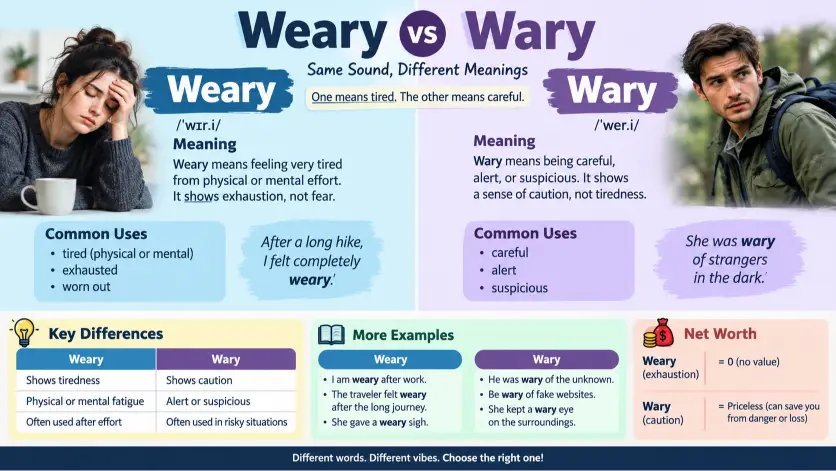
Have you ever wanted to say that someone is tired, only to wonder whether weary or wary is the right word? These two English words look and sound similar, but their meanings are completely different. Weary describes physical or mental tiredness, while wary means being cautious or careful because you sense a possible problem or danger.
This small spelling difference can change the entire meaning of a sentence. Understanding weary or wary is especially useful for students, writers, professionals, and anyone trying to improve everyday English.
In this guide, we will explain both words in simple language, show you how they work in real sentences, and highlight the common mistakes people make when choosing between them. You will also learn an easy memory trick to remember the difference. By the end, you should be able to recognize whether a sentence needs weary or wary without second guessing yourself.
Weary or Wary: What’s the Difference?
Weary is an adjective meaning tired, exhausted, or mentally drained. It can describe physical fatigue, emotional exhaustion, or even boredom caused by something continuing for too long. The noun form is less common, while the related verb weary can mean to make someone tired.
Wary is also an adjective. However, it describes caution rather than tiredness. Someone who is wary remains alert because they suspect that a person, situation, offer, or action could create a problem.
| Feature | Weary | Wary |
|---|---|---|
| Part of speech | Adjective and verb | Adjective |
| Main meaning | Tired or exhausted | Cautious or suspicious |
| Related idea | Fatigue | Carefulness |
| Typical feeling | Low energy | Alertness |
| Common context | Work, travel, stress, repeated tasks | Risk, strangers, decisions, unfamiliar situations |
| Example | She felt weary after the journey. | She was wary of the unfamiliar offer. |
Mini Recap
Weary means tired.
Wary means cautious.
Therefore, a tired traveler is weary, while a careful traveler who watches for possible danger is wary.
Although the spellings look alike, the concepts move in opposite directions. Weary suggests reduced energy, whereas wary suggests increased attention.
Is Weary or Wary a Grammar, Vocabulary, or Usage Issue?
The confusion between weary or wary is primarily a vocabulary and usage issue rather than a basic grammar problem. Both words can function as adjectives, so their grammatical position may look almost identical inside a sentence.
For instance, you can say, “She was weary after work,” and “She was wary of the stranger.” In both examples, the adjective follows a linking verb. Nevertheless, the meaning changes because the vocabulary item changes.
Moreover, neither term is simply formal or informal. Both appear in standard English, professional writing, literature, journalism, and ordinary conversation. However, weary can sometimes sound more literary than the simpler word “tired,” particularly when describing emotional exhaustion or prolonged hardship.
Meanwhile, wary is common whenever caution matters. You might encounter it in workplace policies, safety discussions, financial warnings, academic writing, or casual conversations.
Thus, these words aren’t interchangeable. The correct choice depends entirely on what you want to communicate.
How to Use Weary Correctly
The word weary works when the central idea involves tiredness, exhaustion, boredom, or reduced energy. Furthermore, it can describe a temporary condition or a feeling that has developed gradually.
Workplace Example
After several demanding meetings and a long shift, an employee might say:
“I’m feeling weary after such a busy day.”
Here, the speaker isn’t necessarily worried about the workplace. Instead, the person simply lacks energy after sustained effort.
Another example could be:
“The team became weary after working late for several consecutive nights.”
Consequently, the adjective communicates fatigue caused by prolonged activity.
Academic Example
A student who has spent hours studying might write:
“After weeks of preparation, the students felt weary before the final examination.”
In this context, weary communicates mental and physical exhaustion.
Technology Example
Consider someone who spends an entire evening troubleshooting a complicated device:
“After trying several solutions, he felt weary.”
The technology itself isn’t necessarily dangerous. Rather, the repeated effort has drained the individual.
Usage Recap
Use weary when tiredness is the main idea. Therefore, think about energy, exhaustion, effort, stress, repetition, or prolonged activity. If someone needs rest rather than protection, weary is usually the appropriate choice.
How to Use Wary Correctly
The adjective wary belongs to situations involving caution, doubt, suspicion, or awareness of possible danger. Unlike weary, it doesn’t tell readers that someone lacks energy.
For example:
“She was wary of the unfamiliar visitor.”
Here, the person remains alert because the visitor may represent a risk.
Workplace Example
An employee might receive an unexpected request for confidential information. Consequently, the employee could say:
“I was wary of sharing the document without confirming the request.”
The person isn’t tired. Instead, caution motivates the decision.
Academic Example
A researcher may encounter an unsupported claim in an online source:
“Students should be wary of statistics that lack reliable evidence.”
Here, wary means careful and skeptical.
Technology Example
Suppose a user receives a suspicious message asking for login information:
“Be wary of unexpected messages requesting sensitive details.”
Again, the meaning involves caution rather than exhaustion.
Usage Recap
Use wary when someone is alert because something seems uncertain, risky, suspicious, or potentially harmful. Therefore, if the person is watching carefully rather than seeking rest, wary is the better word.
When You Should NOT Use Weary or Wary
Because these spellings are so similar, writers sometimes select the wrong adjective. However, several simple checks can prevent that mistake.
- Don’t use weary for caution.
If someone is carefully evaluating a stranger, offer, website, or situation, weary does not express that meaning. - Don’t use wary for exhaustion.
If someone has worked for twelve hours and needs sleep, wary doesn’t describe the condition. - Don’t replace “tired” with wary.
Although weary can sometimes replace tired in suitable contexts, wary cannot. - Don’t use weary when you mean suspicious.
A person can be suspicious without being exhausted. - Don’t use wary when describing emotional burnout.
Someone who feels drained after prolonged stress may be weary. - Don’t assume similar spelling means similar meaning.
English contains many words that look or sound alike while carrying unrelated definitions. - Don’t rely only on pronunciation.
Context provides the strongest clue when choosing between these terms. - Don’t use either word automatically.
First identify whether the sentence describes energy or caution. Then select the appropriate adjective.
Common Mistakes: Correct and Incorrect Sentences
| Correct sentence | Incorrect sentence | Explanation |
|---|---|---|
| I felt weary after the long journey. | I felt wary after the long journey. | The intended meaning is physical tiredness. |
| She was wary of the unfamiliar website. | She was weary of the unfamiliar website. | The context involves caution. |
| The workers became weary after the extended shift. | The workers became wary after the extended shift. | Their energy decreased. |
| He was wary of accepting the unusual offer. | He was weary of accepting the unusual offer. | He felt uncertain about possible risk. |
| The athlete looked weary after the race. | The athlete looked wary after the race. | The sentence describes exhaustion. |
| Parents may be wary of unknown online contacts. | Parents may be weary of unknown online contacts. | The concern is caution. |
Decision Rule Box
If you mean tired, exhausted, drained, or worn out, use WEARY.
If you mean cautious, careful, suspicious, or alert to possible danger, use WARY.
A useful memory trick is simple: weary relates to weariness, while wary relates to watching carefully.
Weary and Wary in Modern Technology and Intelligent Tools
Modern communication creates many situations where the distinction becomes especially useful. For instance, people frequently encounter unfamiliar websites, unexpected messages, unknown applications, and questionable requests.
Someone who has spent hours fixing a technical problem may become weary. Meanwhile, someone who receives an unfamiliar request for private information should remain wary.
Likewise, writers discussing digital safety often need the second term because caution is the central idea. However, technology users may experience the first condition after long periods of screen time, repetitive troubleshooting, or demanding digital work.
Therefore, the context remains more important than the subject. Technology doesn’t automatically make one word correct. Ask whether the sentence describes fatigue or caution.
Etymology: Where Did Weary and Wary Come From?
Understanding word history can make vocabulary easier to remember. Weary has deep roots in older forms of English and Germanic languages associated with tiredness and exhaustion. Over centuries, the word developed into its modern sense of being physically or mentally drained.
Wary, meanwhile, developed from a different historical path. Its earlier associations involved carefulness, caution, and being attentive to possible danger.
Thus, although the modern spellings look remarkably similar, the words aren’t simply different versions of one original term. Their histories help explain why their meanings remain separate today.
As a practical vocabulary principle, similar spelling should never be treated as proof of identical meaning.
“Context is the strongest guide when two familiar words look alike but communicate different ideas.”
This principle applies far beyond this particular pair. English contains numerous confusing word combinations where a small spelling change produces a significant difference in meaning.
Two Practical Case Studies
Case Study One: Workplace Communication
Imagine a project manager who has spent several consecutive days handling deadlines, meetings, and revisions. By Friday afternoon, the manager says, “I’m weary.”
That statement tells colleagues the person is exhausted. Therefore, suggesting that the manager is wary would change the message. Wary would imply concern or suspicion about something.
As a result, choosing the correct word prevents coworkers from misunderstanding the speaker’s condition.
Case Study Two: Online Safety
Now consider a customer who receives a message requesting unusual account information. The customer pauses before responding because the request seems questionable.
In this situation, the appropriate expression is:
“The customer was wary of the request.”
The person isn’t necessarily tired. Instead, caution influences the response.
Consequently, these two cases demonstrate a reliable distinction: prolonged effort can create weariness, whereas perceived risk can create wariness.
Error Prevention Checklist
Before publishing or submitting a sentence, check the intended meaning.
Always use Weary when:
You mean tiredness.
You mean physical exhaustion.
You mean emotional exhaustion.
You mean feeling drained after prolonged effort.
You mean becoming tired of something through repetition.
Never use Wary when:
You simply mean tired.
You are describing a lack of energy.
Someone needs rest because of prolonged activity.
The sentence concerns physical exhaustion.
The intended idea is emotional fatigue rather than caution.
Always use Wary when:
Someone is cautious.
A situation seems risky.
A person suspects something may be wrong.
Someone is carefully evaluating an unfamiliar person or offer.
Therefore, identifying the central idea before writing is the fastest way to prevent the error.
Related Grammar Confusions You Should Master
Learning weary or wary can also help you recognize other English words that appear similar but differ in meaning. These pairs frequently cause mistakes because spelling, pronunciation, or visual appearance creates confusion.
- Affect or effect
- Fewer or less
- Advice or advise
- Accept or except
- Compliment or complement
- Principal or principle
- Stationary or stationery
- Lay or lie
- Further or farther
- Then or than
Each pair requires attention to meaning and context. Therefore, memorizing isolated spellings isn’t always enough. Instead, understand what each word communicates and observe how it functions inside a complete sentence.
Frequently Asked Questions
What is the difference between weary and wary?
Weary means tired, exhausted, or drained. Wary means cautious, careful, or suspicious because a person senses possible trouble. Therefore, they aren’t interchangeable.
Is weary a synonym for tired?
Yes. Weary can mean tired or exhausted, although it can sometimes sound more literary or expressive than the everyday word “tired.” Context determines whether it is the most natural option.
Is wary a synonym for careful?
Yes, in many contexts. Wary describes someone who remains careful because they suspect danger, uncertainty, deception, or an undesirable result.
Does weary mean suspicious?
No. Weary generally communicates tiredness or exhaustion. If you mean suspicious or cautious, wary is the correct term.
Does wary mean tired?
No. Wary describes alertness and caution rather than fatigue. Therefore, someone can be wary without feeling tired.
How can I remember weary versus wary?
Think of weary as connected with weariness and reduced energy. Think of wary as connected with watching carefully. This mental association makes the distinction easier to recall.
Which word should I use for someone exhausted after work?
Use weary. For example, “She felt weary after working late.” The sentence focuses on tiredness, not suspicion.
Which word should I use for someone suspicious of an offer?
Use wary. For example, “He was wary of the unusual offer.” The sentence communicates caution.
Are weary and wary pronounced the same?
No. Their pronunciation differs, although their spelling can make them easy to confuse. Listening carefully and considering the sentence’s meaning can help identify the correct word.
Final Conclusion
The distinction between weary or wary becomes simple once you connect each word with its central meaning. Weary describes tiredness, exhaustion, or feeling drained after prolonged effort. Wary, on the other hand, describes caution, suspicion, or careful attention toward something that may create a problem.
Therefore, remember one practical rule: if someone needs rest, choose weary. If someone needs caution, choose wary.
Ultimately, context should guide your choice. Whether you’re writing an academic sentence, sending a workplace message, explaining a technology issue, or creating everyday content, identifying the intended meaning first will help you select the correct word naturally and confidently.









