Have you ever wondered whether supper or dinner is the correct word for the evening meal? Although many English speakers use these words interchangeably, they can carry different meanings depending on region, family tradition, social context, and even the time of the meal. This is why a simple question about what to call your evening meal can sometimes create unexpected confusion. Understanding the distinction can help you choose the word that sounds natural and appropriate in different situations.
From a language and usage perspective, dinner is generally the more widely used term for the main evening meal, while supper traditionally refers to a lighter evening meal in many varieties of English. However, there is no single rule that applies everywhere. Regional English, cultural habits, and personal usage all influence the choice.
In this guide, we will explore the meanings of supper or dinner, their historical background, everyday examples, regional differences, and common mistakes so you can use both words confidently.
Supper or Dinner: What’s the Difference?
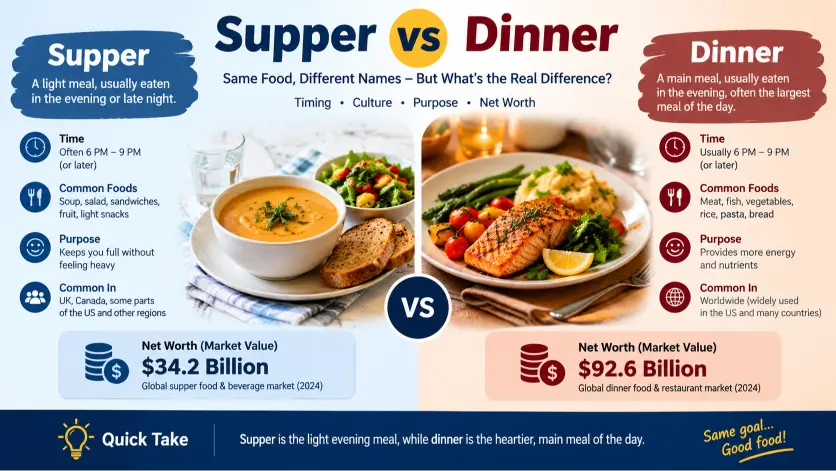
To begin with, dinner is a noun that traditionally means the main meal of the day. In modern English, however, many people use it specifically for the evening meal, regardless of how substantial it is. Therefore, dinner can describe anything from a simple meal at home to an elaborate meal at a restaurant.
By contrast, supper is also a noun, but it traditionally describes an evening meal that is lighter or more informal. In some communities, especially in parts of the United States, Canada, Scotland, and other English speaking regions, supper remains a normal everyday term for the evening meal.
Nevertheless, there isn’t one universal rule that makes one word correct and the other incorrect. Instead, the choice often depends on geography, family vocabulary, social setting, and the speaker’s personal habits.
| Feature | Dinner | Supper |
|---|---|---|
| Part of speech | Noun | Noun |
| Basic meaning | Main meal of the day, often eaten in the evening | Evening meal, traditionally lighter |
| Typical tone | Neutral and widely understood | Casual, traditional, or regional |
| Common modern use | Very common for the evening meal | More common in certain regions |
| Restaurant use | Very common | Less common in many places |
| Formal situations | Natural | Possible, depending on context |
| Family conversation | Very common | Common in some households |
Mini recap: Dinner is generally the safer and more widely understood word for an evening meal. Supper can also mean an evening meal, particularly when the meal is light or when the speaker follows a regional tradition. Consequently, both terms can be correct, but their social and regional associations may differ.
Is Supper or Dinner a Grammar, Vocabulary, or Usage Issue?
First of all, this is mainly a vocabulary and usage issue, rather than a basic grammar problem. Both supper and dinner are grammatically correct nouns. The difficulty arises because English speakers don’t always assign exactly the same meaning to them.
For example, someone might say, “What are we having for dinner?” Another person might naturally ask, “What are we having for supper?” Both sentences are grammatically sound. However, the speakers may come from different linguistic backgrounds or have different ideas about what the evening meal should be called.
Moreover, the distinction isn’t strictly formal versus informal. Dinner is widely accepted in professional, academic, domestic, and social communication. Supper can also appear in ordinary conversation, although it may sound more traditional or regional to some listeners.
In academic writing, dinner is generally easier to understand when discussing an evening meal because it has broad international recognition. Meanwhile, supper may be appropriate when describing a cultural practice, a historical setting, a regional tradition, or a person’s exact wording.
Therefore, the central issue isn’t grammatical correctness. Instead, it concerns meaning, context, region, and established usage.
How to Use Dinner Correctly
First, dinner commonly identifies the main meal of the day. In contemporary English, however, the word frequently refers to the evening meal even when lunch was the main meal earlier in the day.
For instance, someone might say, “We’re having dinner at seven tonight.” This sounds completely natural in everyday conversation. Likewise, “The company hosted a formal dinner” works naturally because dinner can describe a social event centered around food.
Workplace example
A manager might write, “The visiting team will join us for dinner after the meeting.” Here, dinner clearly refers to an evening meal connected with a professional gathering.
Academic example
A researcher could write, “Participants were asked to record what they consumed at dinner.” In this context, dinner is clear and neutral, making it suitable for formal discussion.
Technology example
A food application might display a category such as “Dinner Recipes.” Similarly, a meal planning application could ask users to select their dinner preferences.
Usage recap: Dinner is broadly understood, versatile, and natural in everyday conversation. Consequently, it is usually the most straightforward choice when referring to an evening meal.
How to Use Supper Correctly
Next, supper traditionally suggests an evening meal, often one that is lighter or less elaborate than dinner. Nevertheless, this distinction isn’t followed consistently by every English speaker.
For example, someone might say, “We usually have supper around six.” In a household where supper is the customary word, the sentence sounds entirely natural.
Furthermore, supper can carry a regional or traditional feeling. In some families, the word has been passed from one generation to another. As a result, choosing supper may reveal something about local speech or family vocabulary rather than the size of the meal.
Workplace example
A colleague might say, “We’re planning a small supper for the volunteers.” This can suggest an informal gathering rather than a formal banquet.
Academic example
A historian discussing historical eating habits might write, “The family traditionally gathered for supper before retiring for the night.” Here, supper can help establish the cultural or historical atmosphere.
Technology example
A recipe website or meal planner may use the phrase “supper ideas” to describe simple evening recipes. However, “dinner ideas” is generally more widely recognized across digital platforms.
Usage recap: Supper is correct when it matches the speaker’s regional, family, cultural, or contextual usage. However, it may sound unusual to people who normally use dinner for every evening meal.
When You Should NOT Use Supper or Dinner
Although both words can describe an evening meal, certain situations require more attention. The following examples highlight common cases where choosing one term may create unnecessary confusion.
1. Don’t assume supper always means a small meal
Although supper traditionally suggests something lighter, modern speakers may use it for a complete evening meal. Therefore, don’t automatically interpret supper as a snack.
2. Don’t assume dinner always means an evening meal
Historically, dinner could refer to the main meal regardless of the time. Consequently, a historical text may mention dinner at midday.
3. Don’t treat regional usage as universal
A speaker who regularly says supper may consider it completely ordinary. Meanwhile, another English speaker may almost never use the term.
4. Don’t change someone’s regional wording unnecessarily
If a person says supper naturally, replacing it with dinner doesn’t automatically improve the sentence. Instead, consider the intended audience.
5. Don’t use dinner merely because a meal is formal
A formal meal is often called a dinner, but formality isn’t the only factor. Context, tradition, and event naming also matter.
6. Don’t assume supper is grammatically inferior
Supper is a standard English noun. It isn’t an incorrect alternative simply because dinner is more common in many modern settings.
7. Don’t force a historical distinction into modern conversation
Older definitions can explain how the words developed, but contemporary speakers don’t always follow those historical patterns.
8. Don’t ignore your audience
When writing for an international audience, dinner may provide faster recognition. However, when regional authenticity matters, supper may be the better choice.
Common Mistakes and Decision Rules
Because the meanings overlap, learners sometimes create unnecessary distinctions. The following table shows how context affects the choice.
| Correct sentence | Incorrect or less suitable sentence | Explanation |
|---|---|---|
| We are having dinner at eight. | We are having dinner at eight, therefore supper is wrong. | Both terms can describe an evening meal. |
| We usually have supper early. | Supper is never used for a full meal. | Regional usage can make supper refer to the complete evening meal. |
| The hotel is serving dinner tonight. | The hotel is serving supper, so the sentence must be incorrect. | Supper isn’t grammatically wrong, although dinner may be more conventional for a formal event. |
| What did you have for dinner? | What did you have for dinner, because supper is incorrect English? | Supper is also a standard noun. |
| They invited us to dinner. | They invited us to supper, therefore the invitation is grammatically wrong. | The appropriate term depends partly on context and regional preference. |
Decision Rule Box
If you mean the main meal of the day, especially in modern general usage, choose dinner.
If you mean an evening meal and your regional, family, or cultural usage favors the traditional term, supper can be appropriate.
If you’re writing for a broad international audience and want the least ambiguous choice, dinner is usually easier to understand.
Supper or Dinner in Modern Technology
Modern digital communication has influenced how people encounter food vocabulary. Meal planning applications, restaurant menus, recipe platforms, calendars, and voice assistants frequently use dinner because it has broad recognition.
For example, a digital meal planner may separate options into breakfast, lunch, dinner, and snacks. This structure is immediately familiar to a large audience.
However, supper hasn’t disappeared from contemporary technology. Recipe collections, regional food communities, family meal planners, and cultural publications still use the word naturally.
Furthermore, language tools generally recognize both terms because both belong to standard English vocabulary. The important point is that automated language suggestions can reflect frequency rather than personal or regional preference. Therefore, a less common word isn’t automatically incorrect.
Etymology and Historical Background of Supper and Dinner
The history of these words explains why their meanings can feel confusing today.
Dinner developed from an Old French term connected with the idea of breaking a fast or taking the day’s principal meal. Over time, the word shifted in meaning and timing across different English speaking communities.
Supper has a different history. It is associated with an evening meal and has connections with older Germanic and French vocabulary. Historically, supper could refer to a lighter meal taken later in the day.
As eating schedules changed, the two terms gradually developed overlapping meanings. In some periods and communities, dinner was eaten earlier, while supper occurred later. In other settings, dinner eventually became the standard word for the evening meal.
As a result, modern speakers inherited several traditions rather than one universal rule.
An Expert Style Observation
“In everyday English, meal names often reflect social tradition and regional habit as much as dictionary definition.”
This observation captures an important linguistic principle: words don’t remain frozen. Their meanings evolve as communities change the way they live, eat, work, and communicate.
Two Real World Case Studies
Case Study 1: Regional Family Vocabulary
Consider a family that has used supper for generations. The parents might say, “Supper is ready,” while the children grow up hearing the same expression. Consequently, supper becomes the family’s normal word for the evening meal.
Now imagine one of those children moves to a community where dinner is overwhelmingly preferred. Their original word may suddenly sound old fashioned or regional to their new friends.
The underlying meal hasn’t changed. Instead, the vocabulary surrounding it has changed according to the speech community.
Case Study 2: Restaurant Communication
Imagine a restaurant advertising an evening event internationally. Its management chooses the phrase “Dinner Special” because visitors from different English speaking backgrounds are likely to understand it immediately.
Meanwhile, a small family restaurant in a region where supper is common might advertise “Friday Supper.” In that setting, the traditional term can communicate familiarity and local identity.
Therefore, the choice isn’t simply about correctness. It can influence tone, audience expectations, and cultural atmosphere.
Error Prevention Checklist
Always use dinner when:
You need a broadly recognized term for an evening meal.
You are writing general information for an international audience.
You are describing a formal evening event.
You are discussing restaurant reservations or conventional dining arrangements.
You want a neutral term that most readers will understand immediately.
Use supper when:
Your regional community commonly uses the word.
You are describing a family tradition.
You are discussing historical or cultural eating habits.
You want to preserve someone’s natural wording.
The context specifically favors a traditional evening meal expression.
Never assume:
Supper is grammatically wrong.
Dinner always means evening.
Supper always means a tiny meal.
Every English speaking region uses these terms in exactly the same way.
Related Grammar Confusions You Should Master
Understanding supper and dinner becomes easier when you recognize that English contains many other pairs whose differences depend on usage rather than simple grammatical rules.
Here are several useful comparisons to study:
- Fewer vs less: quantity and countability
- Affect vs effect: grammatical role and meaning
- Former vs latter: identifying two previously mentioned choices
- Lay vs lie: action and grammatical structure
- Farther vs further: physical distance and extended meaning
- Who vs whom: subject and object functions
- Everyday vs every day: adjective versus time expression
- Advice vs advise: noun versus verb
- Practice vs practise: spelling conventions across varieties of English
- Among vs between: distinctions involving relationships and groups
These examples demonstrate an important lesson. Correct English isn’t always about memorizing one rigid rule. Instead, effective usage requires attention to meaning, context, audience, and established convention.
Frequently Asked Questions
What is the difference between supper and dinner?
Dinner generally refers to the main meal of the day and commonly means the evening meal in modern English. Supper traditionally refers to an evening meal that may be lighter or more informal. However, regional and family usage can make the two words interchangeable.
Is supper another word for dinner?
Yes, in many situations supper can refer to the evening meal commonly called dinner. However, the words can carry different regional or traditional associations. Therefore, the exact meaning depends on the speaker and context.
Is it more correct to say dinner or supper?
Neither word is universally more grammatically correct. Both are standard English nouns. Dinner is generally more widely recognized for an evening meal, while supper remains natural in particular regions and communities.
Why do some people say supper instead of dinner?
People may say supper because of regional speech, family tradition, cultural background, or personal habit. In some communities, supper has remained the customary term for the evening meal.
Does supper mean a light dinner?
Traditionally, supper can suggest a lighter evening meal. Nevertheless, modern usage isn’t consistent. Some speakers use supper for a complete evening meal without implying that it is small or simple.
Can dinner be eaten at lunchtime?
Yes. Historically, dinner referred to the principal meal rather than a specific clock time. Therefore, a midday dinner can be perfectly natural, particularly in certain cultural or historical contexts.
Is supper formal or informal?
Supper is generally associated with everyday, traditional, family, or regional language. However, context determines its tone. It can appear in formal writing when the subject specifically concerns cultural, historical, or regional usage.
Which word should English learners use?
Dinner is usually the easiest general choice when referring to an evening meal because it is widely understood. However, learners should recognize supper because they will encounter it in regional speech, literature, menus, and cultural discussions.
Do Americans say supper or dinner?
American usage varies by region and family. Dinner is extremely common for the evening meal, while supper remains familiar in several communities. Consequently, neither word represents every American speaker.
Can both supper and dinner be used in the same sentence?
Yes, although doing so may create a distinction that isn’t necessary. A writer should use both together only when the context genuinely gives them different meanings, such as describing separate meals or historical eating practices.
Final Answer
Ultimately, supper or dinner isn’t a simple case of one word being correct and the other being wrong. Both are established English nouns, and both can describe an evening meal. Dinner is generally the broader and more widely recognized choice, particularly in contemporary international communication.
Meanwhile, supper remains meaningful in regional, family, traditional, and cultural contexts. Its use can suggest an evening meal without necessarily implying that the food is exceptionally small or simple.
Therefore, the best choice depends on your audience and intended meaning. When clarity across different English speaking communities matters, dinner is usually the safest option. When regional identity or traditional wording matters, supper can be completely natural.
The key lesson is simple: English usage changes with time, place, and community. Understanding that flexibility helps you choose the word that fits your context rather than treating vocabulary as a collection of rigid rules.









